
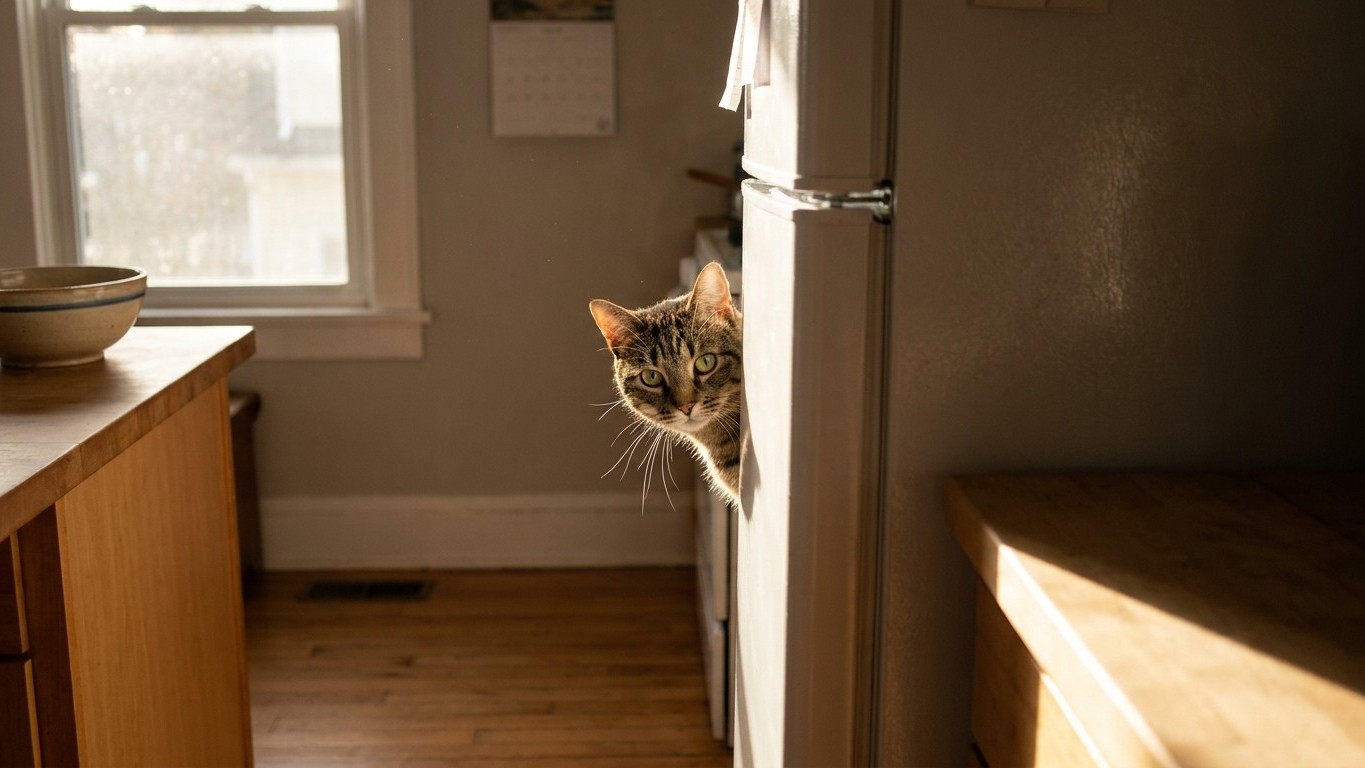
The back wall behind a refrigerator can reach genuinely surprising temperatures, and your cat worked that out long before you did. The compressor and condenser coils at the rear of a fridge release heat as a routine part of the cooling process, and a healthy, properly functioning refrigerator compressor typically reaches temperatures of between 35°C and 50°C (95°F–122°F). That small pocket of warmth, invisible to you, is exactly the kind of microclimate your cat has been exploiting. So before you dismiss it as “just one of those weird cat things,” it’s worth understanding the full picture — because it tells you something genuinely useful about feline biology, and about when to start paying closer attention.
Key takeaways
- Cats exploit the 35-50°C heat pocket behind fridges as a personal spa—it’s within their ideal comfort zone
- A cat suddenly spending all day behind the fridge might not be seeking comfort; she could be hiding because she’s unwell
- Cats hide illness instinctively to survive in the wild, making early disease detection dangerously easy to miss
Your cat is a heat engineer, and she’s quite good at it
For cats, the thermoneutral zone, the temperature range in which they can rest comfortably without spending extra energy — sits between roughly 30°C and 35°C (86–95°F). Within this range, they can maintain their body temperature without needing to shiver or pant. The average living room in Britain, especially in winter, falls well below that. No wonder, then, that your cat is treating the back of the fridge like a private spa.
Cats don’t experience a home as one uniform temperature; they experience a patchwork of microclimates. Sunlit windows, top-floor rooms, and enclosed cat trees can run much warmer than the hallway floor. The gap behind the fridge slots neatly into this logic: it’s enclosed, warm, and consistent. Many cats gravitate towards warm places, and tight spaces with enclosed walls can trap and retain heat, creating a cosy environment that a cat enjoys resting in, especially during the colder winter months.
There’s also a territorial dimension to it. Cats are territorial animals, and squeezing into tight spaces can be a way of marking territory. By occupying a confined area, a cat leaves their scent behind, subtly claiming the space as their own and establishing a familiar and safe zone within the larger environment. The fridge gap, from her perspective, is hers. She’s signed the lease. You just hadn’t noticed.
What the wall temperature is actually telling you
Here’s where the story shifts. A wall that feels pleasantly warm to the touch, nestled just behind the compressor, is entirely normal. But if you press your hand back there and it’s uncomfortably hot, or if your cat is spending more time there than usual, it’s worth checking the appliance. The refrigerator’s compressor and condenser coils release heat as they operate, a normal part of the cooling process, but if the refrigerator sits too close to the wall, heat can build up.
If the condenser coils become excessively dirty, they can’t release heat properly, which disrupts the refrigeration cycle and causes the compressor to overwork and run hotter than usual. The condenser coils are typically found at the bottom of the back of the fridge. Cleaning the condenser coils every 6 to 12 months is recommended to maintain optimal refrigerator performance and prevent overheating. A vacuum with a narrow nozzle attachment does the job nicely.
There’s also a practical safety concern. A cat behind a fridge could come into contact with electrical cords or other components. If your cat has turned the gap into a permanent residence, it’s worth gently blocking access, not as punishment, but to redirect her somewhere just as warm and far less hazardous. A heated cat pad placed in a covered bed nearby, positioned close to the original spot, often does the trick.
When warmth-seeking is actually a health signal
This is the part worth reading carefully. Cats seeking warmth is normal feline behaviour. But a cat who starts hiding persistently, particularly in inaccessible spots, may be telling you something entirely different. If Your Cat Suddenly begins hiding more frequently than usual, or if the behaviour is accompanied by shifts in appetite, energy, or mood, it deserves closer attention. Cats often hide when they are feeling unwell because it helps them feel safe and protected, and this instinct can make early signs of illness easy to miss.
The tendency cats have to disguise their Discomfort is believed to be an evolutionary holdover from their days in the wild, where illness or injury paints a target on them to nearby predators. Not only would the appearance of weakness make a wild cat more vulnerable, but it would also put them in danger of being bullied or abandoned by their group. Your domestic cat retains this wiring completely intact. Arthritis affects up to 90% of cats over age 12, yet many go untreated because cats quietly withdraw instead of limping. The behind-the-fridge retreat can be their version of coping with joint pain, dental disease, or internal discomfort, all without a single audible complaint.
Illness-related hiding tends to come with red flags: not eating for 24 hours or more, no litter box use, unusual vocalising, trembling, or a hunched posture. If your cat has always occasionally napped behind the fridge, that’s almost certainly comfort-seeking. If she’s suddenly there all day, coming out less, eating less, that warrants a vet visit, not a wait-and-see approach. A sudden tendency to hide can be a clue that a cat isn’t feeling well, and any changes in hiding behaviour should be addressed with your veterinarian.
Keeping the habit safe (or redirecting it entirely)
If your cat’s fridge habit is just comfort-seeking, consistent, seasonal, and paired with her normal eating and social behaviour — there’s no real need to panic. But there are sensible steps to take. Pull the fridge a few centimetres away from the wall to ensure proper airflow and reduce heat build-up. Clean the coils regularly. And check the space for any exposed wires or sharp edges that could cause injury during one of her visits.
If your cat is getting into an area she shouldn’t, like behind the fridge or areas with wires, you can try to redirect her by providing alternative hiding spots. Invest in cat furniture like condos, shelves, and beds that offer snug spots, and use positive reinforcement to help her get comfortable with the new spaces. Place new hiding spots close to where she has been hiding, then relocate them gradually once she’s adopted the habit. One approach that works well: an owner whose elderly cat started using the slightly warmer fridge edge in winter added a heated pad inside a box to mimic the microclimate, and removed the behind-fridge behaviour entirely.
The final, rather pleasing detail in all of this: research published in PLOS One found that cats who have hiding spaces available show lower stress hormone levels. Your cat squeezed behind that fridge because evolution, physics, and feline logic all pointed in the same direction. The least we can do is make sure the alternative we offer is equally irresistible.
Sources : dialavet.com | quora.com