
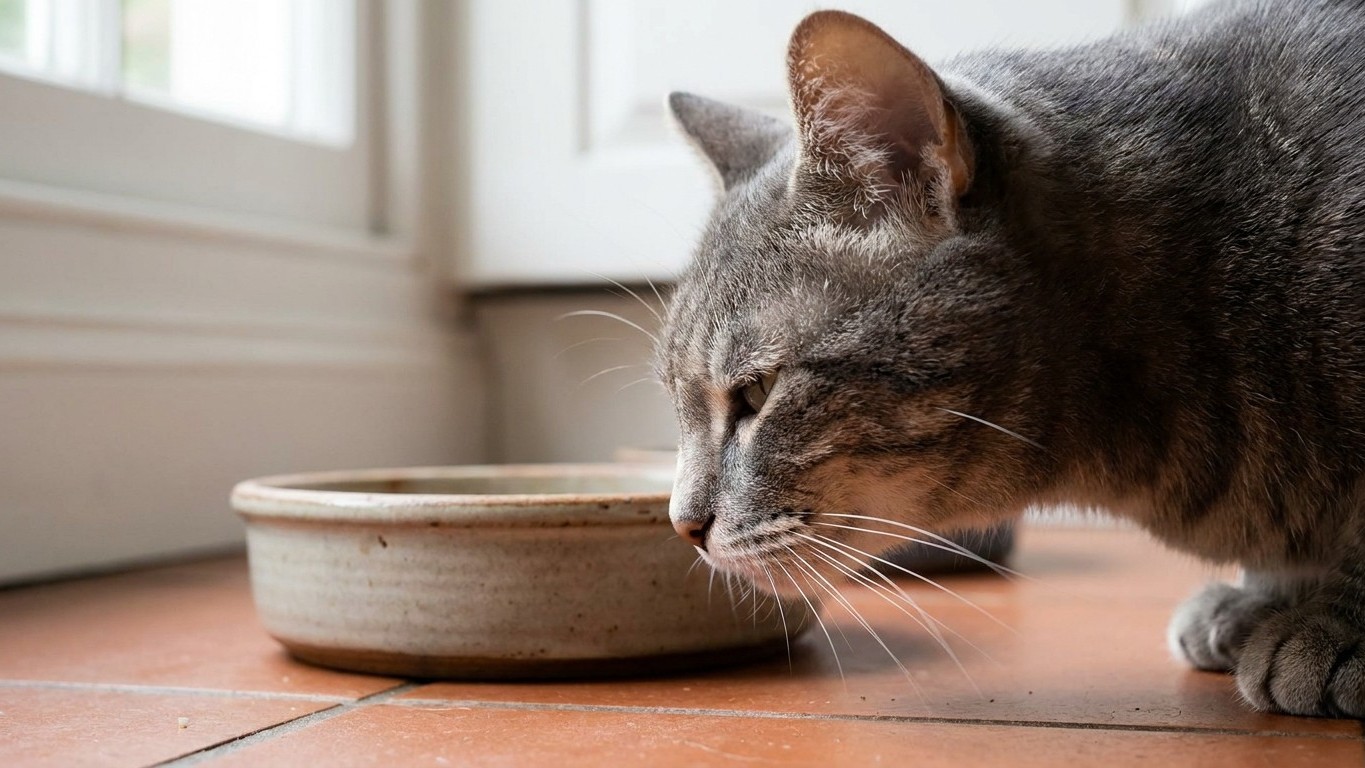
Your cat shoves the water bowl across the kitchen floor every single day. You fill it back up, she drains it, then nudges it two feet to the left again. Maddening? Absolutely. But there’s a very specific reason she might be doing it, and it has nothing to do with stubbornness. Look at her whiskers. Those magnificent, twitching sensory tools may be at the heart of a mealtime drama playing out in thousands of British homes.
Key takeaways
- Cat whiskers aren’t just hairs—they’re complex sensory organs with nerve endings 4mm beneath the skin surface
- Your cat’s bowl-dragging behavior might be an attempt to avoid whisker contact with the bowl’s rim
- A simple fix exists: switching to shallow, wide bowls can transform your cat’s mealtime experience
What whiskers actually are (and why they’re extraordinary)
Cat whiskers are not ordinary hairs. Known scientifically as vibrissae, they are thicker, deeper, and far more sensitive than regular fur. While normal fur is about 0.05 mm thick, whiskers can range from 0.06 to 0.3 mm in diameter, and they are rooted about 4 mm beneath the surface of the skin, where they connect to a dense network of nerves and blood-filled sensory structures. That depth is what makes them extraordinary.
At the base of each whisker sits a specialised structure filled with blood and surrounded by nerve endings. When the whisker moves, even slightly, the pressure change inside this structure activates nerve receptors, and signals then travel through the trigeminal nerve to the brain, where cats have a dedicated sensory processing area for whisker input. Think of it less like a hair and more like a fingertip. A very, very sensitive fingertip pressed against the side of a bowl, fifty times a day.
Cats use their whiskers to understand the environment around them, sensing the tightness of a space, changes in air currents while hunting for prey, and keeping their balance on four paws. Even when whiskers don’t touch anything, they can still detect the air currents created by moving things, including predators and prey. The acute sensitivity of a cat’s whiskers is even partly responsible for the myth that cats can see in complete darkness. Remarkable anatomy, really.
So what is “whisker fatigue”, and is it actually real?
Whisker fatigue refers to possible stress caused by overstimulation of a cat’s whiskers. It is not a disease, and its existence is still debated in the veterinary community. That honest caveat matters. The concept first went mainstream in 2017 when it was picked up by the New York Times, but the veterinary response was sceptical. The American Veterinary Medical Association echoed the view that changes in eating behaviour are a concern and should be addressed with a veterinarian, but noted that “while a cat’s whiskers are very sensitive, there is currently no evidence showing that whiskers rubbing against food bowls causes cats stress or discomfort.”
Science did eventually weigh in properly. In 2021, a study titled “Evaluation of whisker stress in cats” was published in the Journal of Feline Medicine and Surgery. The aim was to determine whether cats fed from a commercially advertised whisker-friendly dish versus their normal food dish would spend more time at the bowl, eat more, and drop less food. The conclusion was that the type of bowl made no difference to these activities, but it did find that, given the choice, more cats preferred the whisker-friendly bowl.
According to owner reports in that study, 63% of cats preferred the whisker-friendly dish, 24% the regular dish, and the remainder had no preference. That’s a notable majority, even if it didn’t translate into measurable differences in how much they ate. Preference isn’t nothing, especially for a creature as particular as a cat.
The anatomical argument for some level of discomfort remains compelling. These thick, hollow structures are deeply embedded into nerve-filled follicles under the skin. “From an anatomic and physiologic perspective, it’s entirely possible for overstimulation of a cat’s whiskers to cause problems,” says Dr Gary Weitzman, DVM, CEO of the San Diego Humane Society and author of the National Geographic Complete Guide to Pet Health, Behavior, and Happiness. The biology supports the possibility, even if the clinical proof remains thin.
Recognising the signs at mealtime
If you notice your cat suddenly making messes with their food, pulling Food Out of Their bowl to eat on the floor, or being more finicky about their food, some whisker fatigue could be to blame. Dragging the water bowl across the floor is a classic version of this, the cat is effectively trying to change the geometry of the situation, to get at the water without pressing her whiskers against the rim.
Signs that may indicate whisker fatigue include pacing near the food and water bowls and approaching them with caution; pawing or pulling food out of the bowl to eat it on the floor; making a big mess around the bowl while eating or drinking; knocking bowl contents to the floor before eating; continuing to act hungry even when there’s still food inside the bowl; and displaying aggressive behaviour when other pets or people are around during mealtimes.
The problem, of course, is that these behaviours overlap with many other conditions. Cats with painful dental disease can exhibit the same symptoms as whisker fatigue. Cats with liver disease, kidney disease, or inflammatory bowel disease can also develop eating problems. This is why the first step should always be a visit to your vet, not a new bowl. Any significant change in eating or drinking habits warrants a proper check-up, always.
What you can actually do about it
The solution for whisker fatigue is simple: replace your cat’s narrow, deep food and water bowls with something flat or wide and shallow so your cat’s whiskers don’t touch the sides of the dish. Although you can buy special “whisker-friendly” cat bowls, you can also try a flat dinner plate from your own collection or even a disposable paper plate. A side plate from the kitchen cupboard costs nothing and tells you immediately whether your cat prefers a wider surface.
Many cats also prefer not to have their water right next to their food. Putting the bowls in different locations gives them more room to eat and drink without feeling crowded, both physically and mentally. Water fountains can be helpful, too, to encourage optimal hydration in cats who don’t like drinking from a bowl. The flowing water surface sits much lower relative to the rim, which reduces whisker contact considerably.
One thing You Should Never do: trim the whiskers. Whatever you do, don’t trim your cat’s whiskers. Trimming whiskers can mute your cat’s expression, dim its perceptions and, in general, discombobulate your cat. Experiments have shown that cats with trimmed whiskers perform worse in dark maze tests compared to when their whiskers are intact. They grow back, but in the meantime, you’ve effectively removed part of your cat’s navigation system.
One last thing worth knowing: in the womb, whiskers develop before most other types of fur. Newborn kittens are born blind and deaf, but their whiskers already function as touch sensors to help them navigate toward warmth and their mother. Whiskers are one of the earliest working sensory systems in a kitten’s life. Your cat has been relying on those facial hairs since before she could open her eyes. The least we can do is offer her a bowl wide enough to use them in peace.
Sources : petmd.com | blog.homesalive.ca