
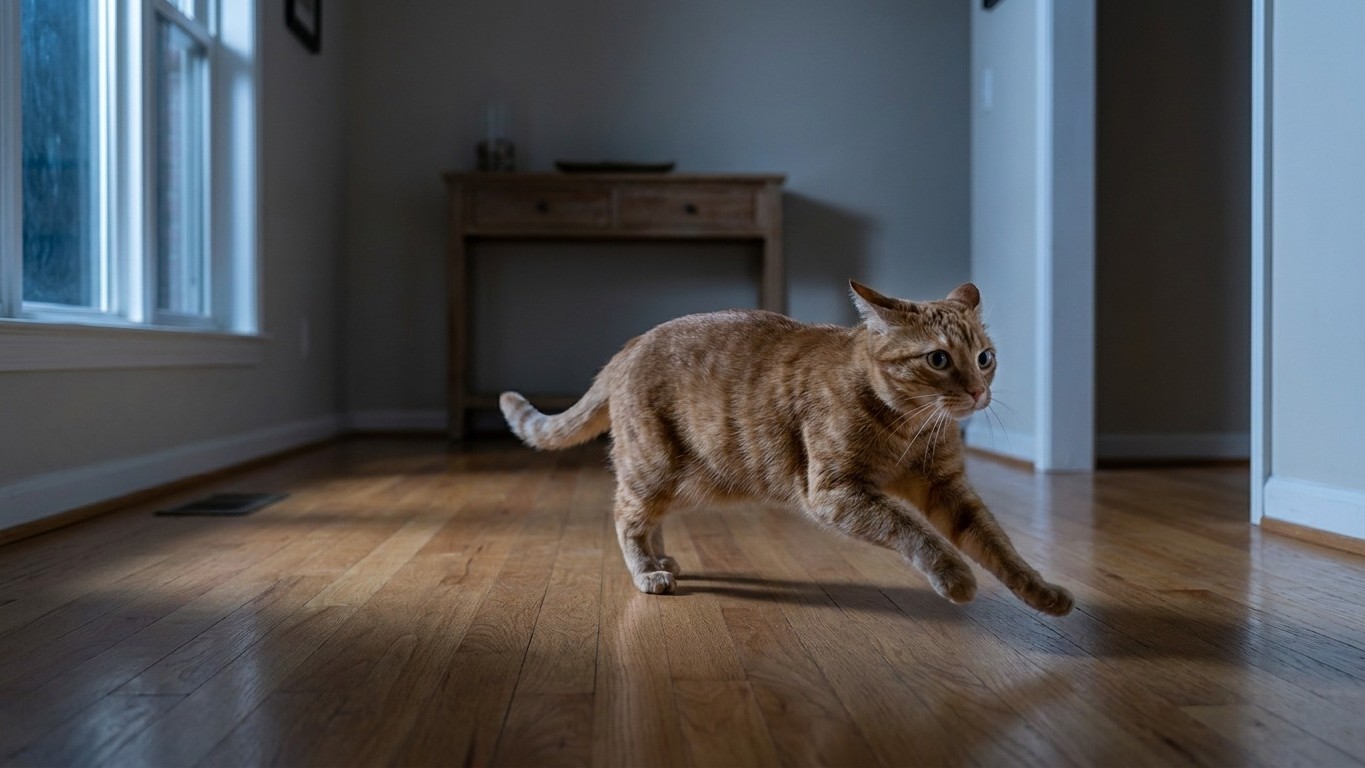
That thundering gallop at 3 AM, the skidding across the kitchen floor, the sudden leap onto the sofa and back again, your cat has not lost the plot. Those explosive sprints have a name, a biological explanation, and even a physical purpose. Far from random chaos, they are a window into the deeply wired instincts that still govern your cat’s body, even if the most dangerous thing in their day is a rogue hair tie.
Key takeaways
- Your cat’s midnight sprints have a scientific name (FRAPs) and are rooted in millions of years of predatory instinct
- Cats are crepuscular creatures engineered by evolution to hunt at dawn and dusk—not mischief-makers keeping you awake
- Most zoomies are harmless and actually release endorphins, but sudden changes in behavior could signal health issues worth investigating
Meet the FRAP: your cat’s ancient energy valve
Frenetic random activity periods, known as FRAPs and colloquially as “zoomies,” are random bursts of energy in which cats run frenetically, commonly in circles. The name sounds clinical, but the experience is anything but: one moment your cat is a motionless, sphinx-like lump on the radiator, and the next they’re bouncing off the hallway walls like a furry pinball. These episodes usually last a few minutes or less.
Cat zoomies are a normal way for cats to release energy and express instinctive behaviours. The key word there is “instinctive.” Zoomies are rooted in feline instincts. Cats are predators by nature, and even if they live indoors, they still have bursts of energy hardwired into their behaviour. In the wild, a cat would stalk prey, chase it, and then rest. Indoor cats still feel these natural urges, and without hunting opportunities, they sometimes release pent-up energy in a sudden, high-speed dash around the house.
There’s also a surprisingly pleasant physiological angle to it. “FRAPs may release endorphins, causing a pleasurable or euphoric response. From a physical standpoint, these bursts of activity can strengthen muscles, boost cardiovascular health, and support overall well-being.” So while you’re bleary-eyed and wincing at the sound of something being knocked off the counter, your cat is essentially experiencing a runner’s high.
Why the middle of the night? Blame evolution, not mischief
The timing feels deliberately inconvenient, but it isn’t personal. Cats aren’t nocturnal, but crepuscular, meaning they’re naturally more active at dusk and dawn rather than during the depths of night. Cats have developed this instinct to help them hunt when their natural prey is most active. It also helps cats avoid some of the true nocturnal predators, who are active only at night, as well as many of the bigger daytime predators they may encounter in the wild. Crepuscular behaviour is essentially a survival sweet spot, and millions of years of evolution don’t vanish just because your cat now lives in a semi-detached in Swindon.
Cats rest and sleep for a majority of the day to conserve energy for short, very active periods. A mature adult cat needs thirteen to sixteen hours of sleep a day, and kittens and young cats need up to twenty hours. This rest is taken in a continuous twenty-four-hour cycle of naps instead of a single long snooze. All that stored energy needs somewhere to go. Your hallway is simply the most convenient hunting ground available.
Felines are more likely to get zoomies at dusk and dawn because that’s when they’re most active. They also tend to experience FRAPs after grooming and using the litter box. That last one deserves a moment of attention. Defecating stimulates the vagus nerve, which can lead to a feeling of release and relief. Depending on the cat’s personality, that might lead to excitement and zoomies. Your cat isn’t being eccentric. They’re experiencing a genuine neurological response.
When the zoomies are saying something more serious
Most of the time, a FRAP is just a FRAP. But not always. Sudden changes in zoomie behaviour might signal underlying health conditions like hyperthyroidism or mobility problems. Older cats with hyperthyroidism may become restless and run excessively. If your previously calm senior cat suddenly starts doing circuits of the living room at 2 AM with no history of this behaviour, a vet check is a sensible next step.
If your cat has fleas or itchy skin, racing around may be their way of trying to escape the feeling. An ageing cat may be losing their eyesight or hearing, which could cause them to run when startled or surprised. Watch for other telltale behaviours of discomfort, like irritability, scratching, or excess licking. “If a cat engages in licking a particular area repeatedly in addition to the zooming around, it may be an indication of pain or anxiety.” Context matters enormously here, a kitten hurtling around after its tea is very different from a 12-year-old cat suddenly careering about in apparent distress.
“Young cats, especially kittens, tend to have frequent and intense zoomies due to their high energy levels and rapid growth. These bursts of activity help practise essential skills like agility, coordination, and motor control.” Even as cats enter their senior years, they may still experience zoomies, though typically less often due to age-related changes like decreased muscle mass and arthritis. Always consult your vet if you’re unsure whether a behaviour is normal for your cat’s age and health history.
What you can actually do about it
The good news: nighttime zoomies are manageable. The trick is to work with your cat’s biology rather than against it. Completing the predatory cycle, hunt, catch, eat, groom, sleep, gives your cat’s brain the resolution it’s built to expect, and rest follows naturally. In practice, this means a proper play session before bed, followed by their evening meal.
Aim for at least two fifteen-minute interactive play sessions per day. “It’s also important to provide mental exercise and satisfaction, don’t just exhaust the cat, but instead, play in a way that allows the cat to stalk and plan.” Wand toys and feather teasers work particularly well because they mimic the unpredictable movement of real prey, satisfying that deeply ingrained chase instinct rather than just burning calories.
Puzzle feeders, treat-dispensing toys, and rotating toy selections can keep your cat’s mind active, reducing the likelihood of random bursts of energy. If your cat naps undisturbed from 9 AM to 5 PM, there is nowhere for that energy to go except into your night. Gently disrupting those long daytime naps with short bouts of engagement can shift the balance considerably.
One detail worth knowing: other non-domestic animals are also known to experience FRAPs, including polecats and elephants. There’s something quietly reassuring about an elephant getting the zoomies. It serves as a reminder that this burst of seemingly chaotic energy is one of the most ancient and widespread expressions of animal joy, your cat included.
Sources : petnation.care | basepaws.com