
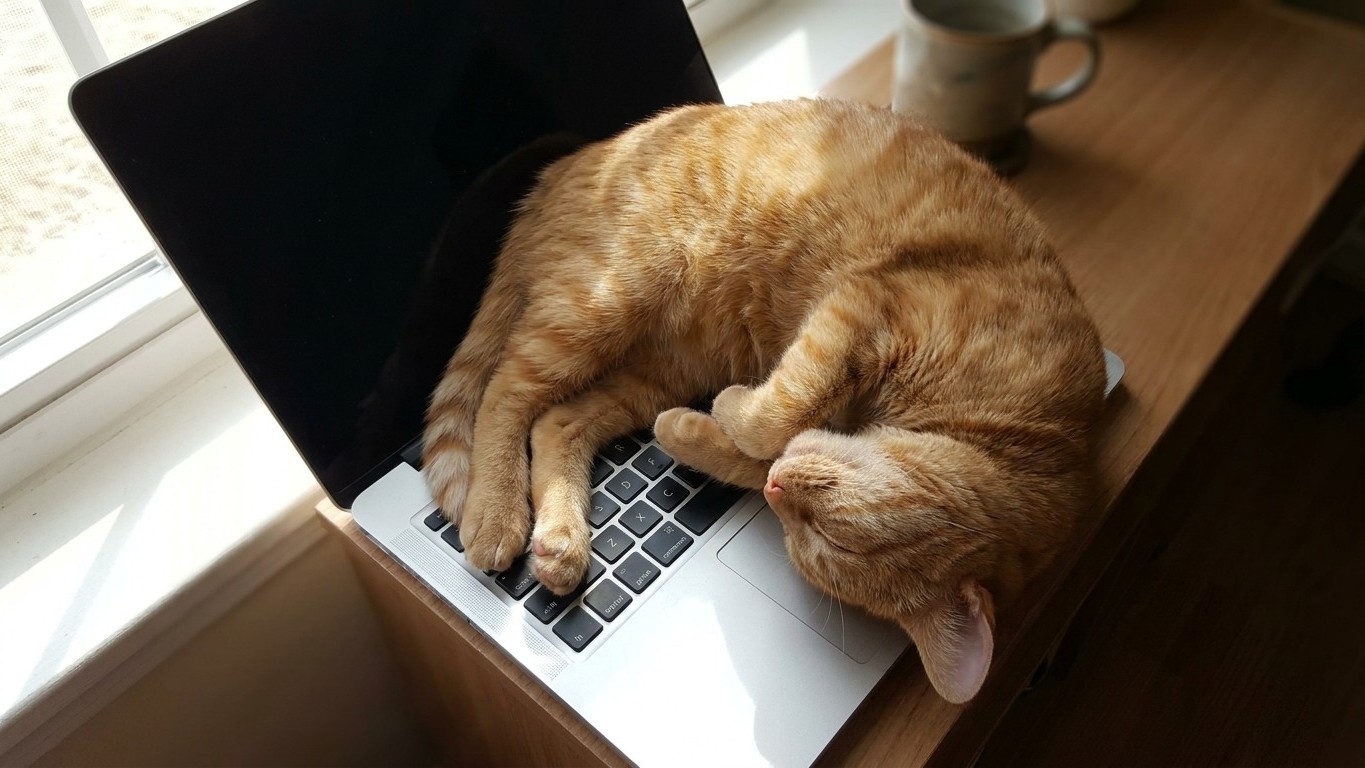
Every cat owner who works from home has seen it. The laptop lid goes up, and within minutes a warm, purring body has settled squarely on the keyboard. It’s endearing, it’s disruptive, and, according to Veterinary dermatologists, it can be quietly damaging your cat’s skin over weeks and months without you ever suspecting a thing.
Key takeaways
- Cats can’t sense gradual heat damage the way humans do—their pain threshold for heat is dramatically higher
- A condition once linked to coal fires is now showing up in veterinary clinics due to laptop exposure
- The damage can look like normal fur loss or grooming stress, making it nearly impossible for owners to spot until it’s advanced
The Hidden Problem With “Just a Warm Surface”
Erythema ab igne, a condition once associated with coal fires and old kitchen stoves, is now more strongly linked to chronic exposure to electronics such as laptops and space heaters. The Latin name translates roughly as “redness from fire,” though there is nothing dramatic about how it develops. It is a skin condition caused by repeated exposure to low levels of heat, not intense enough to cause immediate blistering or pain, but warm enough to gradually damage superficial blood vessels and pigment cells, leading to a mottled, lace-like pattern of redness or brown discolouration.
In humans, doctors have been flagging this for years. The worrying news for cat owners is that erythema ab igne, described as an erythematous, often pigmented, reticular, macular dermatosis, occurs at the site of repeated exposure to moderate heat, and research published in the journal Veterinary Dermatology confirmed it occurs in cats too. Lesions consistent with erythema ab igne were identified in three cats (as part of a broader study), with the cutaneous lesion distribution typically reflecting chronic exposure to moderate heat during lateral or sternal recumbency, the precise position a cat adopts when sleeping on a warm surface for hours at a stretch.
The clinical signs are not subtle once you know what to look for. Erythematous scaly or crusted macules and plaques give rise to mottled hyperpigmentation, with linear and intersecting lattice-like hyperpigmentation with alopecia as a highly characteristic feature, with lesions seen most commonly on the ventral or lateral chest, abdomen, and flank and neck. That is fur loss, skin discolouration, and scaling on the very body surfaces pressed against a laptop base, and Most Owners Miss it entirely until the patches are significant.
Why Cats Cannot Protect Themselves
The physiology here is the part that should genuinely concern any responsible owner. Cats’ skin is thinner, particularly on the abdomen, ears, and paws, and their fur provides insulation that traps heat rather than dissipating it. More critically, cats have a diminished thermal nociceptive response: they do not register discomfort from mild, continuous heat the way humans do. Put plainly, unlike humans, cats lack the ability to perceive gradual thermal injury, they don’t feel pain from sustained low-heat exposure until tissue damage is already underway.
This is not mere oversight on evolution’s part. A cat’s natural body temperature is around 102°F (38.9°C), significantly warmer than a human’s. Our bodies can sense pain from heat at 112°F or greater; cats can only sense pain from heat above 126°F. The heat sensors they do have are concentrated in their faces, making the rest of the body considerably less receptive. A laptop running under a gaming or video-editing session can push its underside surface to temperatures well above the threshold where skin damage begins, yet your cat, curled contentedly on top, feels nothing alarming.
Cats often lounge on warm objects like radiators, heated floors, or recently used electronics, as these surfaces transfer heat directly to their bodies. This instinct, rooted in their desert ancestry, made perfect sense when “warm surface” meant a sun-baked rock, not a machine generating sustained infrared radiation for three hours straight. A heat-seeking cat may camp on vents, laptops, or sunny windows as part of entirely normal thermoregulatory behaviour, but the laptop, unlike the sun, never moves on.
What the Damage Actually Looks Like
Principal clinical lesions consist of irregular areas of alopecia and erythema, sometimes with hyperpigmentation. Owners typically attribute early fur loss on the belly or flanks to over-grooming, stress, or allergy, all reasonable differentials, and the actual cause goes uninvestigated for months. The condition is, by design, silent. The presence of these cutaneous lesions in an animal indicates that the environment should be evaluated for exposure to chronic moderate heat, and the heat source should be eliminated or modified to prevent further exposure and progression of lesions.
Diagnosis is confirmed by biopsy, which reveals a distinctive histological picture. Eosinophilic, wavy elastic fibrils may be seen in the superficial dermis, dubbed the “red spaghetti of Walder” by veterinary dermatologists, a grim but memorable name for a pattern of heat-damaged connective tissue. The therapy is blunt: access to the source of chronic radiant heat must be eliminated. If the skin changes are caught early, the prognosis is reasonable. Persistent or severe cases may result in long-term discolouration that does not resolve, and there is a theoretical concern about cellular atypia developing in chronically damaged tissue.
If you spot patches of thinning fur on your cat’s belly, chest, or flanks, especially on a cat who habitually sleeps on warm electronics — do not wait. Consult your vet promptly. Skin conditions in cats have many causes, and only a proper examination and, where necessary, a biopsy can identify the real culprit.
Practical Steps to Protect Your Cat
The fix is genuinely straightforward, which makes this one of the more preventable welfare problems around. The first priority is simply removing the opportunity. Ensuring your laptop has proper airflow and redirecting your cat’s affection to a warmed blanket or a designated pet heating pad solves the problem at source. A cat heating pad requires little electricity, so there is not a high risk of overheating, and most won’t get hotter than a cat’s internal body temperature, making them safe to leave on for extended periods. That is the key distinction, a purpose-designed product with a controlled maximum temperature versus an uncapped device that simply runs as hot as its workload demands.
Bored cats, particularly in work-from-home households, return to the laptop partly because it is warm and partly because you are sitting there. Interactive treat toys used while you work, or an intense play session during breaks to tire your cat out, mean they get a good nap elsewhere while you use your laptop freely. If there is a particularly sunny spot in your house, placing a bed there gives your cat a naturally warm resting place that costs nothing and carries no thermal injury risk.
For owners who use laptops on soft surfaces, sofas, beds, or laps, it is worth knowing that if the ventilation slots are blocked by an uneven surface such as a bedspread or sofa cushion, the cooling of the laptop will no longer function properly, which pushes surface temperatures higher still. A flat laptop stand, aside from being better for your own posture, meaningfully reduces how much heat reaches whatever is resting on top of the machine.
One detail that surprises most owners: burns can take several days for the extent of the injury to appear, so prompt veterinary attention is a must if there is any suspicion of heat exposure. The visible damage at the surface understates what has happened in the deeper layers of the skin. What looks like a mild patch of sparse fur on Monday may reveal considerably more extensive change by the end of the week, which is precisely why this condition flies under the radar for so long.
Sources : onlinelibrary.wiley.com | transconpet.com