
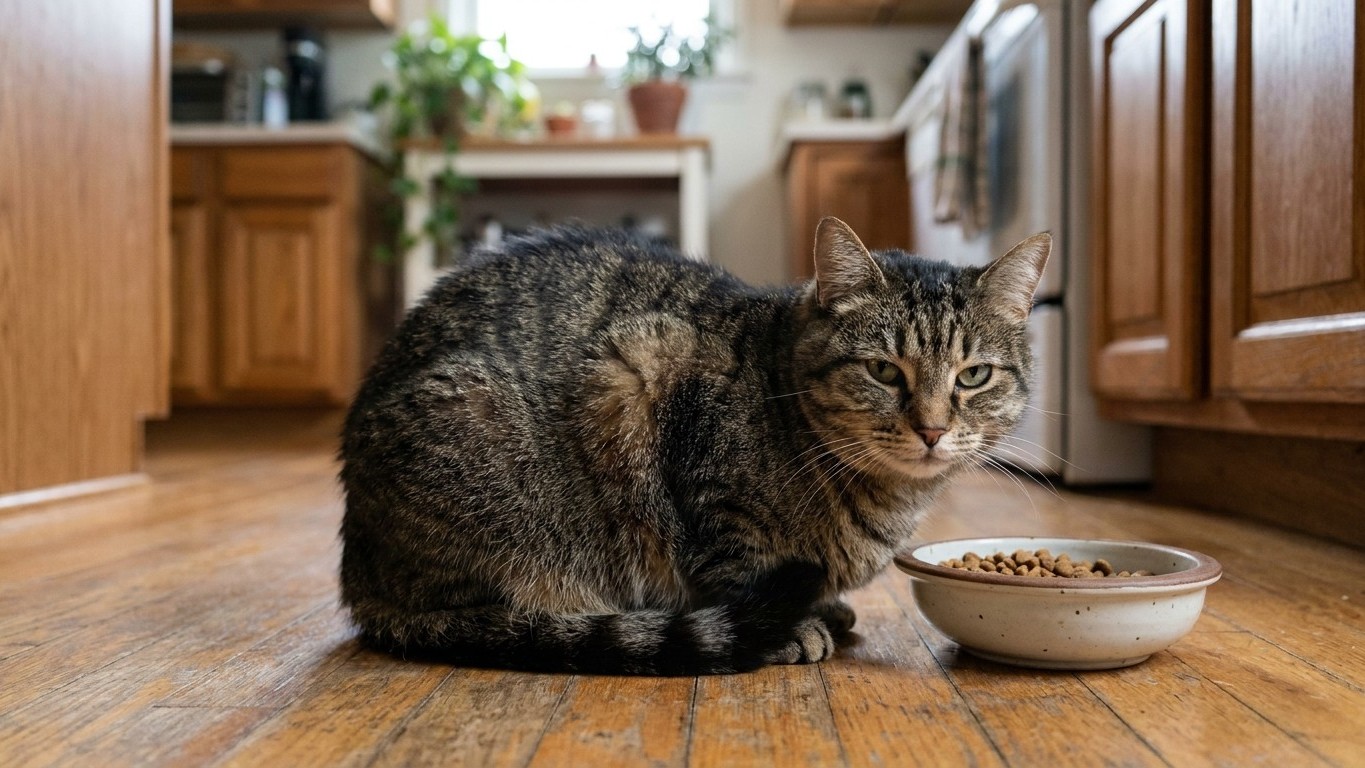
Free feeding. That’s it. That’s the habit that was quietly undoing my cat, Milo. He’s a seven-year-old British Shorthair, and for years I’d filled his bowl with dry kibble every morning and topped it up whenever it looked low. He seemed happy enough. A little rounder, yes, a little slower getting off the sofa, but that’s just cats, isn’t it? Then a routine vet check changed everything.
The vet asked a single question: “Does he have access to food all day?” The answer to that question opened up a conversation about one of the most common, and most overlooked, welfare issues facing indoor cats in Britain today.
Key takeaways
- A single veterinary question exposed a habit that’s silently affecting your cat’s entire body and lifespan
- 63% of cats in developed countries suffer from a condition most owners dismiss as normal aging
- The solution costs nothing and takes just 20-30 minutes daily—but requires understanding what your cat’s body was actually built to do
The “lazy cat” myth that vets are tired of hearing
Indoor cats are prone to falling into a sedentary lifestyle, and this is especially true as the years go by, as they may lose parts of their once adventurous and inquisitive selves. We tend to accept this as normal. We call them lazy. We put a warm blanket on their favourite spot and consider it a kindness. But what’s actually happening, biologically, is far less cosy.
Cats with little to no access to the outdoor environment from a young age are twice as likely to become overweight or obese as a result of decreased physical activity, leading to boredom and consequently to greater food consumption. Twice as likely. That statistic tends to stop people in their tracks, and it should. Feline obesity is a very common disease, occurring in up to 63% of cats in developed countries.
The connection between inactivity and food is more direct than most owners realise. That lack of activity leads to poor muscle tone and a slow metabolism, which fuels the obesity fire. Many indoor cats develop “hunger boredom,” begging or pestering for food because there’s not much else to do. So the cat sits. Gets bored. Eats. Sits some more. It’s a cycle that compounds itself every single day, almost invisibly.
Free feeding: the daily habit that does the real damage
A major factor responsible for feline obesity is the practice of “free feeding,” in which a bowl of dry food is available for consumption by a cat throughout the day. It feels natural to us. Food is there if they want it. Surely that’s fine? The most significant risk is obesity. Cats lack the metabolic control mechanisms of humans, so they are prone to overeating when food is constantly available.
There’s another layer to this. Cats are naturally designed to get most of their hydration from food, as they evolved in desert-like environments. Wild cats consume prey that consists of about 70% water. Dry food contains only 10% moisture or less, while wet food can provide around 70-80%. Because dry food doesn’t offer the necessary hydration, cats fed primarily on kibble often suffer from chronic dehydration. That chronic dehydration, largely silent and easy to miss, plays a large role in feline kidney failure.
And then there’s the monitoring problem. When food is always available, it’s harder to notice changes in your cat’s appetite. A sudden decrease in eating could signal health issues like dental problems or illness, but with free feeding, these changes might go unnoticed. This matters more than people think: changes in appetite are often the earliest sign that something is wrong. Free feeding effectively blinds you to it.
“We should be feeding meals to our cats, not allowing them to eat whenever they want to,” as veterinary guidance from Cornell University’s College of Veterinary Medicine puts it. “There should be a distinct meal time, and the owner should be in control of it.” The shift from topping up a bowl to structured mealtimes is the single biggest dietary change most indoor cat owners could make.
What obesity actually does to a cat’s body
The consequences aren’t abstract. Obesity in cats has been linked to diabetes, urinary disease, constipation, joint disease, and many types of cancer. Compared to lean cats, overweight cats are almost five times as likely to develop lameness, which requires a veterinary visit. Think about that in practical terms: a cat who struggles to jump onto the sofa, who stops grooming its lower back properly, who flinches when touched around the hips. These aren’t signs of old age creeping in. They’re signs of a body under stress from excess weight.
Obesity in cats is more than just extra weight; it’s considered a chronic inflammatory disease with far-reaching health implications. Even without signs you can see, obese cats have higher anaesthesia risks, medical costs, and require special care in selecting the correct dose for medications. A heavier cat doesn’t just cost more to keep healthy; it’s genuinely harder to treat when something goes wrong.
The mental toll matters too. Without adequate enrichment, cats may experience distress, defined as an inability to cope, that can lead to behavioural disorders and stress-related medical diseases. An indoor lifestyle can be predictable and monotonous, and there’s less opportunity to exhibit certain natural behaviours, such as hunting and exploring. A cat who isn’t hunting, stalking, climbing, or playing isn’t thriving. It’s enduring.
What to actually do about it
The good news: this is fixable, and it doesn’t require expensive gadgets or a complete lifestyle overhaul. The first priority is restructuring mealtimes. Most experts agree that scheduled feeding works best for adult cats. You give your cat two measured meals each day, which helps you control portions and keeps your cat from eating too much. If you suspect your cat is already carrying excess weight, always consult your vet before changing their diet; rapid weight loss in cats can cause serious liver problems.
The second, equally important piece is daily play. Most indoor cats need anywhere from 20 to 30 Minutes of Exercise each day, and the intensity can vary based on their age and current fitness level. A cat’s desire to hunt is not connected to the sensation of hunger. Even well-fed cats will stalk when they see or hear potential prey. Almost anything that moves rapidly or squeaks in a high pitch can trigger this instinctive behavioural response. Short, focused sessions with a wand toy in the evening cost nothing and repay you in years.
For cats who inhale food at speed, puzzle feeders are a valuable tool. They challenge your cat to work for their food or treats, engaging both their body and brain, and can reduce fast eating habits and support weight management. Scatter kibble across the floor, hide small portions around the flat, or use a slow-feeder bowl. The effect is the same: mealtimes become mental exercise rather than a passive reflex.
The indoor-only cat should have access to all essential resources, including food, water, Comfortable and safe resting places, simulated hunting and foraging opportunities, play, safe territory with vertical space, and appropriate and clean toileting areas. Vertical space is often underestimated. A cat tree near a window doesn’t just give your cat something to climb; it gives them a territory to survey, which satisfies something deep in their behavioural wiring.
One thing worth knowing as you assess your own cat’s condition: you should be able to feel your cat’s ribs easily under a thin layer of fat, if you have to press to find them, your cat may be overweight. When viewed from above, a healthy cat typically has a gentle hourglass shape, and from the side, you should see a slight upward tuck behind the ribs. That quick home check, combined with a vet visit for a proper Body Condition Score assessment, tells you far more than the scales alone. As always, if you have any concerns about your cat’s weight or health, your first call should be to your vet.
There is one final, rather brilliant detail about how cats sleep that reframes all of this. Research shows cats enter REM sleep, the same stage humans dream in. It’s believed they rehearse hunting movements while sleeping, which explains those adorable paw twitches. Your cat’s body was built to hunt, even in dreams. The least we can do is give it something worth dreaming about during waking hours.
Sources : avma.org | lilydalevetcentre.com.au