
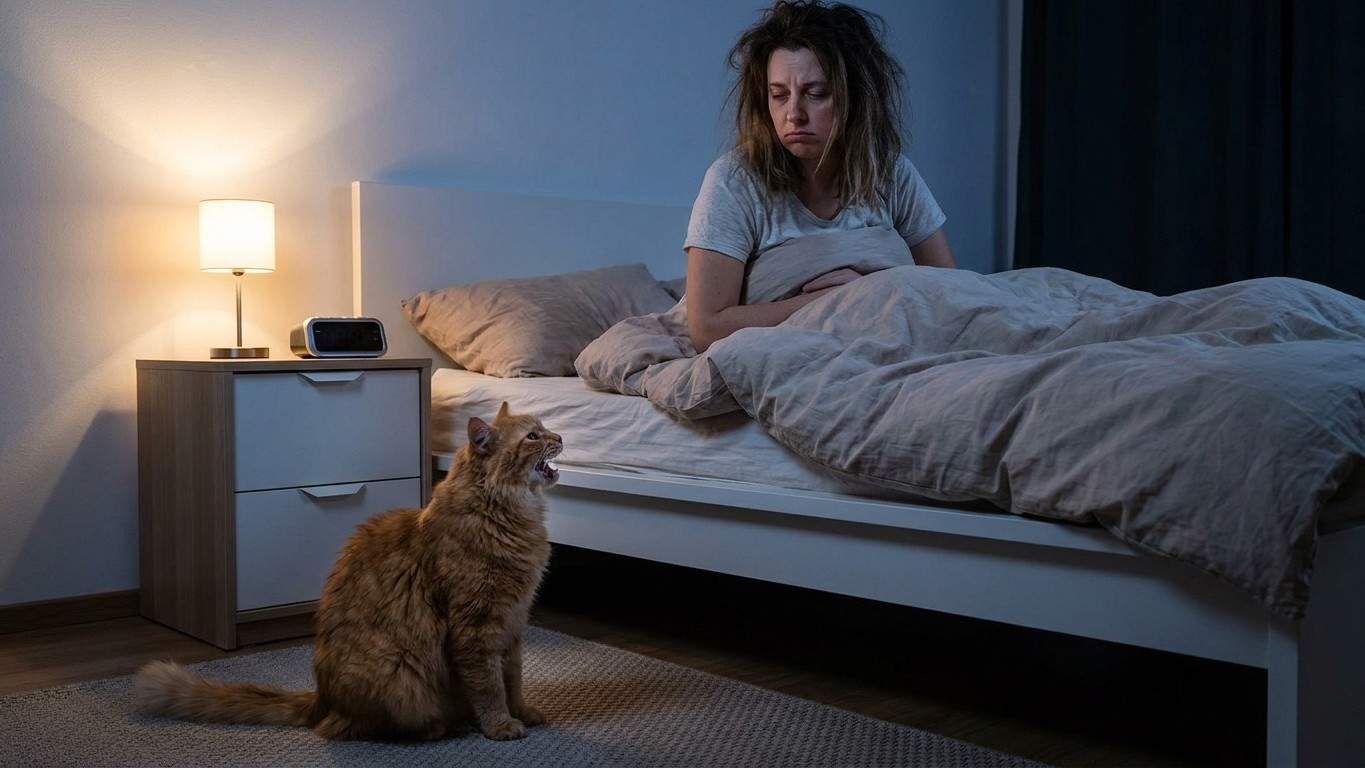
Three in the morning. Your cat is wailing in the hallway, and you do what every sleep-deprived cat owner does: you stumble out of bed, whisper something soothing, and give them a stroke, a biscuit, maybe both. Within seconds, the noise stops. You crawl back under the duvet feeling like a hero. The problem is, you’ve just taught your cat that crying at night works, and tonight, you’ll do it all over again.
Key takeaways
- The one thing every owner does at 3am is exactly what makes cats cry MORE, not less
- Cats learned this behavior from you—and they’re better at training humans than we are at training them
- Your solution might be making it worse, especially if you give in occasionally instead of never
Why cats cry at night in the first place
Although it’s popularly thought that cats are nocturnal, this is not strictly true. They are crepuscular, meaning they are naturally most active at dusk and dawn. Many cats do adapt to the routine of their owners, but this crepuscular tendency means they may be especially active in the early hours of the morning, when the rest of the house is asleep. So the first thing to accept is this: your cat isn’t crying to spite you. Their body clock is simply wired differently from yours.
Younger cats have an increased tendency to be active at night, as their instincts tell them this is a great time to hunt. As they mature, their rhythm will likely adapt to that of the rest of the household. A kitten yowling at 2am is, in a sense, just doing what evolution designed them to do. A cat’s meow is its way of communicating with humans, and unlike dogs, cats rarely “talk” to each other with meows. They save that just for us. That distinction matters, because it means the nocturnal chorus isn’t random noise. It’s directed communication, shaped by what your cat has learned gets a response.
Beyond instinct, the triggers vary. Cat crying at night may simply be because they’re bored, or because they haven’t had enough enrichment during the day to fulfil their physical and mental needs. If you welcome a new kitten, dog, or baby into your family, your cat may be confused about what’s happening, making them more prone to nighttime noise-making. And for older cats, the situation can become genuinely medical. Excessive vocalisation, including at night, can be a sign of overactive thyroid or kidney disease. As cats age, their cognitive function and night vision can deteriorate, causing feelings of insecurity, confusion, vulnerability, and disorientation.
The one thing every owner does, and why it backfires
Here’s the behavioural trap hiding in plain sight. Cats are intelligent creatures and learn pretty quickly what works for them. When the owner gets up to check on the cat because they worry the cat is in some form of distress, this soon becomes a habit. The cat learns that this form of behaviour gets her the attention she wants. By getting up and checking on the cat, owners unintentionally reinforce this behaviour, our cats effectively train us to do what they want.
A published case study from the IAABC Foundation illustrates this with painful clarity. Whenever the cat meowed, the owner tried to figure out what she was asking for and give it to her. The cat learned very quickly that meowing brought rewards, sometimes food, sometimes petting, sometimes a play session. Something good always followed the meowing, so she meowed all the time. Then, when the owner tried to ignore the meowing, she moved from a continuous reinforcement schedule to an intermittent one. Instead of getting a reward every time, the cat only sometimes got a reward when she meowed. When the owner’s tolerance was low, she would give in after just a few meows; when higher, she could hold out for many. The result was that the cat became even more persistent, because often enough, if she meowed long enough, her efforts were rewarded.
This is the key mechanism that vets and animal behaviourists consistently flag. Many owners inadvertently encourage the behaviour by giving the cat something it values during vocalisation, perhaps in an attempt to quiet it down. Attention, affection, play, a treat, all are forms of reinforcement. Reinforcement of even a very few of the vocalisation outbursts perpetuates the behaviour. The cruel irony is that giving in occasionally is actually worse than giving in every time — intermittent rewards make behaviours more resistant to extinction, not less.
What to do instead
The first and non-negotiable step, if nighttime crying is a new behaviour or your cat is older, is a vet visit. If your cat cries at night, especially if this is new behaviour, the first thing you should do is take them for a health check at your vet. There are certain medical conditions that can cause a cat to yowl, especially at night. Rule out hyperthyroidism, hypertension, pain, and cognitive dysfunction before attributing Everything to attention-seeking.
Once medical causes are excluded, the approach is about restructuring your cat’s day, not just your night. Conduct a high-intensity play session using a wand toy around 15 minutes before your own bedtime. Once the cat is physically exhausted, provide their final meal of the day. This satisfies the “hunt-eat” sequence, naturally leading to grooming and a long period of deep rest. This isn’t just a folk remedy — research into feline behaviour has shown that cats adapt best to routines. Predictability in feeding, play, and environment reduces stress. A study published in the Journal of Veterinary Behavior found that cats whose owners engaged in interactive play before bedtime showed significantly less night-time activity compared to control groups.
Using a timed feeder for a midnight snack, or providing a food puzzle that will last through the night, can remove you from the equation entirely, so your cat learns that the machine feeds them, not a bleary-eyed human. And when the crying happens anyway? Under no situation should the owner go to the cat if it vocalises. That’s the guidance from VCA Animal Hospitals, and it’s unambiguous. Silence, stillness, and consistency are the only tools that work.
Be warned: things will get worse before they get better. A phenomenon referred to as an “extinction burst” may occur initially, with the cat increasing the behaviour in the short term when reinforcement is removed, as the cat attempts to reinstate the original reinforcement by intensifying the behaviour. Most owners interpret this escalation as proof the method isn’t working. It’s actually proof that it is. After a few nights, depending on the individual cat, she will have learned that meowing doesn’t work, and it is possible in some cases for her to adapt to her human’s sleeping routine.
When the night crying is something deeper
Senior cats merit particular attention. Cognitive dysfunction syndrome affects a significant proportion of cats over 15 years, causing symptoms including disorientation, altered sleep-wake cycles, and increased vocalisation, especially at night. Hypertension, common in older cats, can cause distress and confusion. Pain from arthritis or other age-related conditions may intensify when cats are less distracted, leading to increased night-time meowing. For these cats, the solution isn’t behavioural extinction, it’s medical management, and possibly environmental adjustments like nightlights to help with disorientation.
Veterinary assessment typically includes physical examination, blood tests to evaluate organ function and hormone levels, blood pressure measurement, and potentially imaging. Providing detailed information about when meowing occurs, its characteristics, and any accompanying behavioural changes helps vets identify underlying causes. Video recordings of the behaviour can be particularly useful for diagnostic purposes.
One thing cat owners rarely realise: meowing as a form of communication is used between kittens and their mother, or as a way for pet cats to seek attention from their humans. Adult cats in the wild essentially don’t meow at each other. The entire behaviour, as directed at you at 3am, is something domestic cats have refined specifically to communicate with people. In that sense, your cat isn’t being difficult. They’re being extraordinarily good at talking to you, and you’ve been a very attentive listener.
Sources : pmc.ncbi.nlm.nih.gov | atlanticvetseattle.com