
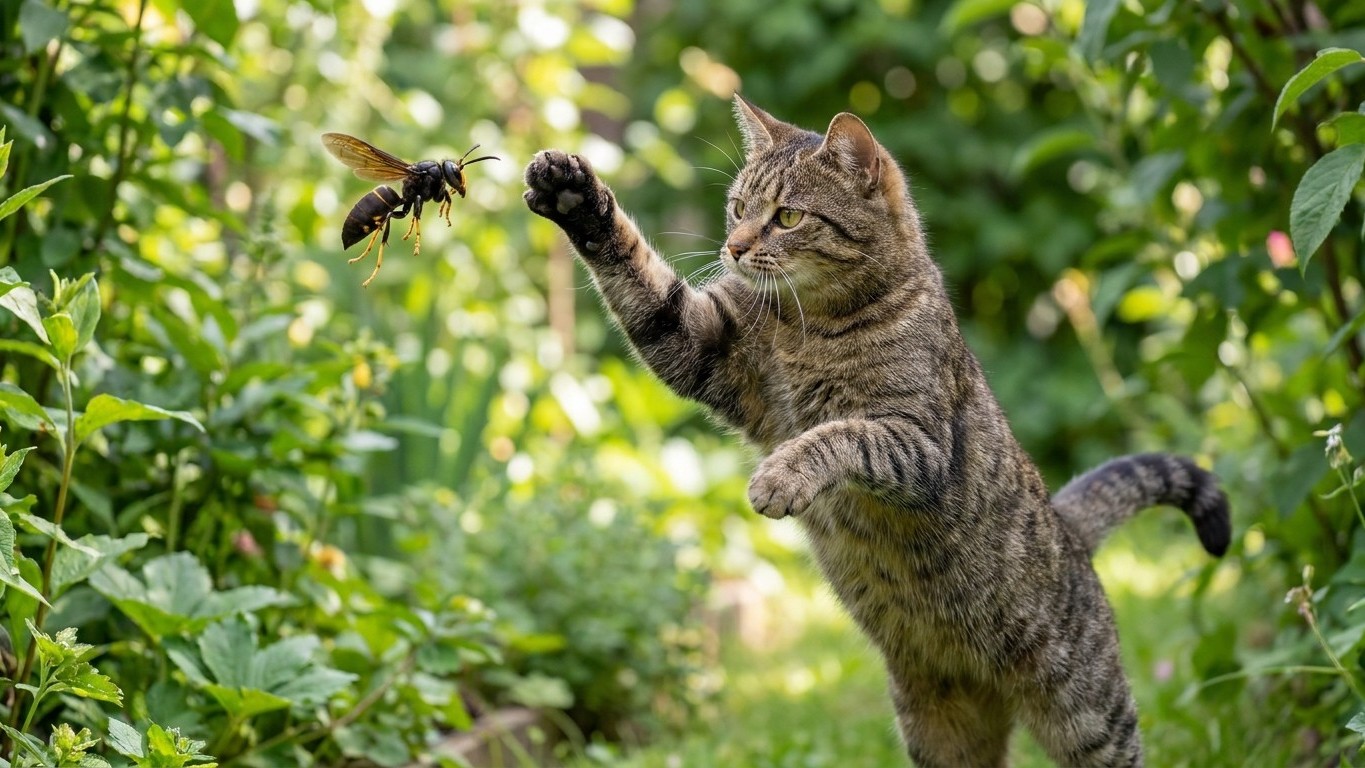
A cat batting at a large buzzing insect is one of the most natural sights in a British garden. That swat-and-pounce reflex, honed over thousands of years of feline evolution, is completely harmless when aimed at a daddy-long-legs or a moth. This spring, though, it is becoming a genuine welfare risk, because the Asian hornet (Vespa velutina) is now present in the UK in growing numbers, and it fights back in a way that can turn a playful encounter into a veterinary emergency.
Key takeaways
- For the first time, Asian hornets survived a full UK winter—changing everything about the spring threat level
- A cat’s hunting drive is so powerful it overrides all other instincts, making them almost certain to attack a large buzzing insect
- One sting can summon the entire colony: hornet venom acts as an alarm signal to nearby workers
Why 2025 is different for UK cat owners
The first full Asian hornet nest of 2025 was uncovered in Langley, Kent, on 16 April. That might sound like an isolated event, but the British Beekeepers Association (BBKA) is treating it as a warning shot. For the first time this year, the BBKA issued urgent warnings, announcing that an ‘unprecedented’ number of Asian hornets could soon appear across the nation. The numbers back this up: a total of 544 credible sightings of yellow-legged hornets were recorded in the UK in 2025, with 161 confirmed nests found and destroyed : 270 since 2016, all of which were destroyed.
The reason for the sharp upward trajectory goes beyond simple spread. Last year, it was confirmed that the Asian hornet had survived a UK winter for the first time. That overwintering milestone fundamentally changes the threat picture. Asian hornet queens begin to emerge from hibernation around April, and one colony can produce up to 350 new queens, so nests must be found before August and September when the fertile females are born. Spring is therefore the window that matters most, for biosecurity teams, and now, for cat owners too.
The pounce reflex your cat cannot override
The feline drive to hunt is highly developed and is separate from the drive to eat. A cat will stop eating a freshly-caught meal to chase after a second object of interest that happens to pass by, and unlike playful behaviour, the hunting drive does not decrease with age. That is the core problem. A well-fed, older house cat has exactly the same compulsion to swat a large buzzing insect as a feral kitten raised on live prey.
The sight or sound of prey triggers a cat’s hunting instinct, making it near-impossible for them to resist the sound of a bird’s wings flapping or the sight of a darting insect. An Asian hornet, significantly larger than a wasp, with an imposing buzz, is almost irresistible prey stimulus. To a cat, a small flying buzzing object seems like a great thing to play with, and they just can’t help but swat at it. The result is predictable: a cat that bats at an Asian hornet is likely to be stung, usually on the paw or the face, before it even understands what has happened.
There is a second, more serious layer to this. Research published in the Journal of Experimental Biology showed that Vespa velutina uses its sting venom as an alarm pheromone, with venom volatiles strongly attractive to other hornet workers and capable of triggering attacks. In plain terms: when your cat provokes one hornet near a nest, the sting it receives can call the rest of the colony. A single swipe could lead to multiple stings in seconds.
What hornet stings actually do to cats
The stings of bees, wasps, and hornets spell trouble for cats. Insect venom causes problems ranging from mild irritation to life-threatening shock. Most single stings from native wasps or bees cause localised swelling and pain that resolve within 24 to 48 hours with basic care. The Asian hornet is a different proposition. Wasps and hornets can sting multiple times, which increases the chance of a pet having a dangerous reaction. The venom of Vespa velutina contains a complex mixture of biologically active molecules, and its venom toxins are proportionally more abundant than in other Hymenoptera venoms.
Stings to the face or mouth are the highest-risk scenario, and they are precisely where cats tend to get hit. Most often stings occur on the face, typically near the nose, or on a paw, thanks to the cat’s tendency to bat prey around. Most wasp and bee stings on cats have mild reactions, but being stung on the face, throat or mouth can be life-threatening. A sting inside the mouth can cause airway swelling fast enough that a cat in apparent good health deteriorates within minutes.
Like some people, many cats are hypersensitive to insect stings. The degree of reaction varies with the cat’s immune system and the type of insect. Allergic reactions usually occur within 20 minutes of the sting but may be delayed for hours, so close monitoring is critical. Severe reactions, anaphylaxis, can be fatal. Warning signs to watch for include panting (cats normally breathe only through the nose), excessive drooling, vomiting, disorientation, or sudden collapse. Any of these demands an immediate call to your vet.
What to do, and how to reduce the risk
If you suspect your cat has been stung, the first step is to bring it indoors immediately and check the face, paws, and inside the mouth. Signs of a serious reaction include vomiting, excessive swelling, and breathing difficulties, these need emergency treatment. Do not administer any human antihistamines or creams without veterinary guidance first. Over-the-counter human medications should not be given to cats without speaking to a vet, as they may contain ingredients that are toxic to them. Always contact your vet at the first sign of concern — better an unnecessary phone call than a delayed one.
Prevention is the more useful strategy. The majority of sightings in 2025 have been in the south of England, and with the weather getting warmer, residents in those areas have been warned. Supervising outdoor cats during peak hornet activity, warm afternoons from late spring onwards, is sensible. Cats that have previously been stung by any wasp or bee may have developed sensitisation, meaning a second sting triggers a faster and more severe immune response.
Reporting matters too. The Non-Native Species Secretariat and the British Beekeepers Association are calling for UK residents to report any sign of yellow-legged Asian hornets. The Asian Hornet Watch app (available free) takes reports with a photo and a location, helping the National Bee Unit track and destroy nests before they expand. A typical nest of between 2,000 and 3,000 hornets can eat more than 11 kg of insects per season, around 90,000 bees. Finding a nest early protects bees, local pollinators, and the cats who cannot resist investigating whatever large thing is buzzing past their nose.
One detail worth knowing for identification: Asian hornets are overall black, with bright yellow legs and just a single yellow segment on the abdomen, quite distinct from the browner, more striped European hornet native to the UK. If you see one in your garden this spring, resist the urge to shoo it away with your hands, keep your cat inside, and report it. The swatting can wait until the professionals have dealt with the nest.
Sources : journals.biologists.com | pubmed.ncbi.nlm.nih.gov