
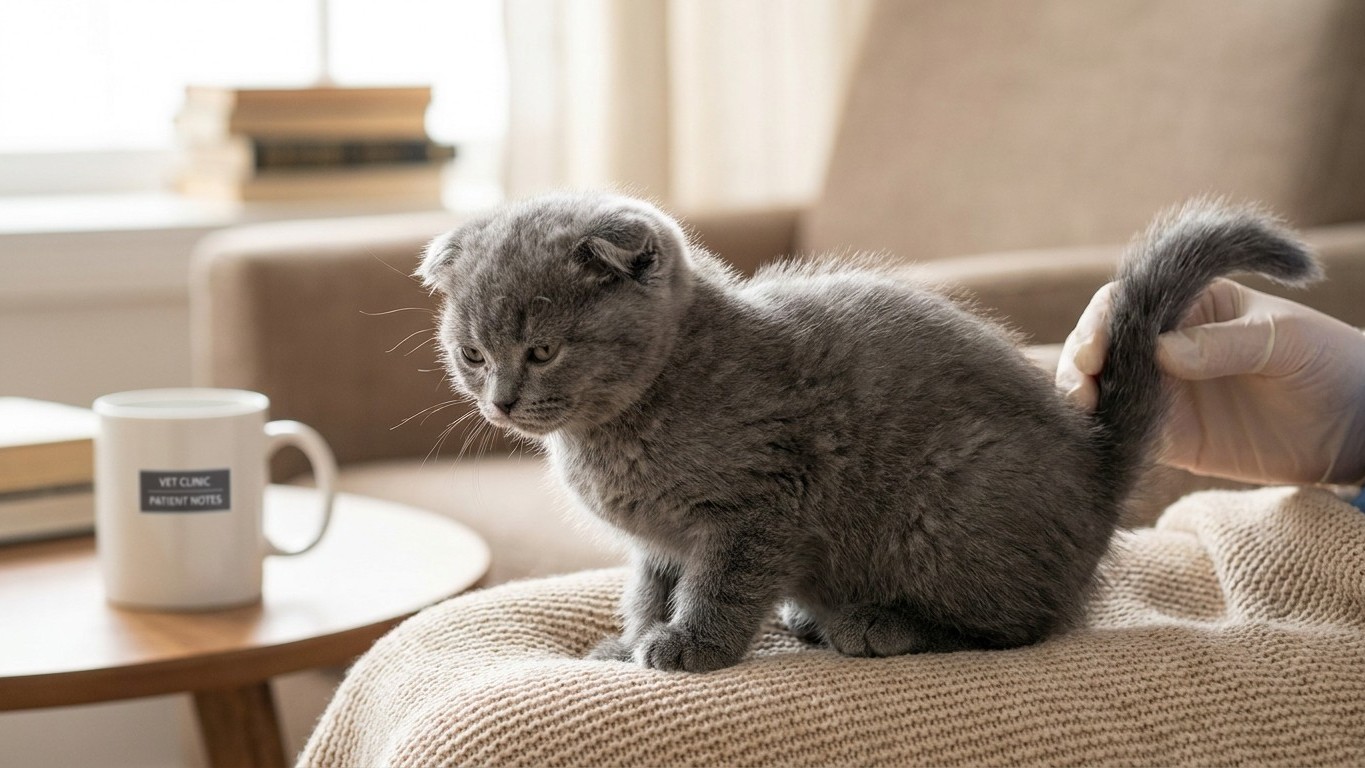
Those folded ears that made you fall in love weren’t just a quirk of cuteness. They were the first visible sign of a genetic condition that affects your kitten’s entire skeleton, and a stiffening tail at eight months is often where owners first notice something’s wrong.
The Science Behind this is now well understood. This ear fold is the result of a natural genetic mutation first observed in a farm kitten in Scotland in 1961, and the genetic mutation which causes the folded ears is a single gene variant in TRPV4, which impacts the development of cartilage. Geneticists at UC Davis identified the exact culprit: a single base change (c.1024G>T) in the TRPV4 gene that results in an amino acid substitution of a valine for a phenylalanine (p.V342F). That tiny molecular typo is dominant, meaning a single copy is sufficient to affect cartilage development, resulting in the Scottish fold osteochondrodysplasia (SFOCD) phenotype, which includes malformation of the distal forelimbs and hindlimbs, malformation of the tail and fold ears.
Here’s the bit most new owners never hear at the breeder’s or the rescue centre: all fold kittens are born with straight ears, and ear folding starts around 3 to 4 weeks of age. By the time you picked your kitten because his ears had already flopped over like a little owl, the same cartilage fault was quietly at work in his tail, ankles and wrists too. It just takes longer to become visible there.
Key takeaways
- The same genetic mutation causing folded ears also damages cartilage in the tail, joints, and bones throughout the body
- A stiffening tail at eight months isn’t personality—it’s often the moment owners first notice the degenerative changes quietly developing inside
- Severity varies dramatically between individual cats, and management strategies can meaningfully slow decline and minimize pain
Why the tail is often the giveaway
Cartilage isn’t just an ear thing. It’s the structural scaffolding for joints throughout the body, and when the TRPV4 gene is faulty, that scaffolding goes wrong everywhere it’s needed. The genetic defect that causes the abnormality of the ear cartilage characteristic of the Scottish Fold breed also causes severe abnormalities of the cartilage of bones. Vets call the resulting condition osteochondrodysplasia, and osteo refers to bone, chondro to cartilage and dysplasia to abnormal development.
The tail is frequently where owners spot the first practical sign, because it’s easy to watch and easy to touch. Lameness in one or more limbs, stiff gait, abnormal postures, difficulty jumping to high places, and a stiff tail are the classic red flags vets look for. A tail that used to swish freely and now moves in short, jerky segments, or feels thickened and rigid rather than whip-like, isn’t just “developing a personality.” This degenerative disease causes abnormal development of cartilage and bone throughout the cat’s body, leading to misshapen toes, thickened and inflexible tails, and, most significantly, severe arthritis and joint fusion. In some cats the changes go further still, and the varying degrees of painful degenerative joint disease can result in fusing of the tail, ankles, and knees.
Timing matters here, and it varies a lot between individuals. In cats suffering from severe forms, bone and cartilage lesions can be found starting at the age of 7 weeks, while in those with more mild forms, the lesions can be seen from the age of 6 months onwards. An eight-month check with a stiffening tail fits squarely into that window where mild to moderate changes typically start showing up on X-ray.
Not every fold cat suffers the same way
This is where I want to push back gently on the doom-laden narrative you’ll find in some corners of the internet. The disease is real and the ethical debate is legitimate, but severity genuinely differs cat to cat. How severe the disease is will vary between one cat and another, with signs depending on the amount of bone and joint damage; some cats may show no signs of pain, others may have minor signs, which may worsen over time.
Breeding history plays a big role in that variation. Cats with two copies of the mutation fare worse than those with one. In cats which are homozygous for the abnormal gene, a progressive, crippling arthritis develops early in life, whilst in those which are heterozygous the disease may be milder. A more recent blinded radiographic study offered a slightly more reassuring picture for heterozygous cats specifically, finding that these heterozygous cats may also have medical problems consisting of deformed distal extremities in the worst cases and accelerated onset of osteoarthritis, though previous studies were undermined by selection biases, lack of controls, unblinded assessment and lack of known genotypes. When that same team controlled for those flaws, the images in heterozygous cats showed much milder radiological signs than previously published, though the trend towards more severity in folded-ear cats persisted.
A large-scale Australian veterinary records study backs up the idea that severe, obviously disabling cases aren’t the universal outcome some assume. Findings from that study suggest a relatively low prevalence of clinically diagnosed Scottish Fold osteochondrodysplasia in the studied population, with cats generally diagnosed with SFOCD at less than 30 months of age. None of that erases the welfare concern, but it does mean a stiff tail at eight months is a signal to act, not necessarily a death sentence.
What to actually do about it
There’s no cure. Osteochondrodysplasia has no cure and the condition is progressive. But “no cure” doesn’t mean “nothing to be done.” Management focuses on comfort and slowing decline, and this is precisely where your vet earns their fee. It’s important to seek treatment right away if something is wrong, so steps can be taken to minimise pain and slow the progression of the disease, and telling the veterinary staff of your cat’s ongoing condition is important so that any medications or future treatments can be given safely. Diagnosis itself isn’t guesswork either, so don’t expect a vet to confirm anything from a glance. The diagnosis is based on clinical signs and radiographs.
Practical home adjustments genuinely help: lower-sided litter trays, ramps instead of jumps onto sofas and windowsills, soft bedding placed somewhere warm, and keeping an eye on weight, since every extra gram is extra load on compromised joints. Pain relief prescribed and monitored by a vet, never over-the-counter human medication, is the mainstay of management once symptoms appear.
If you’re considering another fold kitten down the line, ask the breeder for TRPV4 genetic test results before you fall for another set of endearing floppy ears. It’s a five-minute conversation that could spare a future cat years of quietly stiffening joints.
Sources : researchgate.net | link.springer.com