
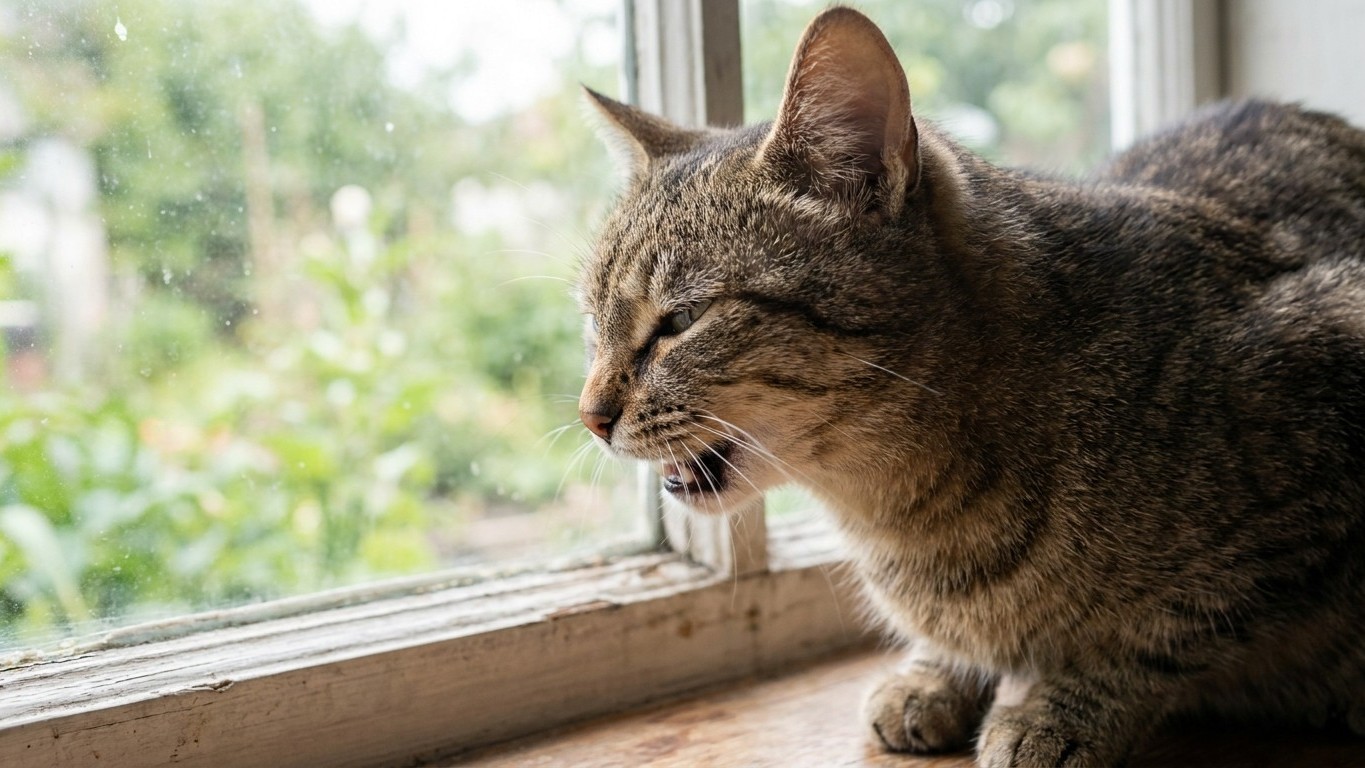
A dry, hacking cough that sounds exactly like a hairball attempt but never actually produces one is one of the classic warning signs vets associate with feline lungworm, not a grooming problem at all. If your cat has been “coughing up nothing” for weeks or months despite regular doses of malt paste, the real culprit may be a parasite picked up from something as ordinary as a slug on the patio.
Key takeaways
- A dry, non-productive cough in cats can be mistaken for hairballs but might signal a serious respiratory parasite instead
- Cats don’t need to intentionally eat slugs—infection spreads through contaminated prey, water, or even slime trails on their paws
- A simple stool sample using the Baermann technique can reveal what months of hairball paste never could
Why hairball paste does nothing for this cough
Hairball remedies work by lubricating the digestive tract so swallowed fur passes through more easily. They do nothing whatsoever for a respiratory problem, and that’s exactly the trap many owners fall into, because the sound of a cat trying to dislodge a hairball and the sound of a cat with early lungworm disease can be almost identical to the untrained ear. Vets describe the clinical picture as ranging from mild coughing with slightly faster breathing right through to moderate coughing with slightly increased breathing rates to severe, persistent coughing, labored breathing, and respiratory distress or failure. Some infected cats show barely anything at all, which is precisely why the condition can be missed, or misattributed, for so long.
The parasite responsible in the vast majority of UK cases is the most common type of lungworm in cats (aelurostrongylus abstrusus), which affects their lung tissue. Adult worms are tiny, thread-like creatures that set up home in the smallest airways and air sacs of the lungs, where they trigger an inflammatory reaction that irritates the tissue and produces that persistent, dry, non-productive cough. Other, less common feline lungworms exist too, including Troglostrongylus brevior, Oslerus rostratus, Capillaria aerophila, and, outside of Europe, Paragonimus species, and mixed infections with more than one species at once are entirely possible.
The garden connection: slugs, snails and an unlucky snack
Here’s the part that catches most owners off guard: your cat almost certainly didn’t eat a slug on purpose. Cats can become infected by eating slugs or snails, or by eating another animal that has eaten a slug or snail, such as a snake, lizard, mouse, or bird. Slugs and snails act as intermediate hosts, picking up first-stage larvae that have been coughed up and passed in the droppings of an already-infected cat, fox, or hedgehog, then developing them into an infectious stage inside their own tissue over several weeks.
Cats are fastidious hunters and groomers, so a slug slime trail across a paw, a nibbled bird that had itself snacked on a snail, or even lapping from a puddle contaminated with larvae can be enough. Cats commonly catch lungworm from infected prey such as birds and mice, from drinking water contaminated with lungworm or from snails and slugs. Once swallowed, the larvae burrow through the gut wall, hitch a ride in the bloodstream, and travel all the way to the lungs, where they mature into egg-laying adults. It’s a genuinely remarkable journey for something that starts life on a garden slug.
Why the stool sample was the turning point
The reason a vet reaches for a faecal sample rather than simply listening to the chest is that the adult worms lay eggs which hatch into larvae inside the lungs; the cat then coughs these larvae up, swallows them again, and passes them out in its droppings, completing a rather grim internal loop. Laboratories detect this using a specific method called the Baermann technique, sent to a lab or done by your vet. This is the most accurate way to diagnose lungworms. It isn’t always straightforward, though. It can be a challenge for the veterinarian to diagnose lungworm because infected animals do not always pass the larvae in their feces, and when they do, they may be few in number. That’s why a vet suspecting lungworm may repeat the test, or combine it with a chest X-ray to look for the tell-tale nodules and inflammation the parasite leaves behind.
The overlap with other, far more common feline conditions is precisely what makes lungworm such a slippery diagnosis. Lungworms in cats can be tricky to diagnose because the symptoms can look like other diseases such as asthma, heartworm disease, bronchitis, and pneumonia. Age matters too: vets weigh up the likelihood differently depending on the patient, since in young outdoor cats, parasitic lungworm infection is a more likely diagnosis, while in older cats, another disease may be more likely.
What happens after diagnosis, and how to reduce the risk
The reassuring news is that once lungworm is correctly identified, treatment with the right antiparasitic medication is usually effective, and most cats stop showing clinical signs fairly quickly afterwards. It’s rarely a death sentence, though vulnerable animals need closer monitoring, since elderly cats and kittens are more at risk of serious illness if they get lungworm especially if it causes a secondary infection. Left completely untreated in severe cases, the inflammation can progress towards pneumonia or, rarely, more serious complications, which is exactly why persistent coughing deserves proper investigation rather than months of malt paste.
You can’t wrap your cat in cotton wool, and frankly, hunting instinct is part of what makes cats such compelling creatures. But keeping up with a vet-recommended parasite prevention schedule, discouraging hunting where practical, and taking any cough that lasts more than a week or two to your vet rather than the pet aisle will save both your cat’s comfort and your own nerves. Next time that dry, retching cough starts up in the middle of the night, don’t reach straight for the tub of hairball paste; ask your vet whether a simple stool sample might tell a very different story about what’s been going on in that garden of yours.
Sources : worldcatfinder.com | hillspet.com