
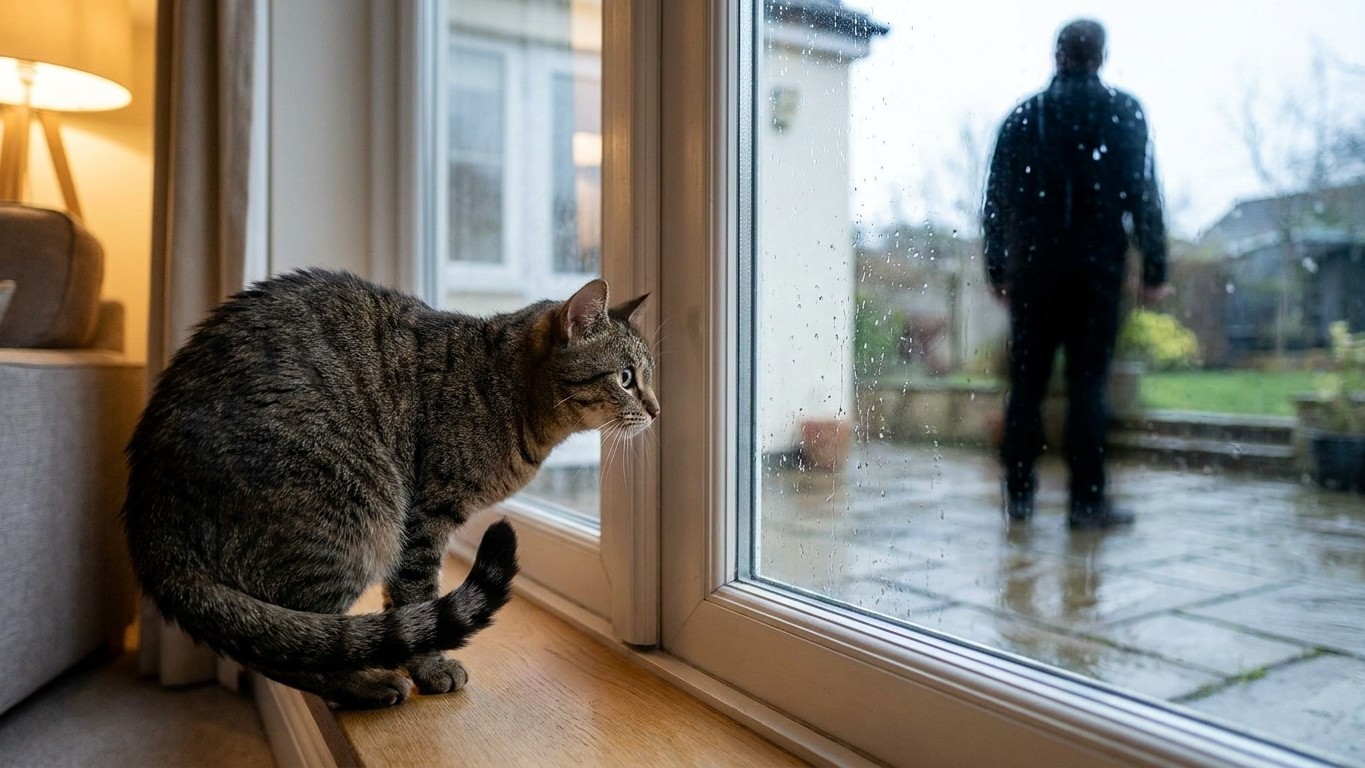
That bite genuinely had nothing to do with you. When a cat is fixated on a stranger, an intruding tomcat, or any threat behind glass, touching him at that exact moment can trigger what behaviourists call redirected aggression, and it’s one of the most common yet misunderstood reasons cats suddenly turn on the people who love them most. Displaced aggression occurs when an animal is fearful or agitated by external stimuli but is unable or unwilling to direct their aggression toward the stimulus, so the aggressor directs it toward whoever is nearest. Your hand just happened to be nearest.
Key takeaways
- A cat fixated on a window intruder enters a physiological state where flight isn’t possible and stress has nowhere to go
- Stroking a tense cat doesn’t calm him down—it registers as part of the threat and makes redirected aggression more likely
- 95% of redirected aggression cases involve loud noises or other animals, and the bite is a stress-release mechanism, not malice
What’s really happening behind those wide eyes
A cat glued to the patio door, pupils blown wide, tail flicking like a metronome gone wrong, isn’t simply curious. He’s stuck in a physiological limbo. Animals have specific responses to deal with threats, namely flight, fight, freeze, and appeasement, and flight takes priority over the others in cats. The trouble starts when flight isn’t an option, because there’s a pane of glass, a locked door, or a lead keeping him rooted to the spot. He can’t run, so his nervous system stays revved with nowhere to send that energy.
Redirected aggression occurs when a cat becomes highly aroused, frightened, frustrated or anxious because of something it can see, hear or smell, but cannot access, escape from or resolve. The stranger on your patio was never in reach. Neither was the neighbour’s cat that sometimes struts across the garden, nor the fox that occasionally trots past at dusk. Picture a cat sitting on a windowsill who sees another cat out on the property; he becomes very agitated, begins to focus on the other cat and shows aggressive body postures, hisses, or growls. The frustration builds with nowhere to go until it simply erupts, and whoever happens to be closest becomes the outlet.
This isn’t rare or freakish. A case-control study examining the medical records of cats diagnosed with this behaviour found that in 95% of the cases, loud noises or interactions with other cats were identified as the inciting event, with aggression most likely directed toward the owner, or toward another cat living in the same household. It’s also worth knowing this pattern shows up far more in our feline companions than in dogs, which says something about how differently the two species process cornered frustration. The behavior is more common in cats than it is in dogs.
Why stroking made it worse, not better
Here’s the uncomfortable bit. The instinct to soothe a tense cat with a gentle stroke makes perfect sense to us, but from a feline nervous system already flooded with stress hormones, that touch can register as part of the threat itself. Animal welfare organisations warn explicitly against this. Don’t pick the cat up or try to calm him down with petting because this may further solidify the cat’s perception of your involvement with the trigger, creating a negative association and potentially making you a casualty of war. Rather brutal phrasing, but accurate. Your hand, at that precise second, became part of the problem in his frazzled brain, not the solution.
There’s an intriguing evolutionary angle here too. Research across other species suggests individuals that redirect their aggression had lower levels of glucocorticoids compared with those that do not, suggesting redirected aggression may be a coping mechanism in stressful situations. lashing out at a nearby target might actually help an animal discharge stress more efficiently than bottling it up. Cold comfort when you’re the target, admittedly, but it reframes the bite as a release valve rather than malice.
When the fangs come out, what actually helps
The moment it happens, resist every urge to scold, restrain, or comfort the cat further. Vets and behaviourists agree on the same first step: distance. Walk away calmly rather than looming closer, and if he needs guiding somewhere safer, herd him gently into a quiet room with dim lighting, water, and a litter tray, then leave him entirely alone. Recovery isn’t instant. It can take anywhere from a few hours to a few days for cats to recover from a redirected aggression episode. Rushing back in to check on him or offer treats too soon can restart the whole cycle.
The bite itself needs proper attention, and not just a dab of antiseptic and a shrug. If someone is bitten, wash the wound and contact a human medical professional because cat bites infect easily. Cats’ teeth are narrow and puncture deep, driving bacteria well below the skin’s surface where infections like Pasteurella can take hold within hours. If you’ve been bitten and the area starts swelling, reddening, or throbbing, get to a GP or minor injuries unit promptly rather than waiting it out.
Once everyone’s settled, do some detective work. Was there genuinely a stranger at the door, or could it have been a sound, a scent on someone’s coat, or another animal you didn’t clock? If bites or deep scratches happen, if episodes are repeated, or if the behaviour seems sudden without a clear trigger, it’s worth scheduling a visit with your vet to rule out pain, neurologic disease, hyperthyroidism, and other medical causes. Redirected aggression that repeats without an obvious spark can sometimes point to something physical rather than purely behavioural, and that’s not a diagnosis to make from your sofa.
Longer term, cutting off the visual trigger tends to work better than any amount of soothing ever could. Frosted window film, closed blinds during peak “patrol hours”, or simply relocating the cat’s favourite perch away from the glass can prevent the arousal spiral before it starts. One detail that surprises most owners: common triggers include seeing another animal through a door or window, or smelling another cat’s scent on a family member, a visitor, or on clothing, meaning your cat might have reacted to your jumper rather than the person standing behind you at all.
Sources : journals.sagepub.com | petmd.com