
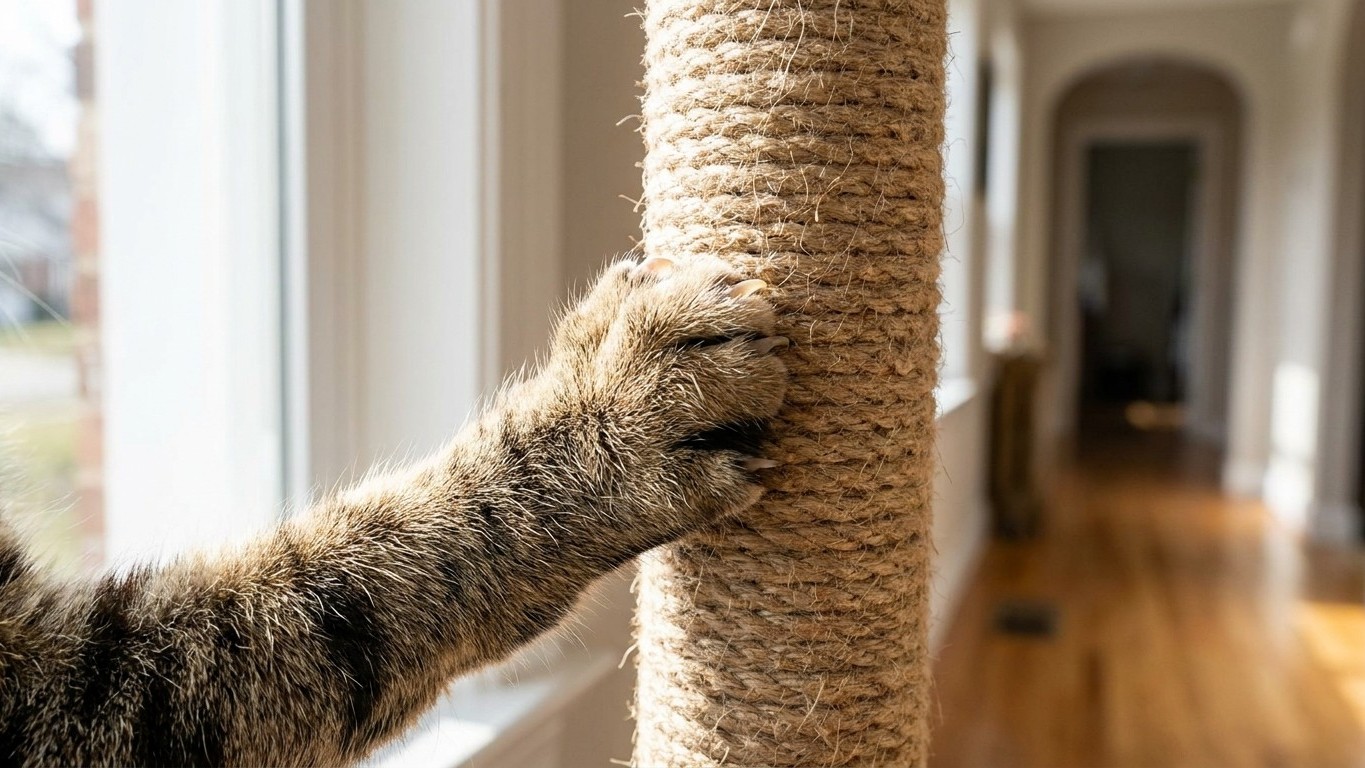
Sofas do not lie. That torn strip of fabric on the arm nearest the doorway is a message, and it reads: “I need to mark this room, and you took away my tool for doing it politely.” Moving a scratching post out of a busy hallway feels like tidying up, but to a cat, it can look like removing a signpost from the exact spot she was using to say this is mine.
Key takeaways
- A scratching post location matters more than owners realize—moving it can trigger unexpected furniture destruction
- Cats mark territory in high-traffic zones for a reason, and the sofa arm becomes Plan B when the original spot disappears
- Multiple strategically placed posts beat one lonely post in an unused room every single time
Why the sofa suddenly became the target
Glands between a cat’s pads mix to produce a chemical message, a combination of pheromones and odours, and when their claws scrape down a surface, that chemical message is deposited, along with a strong visual, chemical and scent signal to other cats. That hallway wasn’t a random choice for the original post. Front halls, doorways and other high-traffic thresholds are prime scratching real estate because they sit at the edge of a cat’s territory, the place where the outside world meets home turf.
Entryways and doorsteps are a location behaviourists often recommend for a scratching post specifically because of territorial marking. Shift that post into a spare room, and the cat doesn’t simply relocate her habit there too. She often finds the nearest available upright surface that’s still close to the zone she originally wanted covered, and nine times out of ten, that’s the sofa arm sitting a few feet from where the post used to live.
Cats scratch to express emotions like excitement or stress, to mark objects with their scent through the glands in their paws, to remove the dead outer layer of their nails and, often, just to get a good stretch. None of that need vanishes because the post has moved house. If anything, a sudden change to a familiar routine can nudge things in the wrong direction. A change of environment, such as introducing new people or pets to the home, can lead a cat to scratch furniture to mark their territory, and the same principle applies to rearranging the furniture itself.
The post wasn’t wrong, the postcode was
It’s tempting to assume a cat that starts attacking the sofa has simply “gone off” her scratching post. Usually the post itself is fine. Cats may prefer the texture, location, or stability of furniture over a scratching post, and location tends to matter far more than owners expect. If a cat has been targeting a certain area in the house, the fix is to place a scratching post in front of the damaged furniture or carpet, not several rooms away from it.
Sleeping spots matter too. Cats often stretch and scratch when they first wake up, so it helps to place a scratching post near a cat’s sleeping area as well as near her main thoroughfares. A spare room she visits once a fortnight simply doesn’t tick either box. Meanwhile the sofa, positioned in the room she lounges in daily, ends up doing double duty as both her bed and her nail bar.
Stability and texture matter almost as much as position. Most cats prefer, even more than furniture, a scratching post that is at least 32 inches tall and won’t wobble when scratched, made of sisal rope. A flimsy post tucked in a corner of an unused room fails on three counts at once: wrong place, possibly wrong height, and easy to topple. A sofa arm, by contrast, is tall, rock solid and upholstered in exactly the kind of textured fabric that gives satisfying purchase.
Getting the scent trail back on side
The good news is that this is entirely fixable, and it doesn’t require confiscating the sofa. Placing a scratching post directly in front of the area being scratched is one of the most reliable ways to redirect the behaviour. That might mean returning the original post to the hallway, or better still, adding a second one right beside the sofa arm itself, at least temporarily, before gradually shifting it a few inches at a time towards a spot you’re happier with.
Encouragement helps speed things along. Running your fingernails over the post can create an intriguing audiovisual demonstration that draws a cat over to inspect and try the scratcher. Catnip, a few treats, or simply praise the moment she uses the right surface all reinforce the message far more effectively than telling her off. That’s not just a nicety, it’s backed by evidence: punishing a cat for natural scratching behaviour is ineffective and counterproductive, and verbal or physical punishment has actually been associated with higher reports of unwanted scratching.
Protecting the sofa in the meantime doesn’t have to mean an ugly plastic cover for months on end. Covering the furniture with double-sided tape or bubble wrap while the new post beds in gives the fabric an unpleasant texture that most cats avoid, without any shouting involved. Feline pheromone sprays, which mimic the scent a cat would leave after scratching, can also take some of the pressure off a spot she’s already claimed, making her less driven to reinforce the mark over and over.
One thing worth remembering: this was never really about disobedience. Multiple posts dotted through the rooms a cat actually uses, rather than one lonely post banished to the spare room, tend to solve the problem for good, because the best approach isn’t to try to stop the scratching but to teach her where and what to scratch, giving her cat-attractive surfaces exactly where she already wants to leave her mark. If claws seem unusually thick, curved or are catching on fabric more than they used to, that’s worth a quick trip to the vet too, since overgrown claws can catch on soft furnishings or even grow into a cat’s pads, and very overgrown or thickened claws can sometimes signal underlying conditions like osteoarthritis or hyperthyroidism. A tidy hallway is a nice bonus. A cat who feels secure enough not to need the sofa isn’t.
Sources : humaneworld.org | cats.com