
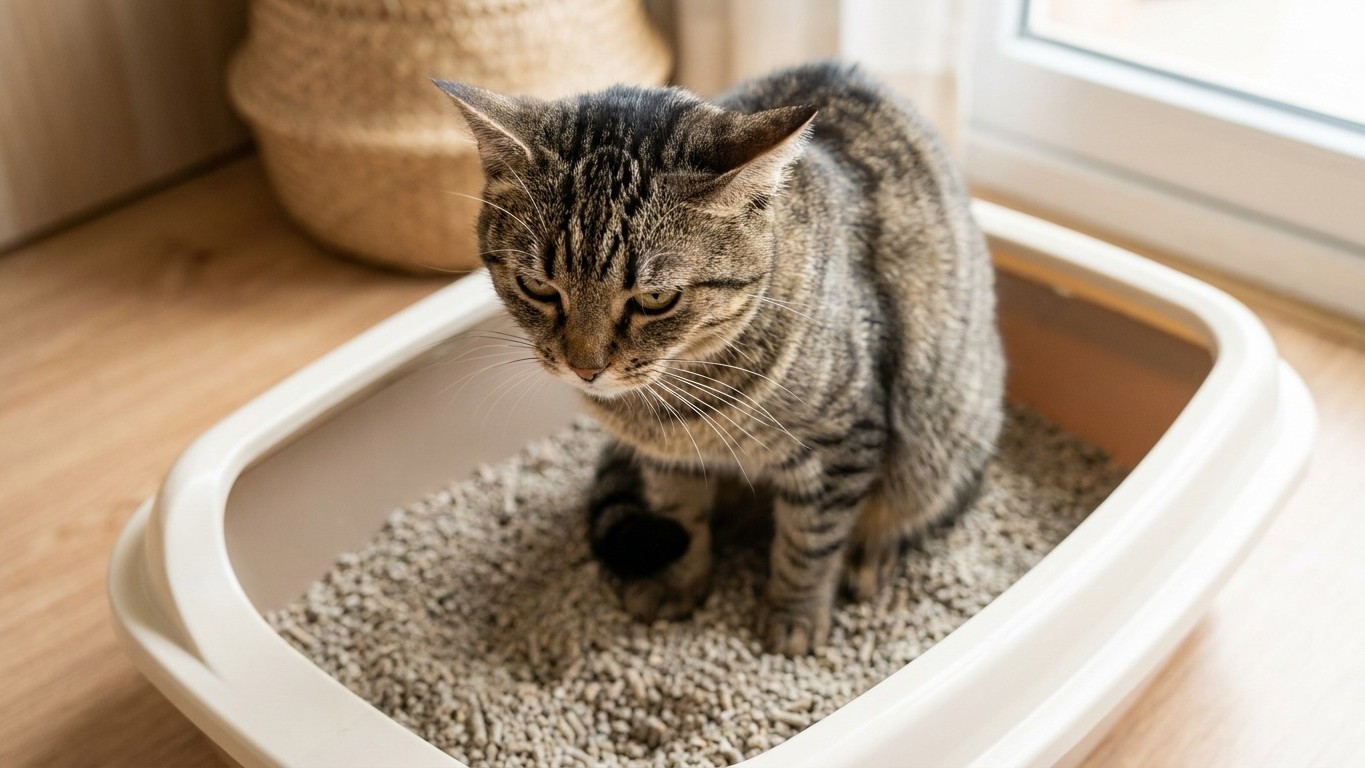
Watch a neutered tom trot to the litter tray six times in an afternoon, hunch for a minute, and produce barely a teaspoon of urine, and it’s tempting to think he’s just fussy about a dirty tray. He isn’t. What you’re seeing is concentrated, mineral-heavy urine sitting in a bladder that’s already inflamed, and in many households the trigger sits right there in the food bowl: standard dry kibble, which typically contains somewhere between 6% and 10% moisture. Cats evolved in dry desert environments and have a naturally low thirst drive, and in the wild they get most of their fluids from prey, whose bodies contain about 70-75% water. Modern dry food contains only about 6-10% moisture, a huge shortfall that many cats simply never make up at the water bowl.
This isn’t a case of “nothing happening” in the litter tray. Something is happening, it’s just invisible to us. Frequent trips with little or no output, straining, or a cat who seems glued to the tray are classic signs of feline lower urinary tract disease, known to vets as FLUTD. Cats with FLUTD show any or all the following clinical signs: urinating outside the litter box, visiting the litter box frequently, straining to urinate, and blood in the urine. Crucially, your cat may also make very frequent trips to the litter box but only pee small amounts at a time. That’s the “nothing” owners describe. It isn’t nothing at all.
Key takeaways
- Why does a neutered male cat make six litter box trips in one afternoon but produce almost nothing each time?
- Dry kibble contains just 8% moisture while wild prey cats evolved eating contains 70-75% water—what happens in the bladder when this gap isn’t filled?
- When does frequent urination shift from a nutrition problem to a genuine emergency requiring immediate vet care?
Why neutered males draw the short straw
Anatomy is unkind to boy cats here, and neutering doesn’t change the plumbing. Male cats, neutered or intact, are at greater risk than females because their urethra is longer and narrower. That narrower channel is far more easily irritated by crystals, mucus plugs or inflammatory debris, and when things go wrong, they go wrong fast. Urethral obstruction is most often found in male cats one to 10 years of age, and it is the most serious cause of FLUTD, potentially life-threatening. A cat’s bladder can feel deceptively normal one evening and be rock-hard by morning.
Vets sometimes describe the difference in how the bladder feels on examination, and it’s a useful mental image for owners too. In a normal cat, the bladder should be small and soft, like a water balloon, but in a cat with FLUTD or FIC it’s often extremely small since the cat has been urinating so frequently, whereas in a blocked cat the bladder will be firm and hard like a baseball, and likely painful on palpation. That baseball bladder is an emergency, not a “wait and see” situation.
What that 8% moisture actually leaves behind
Here’s where the science gets genuinely interesting, and slightly more nuanced than the headline suggests. It isn’t that dry food itself is toxic to the urinary tract. The issue is concentration. Wet food contains 70 to 80 percent moisture compared to dry food’s approximately 10 percent, and for cats with a naturally low thirst drive, this difference has direct implications for urinary health. Less water in, less urine out, and what urine there is becomes a denser soup of minerals, exactly the environment in which struvite and calcium oxalate crystals like to form.
A comprehensive review published in 2026 backs this up with hard numbers. A scoping review by Kosmal et al. analysed 32 publications and found that cats on dry diets have lower total water intake and higher urine specific gravity, suggesting a greater risk of lower urinary tract diseases including crystalluria and urolithiasis. An older but frequently cited British study found something similar in practical terms: Buckley et al. examined the impact of food moisture content on urinary parameters and found that cats fed a diet with 73% moisture had significantly lower urine specific gravity and lower risk of calcium oxalate crystal formation compared to dry food.
Not every vet nutritionist agrees that moisture is the whole story, and I think that’s a fair challenge worth mentioning. Lower urinary tract signs in indoor-housed cats may be more closely associated with cat-related factors than with demographic or environmental factors, so dry food being a risk is more likely a case of correlation rather than causation, since indoor cats eat dry food and their lack of activity is more likely the causative factor than the food itself. Stress, boredom and being cooped up indoors all matter just as much as the kibble bag. Obesity piles on further risk, and neutered cats are notoriously prone to weight gain thanks to slower metabolisms.
Reading the signs, and when to stop watching and start driving
Frequent, small, uncomfortable trips to the tray deserve a same-week vet visit at minimum. But there’s a line beyond which this becomes a genuine emergency, not a nutrition chat. Urethral obstruction is the most serious cause of FLUTD, and is potentially life-threatening; affected cats strain to urinate and produce little or no urine. Owners often mistake this for constipation, since the posture looks similar, but straining in the litter box is more often a sign that the urethra is blocked in male cats than a bowel problem. If your neutered tom is crying out, hiding, vomiting, or straining with genuinely nothing coming out for more than a few hours, this is a call-the-emergency-vet-now situation, not a Monday-morning appointment. Once the urethra becomes completely blocked, urine starts to back up into the kidneys, and toxins accumulate quickly enough to become fatal within a day.
The practical fix is refreshingly unglamorous. Adding wet food to even part of the daily ration, running a pet water fountain (many cats prefer moving water to a static bowl), and placing multiple water stations around the house all nudge total fluid intake upward without any drama. Some owners add a splash of water to kibble itself, which works reasonably well if the cat tolerates the texture change. None of this replaces a proper veterinary work-up though; recurrent litter tray visits, blood-tinged urine, or any sign of straining without output always warrants a vet’s assessment to rule out infection, stones or idiopathic cystitis before you assume diet is the only culprit. One detail that surprises most owners: a cat can look perfectly normal, groom happily, and eat well right up until the moment the urethra fully blocks, so the litter tray, not the food bowl or the cat’s general demeanour, remains the single best early warning system in the house.
Sources : mycatjournal.com | nutritionrvn.com