
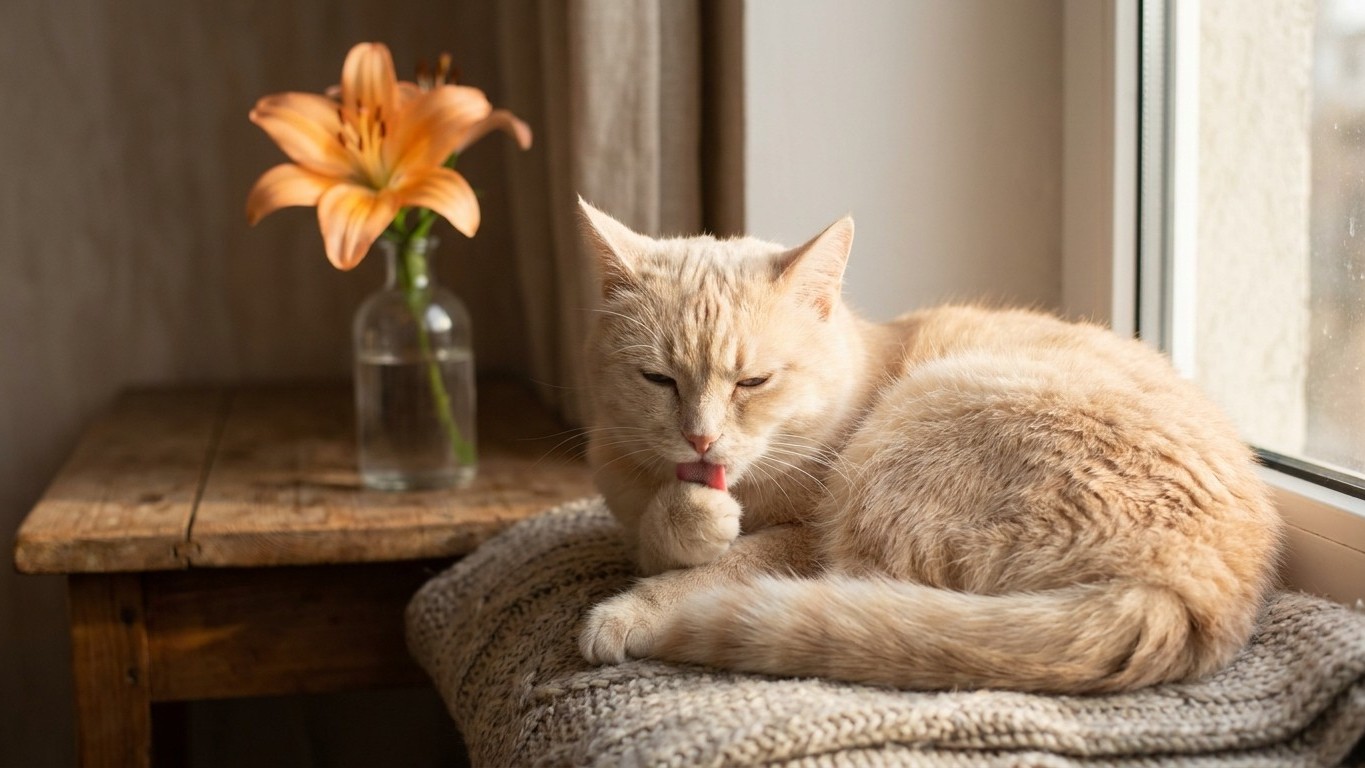
Three days. That’s the gap between a cat brushing against a vase of lilies and the moment its kidneys can shut down completely. If you’ve ever set a fresh bouquet on the kitchen table in high summer, when Oriental lilies like Stargazer and Casablanca are at their most fragrant and widely sold, you’ve unknowingly created one of the most lethal hazards a cat can encounter indoors.
The scenario is almost always the same. A cat wanders past the vase, brushes its whiskers or flank against the open flowers, and picks up a dusting of orange pollen. Later, doing what cats do best, it grooms that pollen straight off its fur and swallows it. Cats are unlikely to eat lilies on purpose, but they can play-bite into petals and leaves or accidentally brush against the pollen-laden stamens, then absent-mindedly lick it off their fur. No drama, no crunching on stems, no obvious “poisoning moment” for an owner to spot. Just a quiet grooming session that sets a countdown running.
Key takeaways
- A cat needs only tiny pollen grains or leaf fragments to trigger fatal kidney damage in less than 72 hours
- The first symptoms seem like a minor illness, creating a dangerous false sense of security before kidney crisis hits
- If your cat has any lily contact, racing to the vet within 2 hours could mean the difference between life and death
A few grains of pollen, one enormous risk
The entire lily plant is toxic: the stem, leaves, flowers, pollen, and even the water in a vase. Eating just a small amount of a leaf or flower petal, licking a few pollen grains off its fur while grooming, or drinking the water from the vase can cause your cat to develop fatal kidney failure in less than 3 days. Read that again: fewer than 72 hours from an amount of exposure so small it wouldn’t register on a kitchen scale.
Not every plant sold under the “lily” banner carries this risk. All members of the plant genus Lilium produce a chemical that is present in all parts of the plant that can damage cat kidneys. However, Easter lilies (Lilium longiflorum), Stargazer lilies (Lilium ‘Stargazer’ hybrid), and Asiatic lilies (Lilium asiaticum) seem to be the most hazardous. Daylilies belong to a different genus, Hemerocallis, but they’re every bit as dangerous. Daylilies, which are in the genus Hemerocallis, are also toxic to cats and can cause kidney failure.
Confusingly, plenty of flowers wear the lily name without deserving the same fear. Despite having “lily” in their name, the peace lily and calla lily are not true lilies and do not cause kidney failure in cats. These plants do, however, contain oxalate crystals that can cause milder signs, such as irritation in the mouth, tongue, throat, and esophagus and vomiting. Lily-of-the-valley is a different beast entirely: it contains toxins that cause the heart to beat abnormally, and this abnormal heart rhythm can be life-threatening. None of that makes it safe to relax around your bouquet, mind. It just means the danger takes a different shape.
The clock nobody hears ticking
What makes lily poisoning so cruel is the lull between exposure and catastrophe. Early signs of lily toxicity in cats include decreased activity level, drooling, vomiting, and loss of appetite, starting 0 to 12 hours after ingestion. A tired, off-colour cat on day one looks like a hundred other minor upsets. Some owners even see a brief false recovery. Although an affected cat is likely to remain depressed, the patient may appear to improve, briefly (with or without symptomatic treatment) as the gastrointestinal signs abate.
Then the kidneys start failing in earnest. Signs of kidney damage start about 12 to 24 hours after ingestion and include increased urination and dehydration. By the time three days have passed, untreated cats are often in crisis. If untreated, cats die in three to seven days. That’s the brutal maths behind the title of this piece: the flowers go on the table for their scent on day one, and by day three the vet is delivering the worst possible explanation for a suddenly desperately sick cat.
There’s no shortcut once the toxin is in the bloodstream. There is no antidote for lily poisoning in cats; if it’s detected early, your vet can provide supportive care to manage symptoms and provide your cat with the best chance of recovery. Treatment within the first couple of hours gives the best odds, largely because vets can still try to limit how much toxin the body absorbs. If the ingestion is witnessed and the cat receives medical attention within 2 hours of ingestion, treatment focuses on gastrointestinal decontamination via induced vomiting. After that window closes, it’s a race to protect the kidneys with fluids rather than remove the poison itself.
What a vet actually does, and why speed matters so much
A cat that arrives promptly usually gets a multi-pronged response. This may include emptying their stomach (by making them vomit), giving activated charcoal to prevent further absorption of toxins, cleaning any lily pollen off their coat, and placing them on a drip to flush out the toxins in the bloodstream and support your cat’s kidneys. That drip isn’t a token gesture. Aggressive intravenous fluids, sustained for days rather than hours, are the single intervention shown to protect kidney tissue while the body clears whatever toxin is circulating.
The honest, sobering statistic every cat owner should know is this: fewer than 50% of cats will survive once symptoms of lily poisoning progress to kidney damage. That’s not a scare tactic, it’s simply what happens once tubular cells in the kidney start dying off faster than they can regenerate. Cats who reach a vet before symptoms even begin have dramatically better odds than those who arrive once vomiting and lethargy have already set in.
If you’ve had lilies in the house and even suspect contact, don’t wait for symptoms. Your vet will make a diagnosis based on the Signs Your Cat Is showing and their history of exposure to lilies, take blood tests, and on examination, they may find that your cat’s kidneys are enlarged and painful. Telling the vet exactly what species of flower was in the house, and roughly when contact happened, matters enormously for how they triage the case.
The safest bouquet is the one without lilies in it
Marketing sometimes muddies the water here. Pollen-free lily varieties are sold as a cat-friendly compromise, but the claim doesn’t hold up. Pollen-free lilies are often marketed as a ‘safe’ option for cat owners. However, as all parts of the lily are toxic, not just the pollen, a pollen-free lily will not be safe for cats, and the advice for cat owners to avoid lilies remains the same. Stems, leaves, petals and vase water all carry the toxin, whether or not the anthers have been stripped out at the flower shop.
If a friend hands you a lily arrangement as a gift, the kindest thing you can do for your cat is bin it, or swap it for something safer, rather than trying to keep it “out of reach”. Cats are climbers, jumpers and counter-surfers by nature, and a single stray pollen grain on a paw is all it takes to start that three-day clock running.