
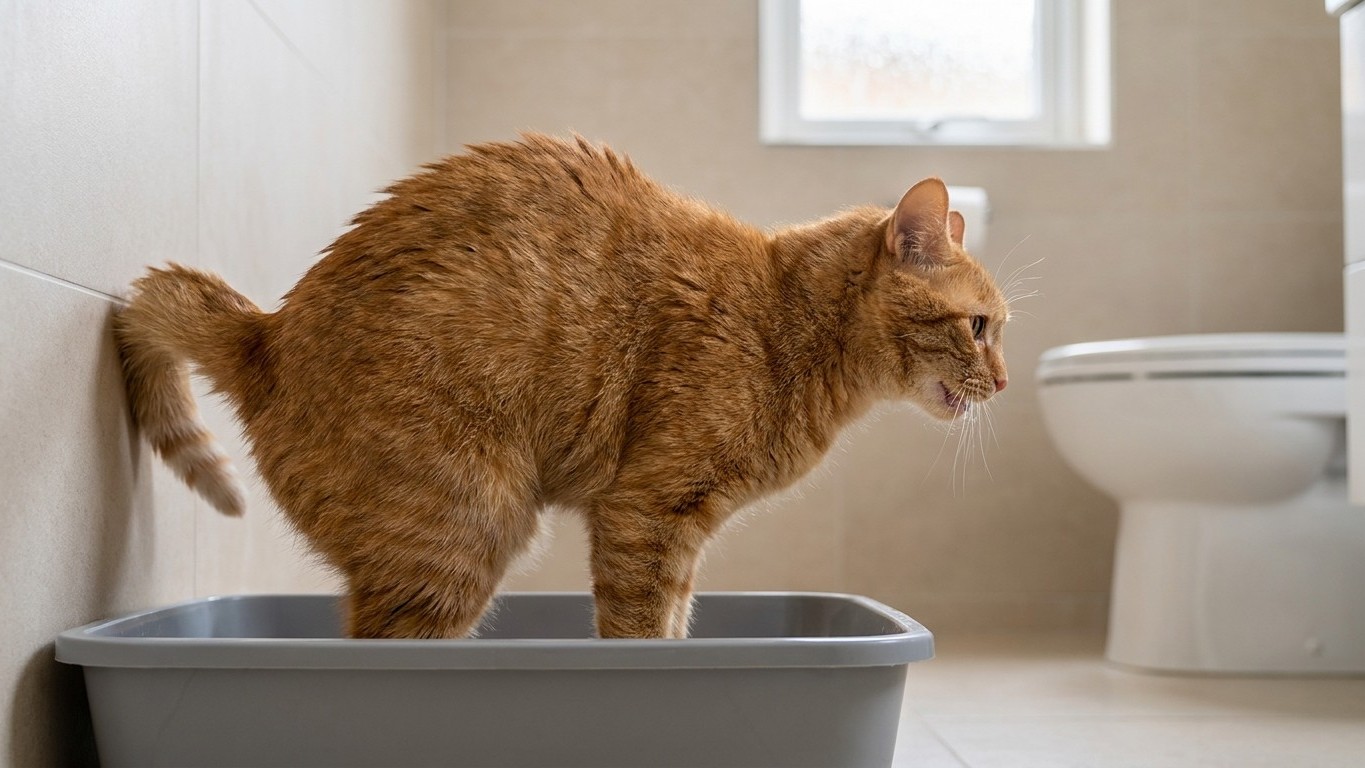
A cat who strains in the litter tray and produces nothing, or just a dribble, isn’t being fussy or moody. He’s very possibly blocked, and that’s one of the few genuine feline emergencies where the clock Matters More Than almost anything else in veterinary medicine. It most commonly affects male cats and can lead to kidney failure, heart abnormalities, or death within 24–48 hours if not treated immediately. The “he’s sulking” theory is exactly the trap owners fall into, and vets know it well.
Signs of urethral obstruction may not be recognisable to many pet owners until the condition is quite advanced, with early indicators including increased vocalisation, frequent trips to the litter box, licking at the hind end, or straining unproductively, which owners often mistake for a urinary tract infection, cystitis, or constipation, delaying veterinary attention. I’ve heard the phrase “he’s just sulking after the holidays” more than once from worried readers, usually after Christmas or a house move disrupted the household routine. It’s an understandable mistake. A cat crouched awkwardly over the tray, visiting again and again, looks a lot like a grumpy animal making a point. It isn’t.
Key takeaways
- A cat straining in the litter box with little output could be blocked—and the clock is ticking in ways owners rarely realize
- Male cats face this crisis far more than females due to their longer, narrower urethra, and one study found 100% of confirmed full obstructions occurred in males
- The real culprit isn’t usually stones—it’s stress-triggered inflammation from idiopathic cystitis, which can swell and plug that narrow male anatomy completely
Why male anatomy makes this so dangerous
The reason this problem lands so disproportionately on toms comes down to plumbing. Male cats are more vulnerable to urethral obstruction in part because their urethra is longer and narrower than in females. Mineral crystals, mucus plugs, or small stones that a female cat would pass without drama can lodge in that narrow channel and stop urine flow completely. Urinary blockage occurs most commonly in male cats because the male urethra is skinnier than the female one and more prone to blockage. A hospital study from the Czech Republic examined 214 cats with signs of feline lower urinary tract disease and found that of the 114 cases where a full obstruction was confirmed, every single one was exclusively males. That’s not a small skew. It’s about as close to an absolute rule as veterinary statistics get.
Once the urethra is fully blocked, the bladder can’t empty, and the consequences cascade fast. Potassium builds up in the blood because the kidneys can no longer excrete it properly, and that potassium interferes directly with the heart’s electrical rhythm. Early changes include peaked T waves, a shortened QT interval, and ST segment depression, progressing to bundle-branch blocks and, in late stages, disappearance of the P wave, a widened QRS, and ventricular fibrillation or asystole. That’s the grim mechanical reality behind why a cat who seemed merely uncomfortable at breakfast can collapse by teatime.
What’s actually blocking him, and why stress matters
Owners often assume bladder stones are the culprit, but the numbers tell a different story. Feline idiopathic cystitis is the most common cause of FLUTD in cats, causing around 60 to 70% of cases, according to Cats Protection. Stones and crystals, by contrast, account for a much smaller slice: urinary crystals and bladder stones make up 10-15% of FLUTD cases, commonly magnesium ammonium phosphate (struvite) and calcium oxalate. Idiopathic cystitis, frustratingly, has no single identifiable trigger, but stress and lifestyle are believed to play an important role in many cases of FLUTD. A new cat introduced to the household, building work, a change in litter brand, even rearranging the furniture, any of these can tip a predisposed male cat into a flare-up. The inflammation this causes can produce enough debris and swelling to plug that narrow male urethra completely, which is why a condition with “no known cause” can still turn into a life-threatening mechanical blockage within hours.
Overall, FLUTD isn’t rare. It is common in adult cats, affecting from 0.5% to 1% of the population. Among the cats who do get it, males are more prone to problems related to obstructions due to their long, narrow urethra. A Thai teaching hospital study similarly found that FLUTD was most likely to be diagnosed in castrated male cats, adding weight to the idea that neutered toms in particular deserve close watching for litter tray changes.
What happens at the vet, and what it costs to wait
A blocked cat needs sedation or anaesthesia so a vet can pass a catheter and clear the obstruction. Cats with urinary obstruction require emergency treatment, with sedation or general anaesthesia needed in all but the sickest patients to allow placement of a catheter into the urethra to flush out the plug or force the stone into the bladder. Bloodwork and often an ECG follow, since an extended database checking electrolytes and blood gas, alongside potential findings of metabolic acidosis, hyperkalaemia, and azotemia, guide urgent treatment. Most cats then need a catheter left in place for a day or two. Patients with metabolic abnormalities or a difficult obstruction typically need a urinary catheter to remain in place for 24 to 48 hours, or until urine appears normal.
This isn’t a cheap fix, either. A University of Florida trial looking at treatment costs noted that the current standard of care, hospitalising cats with an indwelling urinary catheter for 1 to 2 days with intravenous fluids, costs approximately $2,000 with no complications. Cats who block repeatedly may eventually need surgery. Perineal urethrostomy widens the urethral opening to reduce future blockages and is recommended for cats with chronic urinary obstructions.
What to actually do if you spot the signs
Watch for the cluster that matters: repeated trips to the tray with little or nothing produced, crying out, licking at the back end, sudden lethargy, or vomiting. None of these are subtle once you know to look, but they’re easy to miss on a busy day. If your male cat shows any of them, don’t wait for the morning surgery slot. If treated quickly and with aggressive medical care the prognosis is good, but if left untreated it can be fatal in as little as 24 hours. Call an emergency vet line straight away rather than a next-day appointment.
Once he’s recovered, prevention becomes the priority, particularly since urinary tract disorders have a high rate of recurrence, and some cats seem to be more susceptible to urinary problems than others. Practical changes make a genuine difference: more wet food to boost water intake, a pheromone diffuser or extra hiding spots to dial down household stress, and keeping him at a healthy weight. One detail worth remembering, and one that surprises a lot of owners, is that a cat who’s blocked for the second time often shows far more obvious pain than the first time round. That’s not him being dramatic. It’s his body telling you, loudly, that the tray is not the place for wait-and-see.
Sources : fvpetemergency.com | avma.org