
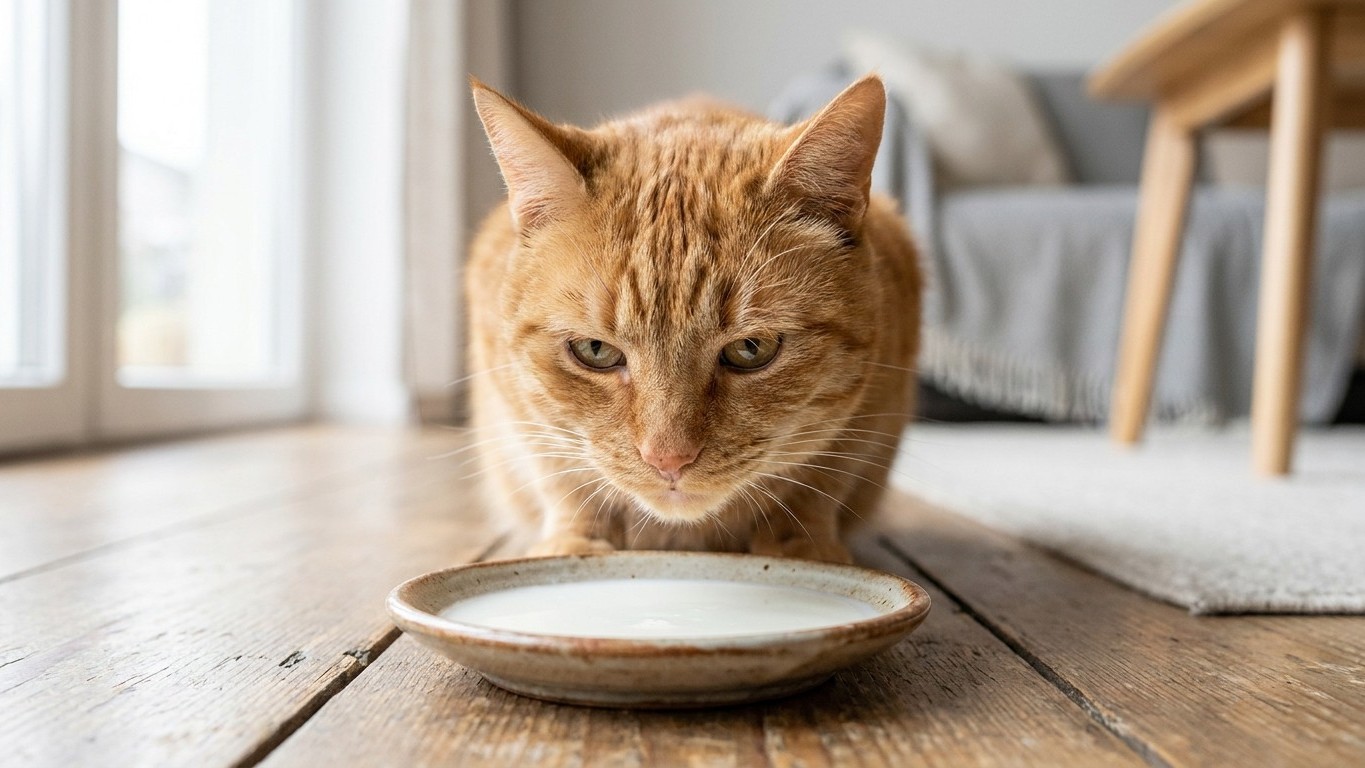
That saucer of milk might feel like the ultimate feline treat, the sort of thing cartoon cats have been lapping up for decades. But most adult cats simply cannot process it properly, and the reason lies in a piece of biology that catches almost every cat owner off guard: they stop producing the enzyme needed to break it down.
Cats.org.uk, the UK’s largest feline welfare charity, puts it plainly: the surprising truth is that most cats are actually lactose intolerant, meaning milk and other dairy products can cause digestive issues for your cat. It’s not a fussy quirk or an allergy in the traditional sense. It’s a straightforward case of missing machinery in the gut.
Key takeaways
- Kittens produce lactase, but cats lose this enzyme by their first birthday—yet owners keep offering milk
- Undigested lactose becomes a bacterial buffet in the colon, triggering bloating, gas, and delayed diarrhea 8-12 hours later
- Fresh water and lactose-free alternatives are safer—but most cat owners have no idea their ‘treat’ is causing harm
Why kittens can drink milk but adults can’t
Every kitten arrives in the world fully equipped to digest their mother’s milk. Kittens produce lots of lactase because they need it to digest their mother’s milk, but as cats grow and transition to solid food, their bodies produce less lactase. That enzyme, lactase, is the only tool the body has for splitting the milk sugar lactose into pieces small enough to absorb through the gut wall.
Once weaning happens, nature essentially switches the tap off. There’s a nutrition expert quoted by WebMD who frames it rather neatly: Linda P. Case, an adjunct assistant professor at the University of Illinois College of Veterinary Medicine, notes that “the only time animals are exposed to lactose is when they’re babies — in their mother’s milk.” Cats simply weren’t built by evolution to keep drinking milk once they’ve moved onto meat, so the body stops wasting energy manufacturing an enzyme it no longer needs.
A study referenced by veterinary sources found something worth remembering if you’ve got a young cat at home: most adult cats stop producing lactase by the time they’re a year old. So that gorgeous ginger tom who happily necked a bowl of milk as a six-month-old kitten might genuinely struggle with the exact same treat by his first birthday.
What actually happens inside the gut
Here’s the bit that surprised me most when a vet walked me through it. Undigested lactose doesn’t just sit harmlessly in the stomach. If an adult cat consumes milk or dairy products, the lactose does not break down and enter the bloodstream in the small intestine but continues unchanged into the large intestine. Once it reaches the colon, it becomes an all-you-can-eat buffet for resident bacteria.
Those bacteria ferment the sugar, and the fermentation process drags water into the bowel while producing gas as a by-product. Sources citing Cornell University’s veterinary college describe it directly: the undigested lactose passes through the intestinal tract, drawing water with it, while bacteria in the colon also ferment the undigested sugars, producing volatile fatty acids. That combination, extra water plus fermentation gas, is precisely what triggers the bloating, cramping and diarrhoea that catch owners off guard hours after the “treat.”
Timing matters here, and it’s genuinely unexpected. This isn’t an instant reaction. According to pet health sources, this often leads to gastrointestinal upset and diarrhoea about 8 to 12 hours later. So if your cat has an accident overnight or seems off the next morning, that innocent bowl from teatime the evening before could easily be the culprit, and most owners never make the connection.
It’s also worth knowing this isn’t an all-or-nothing switch across the species. Genetics plays a real role in how severely any individual cat reacts. As one Veterinary-reviewed resource explains, it is purely because of their genetics that cats don’t produce lactose enzymes in their small intestine, and severity may vary from breed to breed as some breeds can be more intolerant to milk than others. A handful of cats genuinely tolerate small amounts without fuss, but as Chewy’s veterinary content puts it, some cats retain the ability to tolerate milk well, but they’re the exception, not the rule.
So what should go in the bowl instead
Fresh water remains, unglamorously, the correct answer. Cats.org.uk is unambiguous on this: the best thing for adult cats to drink is water. No fermentation, no fuss, no 3am dash to check the litter tray.
If you still fancy spoiling your cat with something a bit special, there are gentler routes than the dairy aisle. Specially formulated cat milks exist precisely because ordinary cow’s milk is the problem, not milk-flavoured treats generally; these products are lactose-free or have significantly reduced lactose content plus essential cat nutrients, making them safe for cats, though they’re still best kept as an occasional indulgence rather than a daily habit. A splash of low-sodium chicken broth or the water from a tin of tuna (never brine, and never anything containing onion or garlic, which are toxic to cats) tends to go down just as well and skips the gut drama entirely.
If your cat has already had a milky mishap and you’re seeing loose stools, don’t panic straight away. Cats.org.uk recommends a simple recovery approach: feed them small, bland, frequent meals, which could include boiled chicken or white fish, making sure any bones or skin are removed. Should the diarrhoea persist beyond a day or two, or if your cat seems lethargic, stops eating, or shows signs of dehydration, that’s your cue to ring the vet rather than wait it out.
One genuinely odd detail worth knowing: it’s not actually the fat in milk drawing cats to the bowl in the first place, it’s the smell. Cats have a famously average sense of taste but a formidable nose, and researchers suspect the likely reason cats are drawn to yogurt and milk is that they smell the fats and proteins, with a heightened sense of smell making up for their less sensitive taste reception. Your cat isn’t chasing a flavour memory so much as following her nose straight into a stomach ache.
Sources : petplace.com | askavet.com