
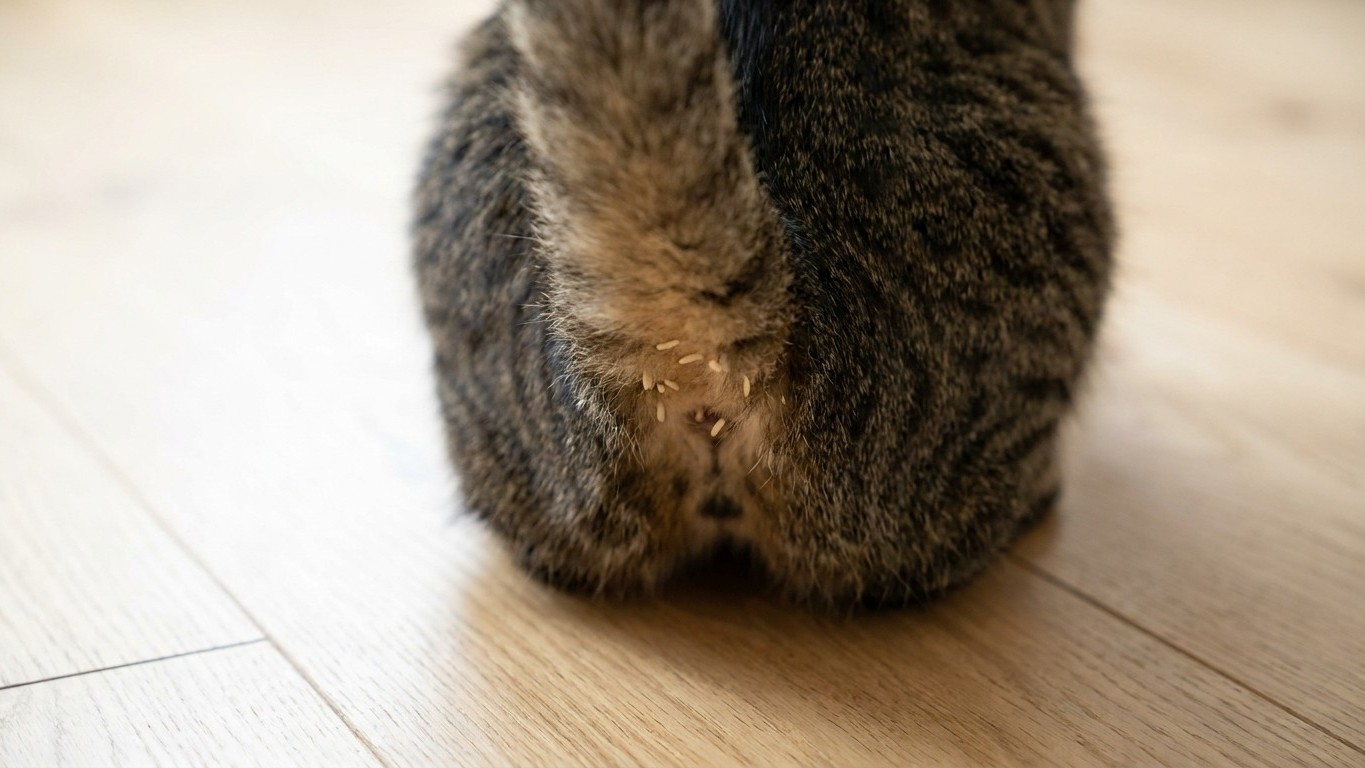
Those tiny cream-coloured specks stuck to the fur under your cat’s tail are not dried litter, and they’re not a grooming mishap either. They’re tapeworm segments, called proglottids, and each one is a walking parcel of parasite eggs that has just crawled its way out of your cat’s back passage. Spotting them is actually useful, because it’s often the only outward clue that a tapeworm infestation is happening inside your cat’s gut.
Key takeaways
- What looks like rice pudding stuck to your cat’s fur is actually something far more sinister moving around
- Even indoor cats aren’t safe from this parasite, and the culprit is hiding in your home right now
- One overlooked detail during treatment means your cat could be reinfected within weeks
What you’re actually looking at
The segments look like grains of rice or cucumber seeds and are about ½-inch (12 mm) long and about ⅛-inch (3 mm) wide. Fresh ones aren’t dry and brittle at all. Sometimes several tapeworm segments will be stuck together end-to-end, and as they dry out, they become harder and more yellow than white. That’s the giveaway that fools so many owners into thinking they’ve just found stray bits of rice pudding or old litter granules clinging to the fur.
Here’s the bit that genuinely surprises people: those segments can still move. Occasionally, proglottids can be seen moving on the hairs around the anus, or more commonly, on the surface of freshly passed faeces. Each little segment is essentially a self-contained egg sac. As a proglottid dries, it becomes a golden colour and eventually breaks open, releasing the fertilised eggs into the environment, and a single proglottid may contain as many as 20 tapeworm eggs. Your cat’s bedding, favourite blanket or sofa cushion can end up seeded with dozens of eggs from just one segment.
How on earth did an indoor cat catch this?
The most common culprit by far is the flea. Cats get these tapeworms when they eat fleas containing immature forms of the parasite, usually when they are self-grooming in an attempt to rid themselves of fleas. It’s a peculiar little life cycle: the flea larva eats tapeworm eggs from the environment, the flea grows up carrying the parasite inside it, and then your cat swallows the infected flea while having a wash. No biting required from the cat’s end, no dramatic symptoms at the point of infection. It just happens quietly, one grooming session at a time.
This is precisely why strictly indoor cats aren’t safe from tapeworms either. Fleas can enter on human clothing, visitors’ pets, shared corridors, and even through small gaps, or they arrive on a newly adopted cat or dog. A cat that has never set paw outside can still pick up an infected flea from the hallway carpet or a visiting dog. Outdoor cats have a second route in, too, through hunting: eating an infected rodent passes on a different tapeworm species entirely. Either way, once the parasite reaches the gut it attaches itself with hooks and suckers and starts shedding segments within a few weeks.
Why you shouldn’t just shrug it off
The reassuring news first: this isn’t usually a medical emergency. Other than the presence of proglottids, most cats with tapeworms don’t have many other symptoms. Many affected cats eat, play and sleep exactly as normal, which is part of why the condition goes unnoticed for so long in some households. But “rarely serious” doesn’t mean “ignore it”. If your cat has tapeworms, you might see worm segments crawling around their bottom, and while worms rarely cause serious problems in adult cats, they can cause serious dehydration, anaemia, gut blockages and even death in kittens. A kitten’s small body simply can’t absorb the same hit to its nutrition that an adult cat can shrug off.
Watch for the secondary clues too. Cats with tapeworms often scoot their bottom along the carpet or lick and nibble at the area obsessively, trying to dislodge the irritation those wriggling segments cause. In rare cases, intestinal blockage can occur if there are a large amount of tapeworms present, though this is genuinely uncommon. There’s also a human angle worth knowing about: some tapeworm species can spread to humans, and since it is difficult to tell the species without a PCR test, it is important to limit contact with the tapeworm segments. Small children who share a bed with the family cat are the ones most at risk, so wash hands after handling bedding or scooping the litter tray.
Sorting it out, and stopping it coming back
Treatment itself is refreshingly simple. Treating tapeworms in cats is fairly straightforward, and most veterinarians will recommend a medication called praziquantel. It works by dissolving the worm from the inside, meaning you’re unlikely to see any dead worms passed afterwards, which understandably worries some owners who expect a dramatic result. Your vet may prescribe it as a tablet, spot-on treatment or injection depending on how cooperative your cat is about being pilled.
The catch, and it’s an important one, is that deworming alone doesn’t fix the root cause. Tapeworm treatment doesn’t protect against future infections, so prevention is key, and it’s not unusual for a cat to be treated for tapeworms, then immediately be reinfected. If fleas are still hopping around your home, your cat will simply pick the parasite straight back up. That means treating every pet in the household for fleas simultaneously, washing bedding on a hot cycle, and vacuuming skirting boards and sofa crevices where flea eggs like to hide. Kittens should have their first worming treatment at 3 weeks old and after that, be wormed every two weeks until they are 16 weeks old, and after 16 weeks, they will need a treatment every three to six months. For adult cats, a routine treatment every few months, paired with year-round flea prevention, keeps this whole unpleasant cycle firmly out of your cat’s gut, and off your sofa cushions.
Sources : dialavet.com | dialavet.com