
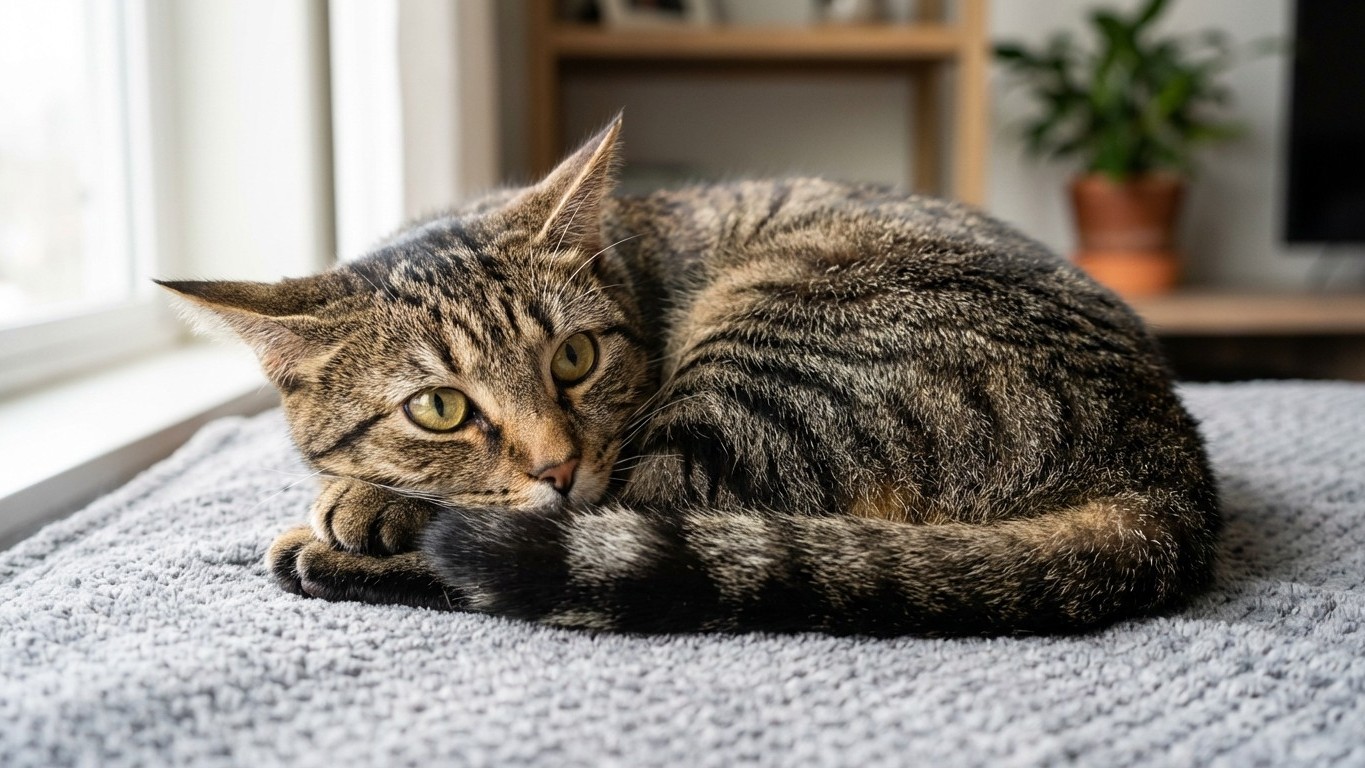
Most cat owners believe they can read their pet reasonably well. They know the chirp at the window, the slow blink from the sofa, the imperious stare that demands breakfast five Minutes early. But the tail? That’s where even the most devoted cat owner tends to go badly wrong. Behaviourists see it constantly: a cat sitting calmly, tail wrapped around its body like a fluffy scarf, and an owner who smiles and says, “She loves it when I stroke her.” She almost certainly does not.
Key takeaways
- There’s one tail position almost every cat owner gets dangerously wrong
- What looks calm and composed is actually your cat signaling fear or pain
- Dog owners especially struggle because we learned the opposite lesson from our previous pets
The tail position that tricks almost everyone
The culprit is the tucked or tightly wrapped tail. When a cat is sitting or lying down with their tail wrapped around their body, they are frightened, defensive, in pain, or feeling unwell. It looks tidy. Neat, even. It has none of the drama of a puffed-up bottlebrush tail or the obvious aggression of a rapid lash. And that, precisely, is the problem. Because it reads to us as composed, settled, content, when the cat is Actually trying to make itself as small and unthreatening as possible.
When a cat tucks their tail under their body or wraps it around themselves, this can be a sign of uncertainty that may indicate feelings of fear and submission, especially when this tail Position is accompanied with wide eyes, dilated pupils, and flattened ears. Combine a wrapped tail with a slightly hunched posture and you have an animal that is quietly miserable, and, if you keep stroking it, one that is building up to a scratch or a bite that will feel completely unannounced. It isn’t. The announcement has been there the whole time, in the tail.
What makes this particular signal so easy to miss is that it looks like the opposite of the classic stress poses we’ve been taught. A tail resembling a pipe cleaner reflects a severely agitated, stressed, and frightened cat trying to look bigger to ward off danger. That one we recognise. A Halloween cat, arched back, puffed tail, is unmistakable. But the quiet, self-contained wrap? It barely registers. A third of people struggle to recognise signs of an unhappy cat. Cats can be subtle, and their distress may not always be obvious.
The dog-wag problem (and why it ruins everything)
A huge part of the confusion comes down to dogs. Tail wagging in dogs is generally thought of as friendly, but the equivalent movement in cats is not. We grow up associating tail movement with joy, and we carry that assumption straight into our relationship with cats, where it causes endless misreads. If you’ve spent any time around a cat who is wagging, waving, or thrashing their tail with rapid and jerky motions, they’re channelling agitation and frustration. Cats who are swishing or lashing their tails left to right are indicating that they are to some degree conflicted, stressed, anxious, or upset.
Research backs this up rather neatly. Cats displayed more tail wagging when a human experimenter did not engage in communication with them. Lateral tail movements tend to occur when cats are facing a frustrating situation, suggesting that being in a room with an unfamiliar human ignoring them might be uncomfortable for cats, if not frustrating. So even the apparently passive swish is less likely to mean daydreaming and more likely to mean something is off. No wonder owners get confused.
Cats use their tail movements, along with their eyes, ears, and body postures, to communicate. The tail is never working alone. It’s part of a whole-body broadcast that, once you know how to tune in, becomes almost impossible to miss.
What a happy tail actually looks like
Here’s the reassuring side of all this. Once you know the distress signals, the genuinely positive ones become just as clear. When your cat holds their tail high in the air as they move about their territory, they’re expressing confidence and contentment. A tail that sticks straight up signals happiness and a willingness to be friendly. A very slight quiver at the tip when they trot towards you? That’s essentially the feline equivalent of a beaming grin. The tail quiver is quite possibly the cutest tail action, as it means they’re excited to see you. Your cat will approach you with their tail high in the air and the tip will do a little quivering movement.
The question-mark tail, that elegant hook at the top of an upright tail, is another green light. If your cat bends their tail into the shape of a hook or question mark, this is a very positive sign. According to veterinary behaviourists, the “question mark tail” is a pro-social behaviour, it’s like walking up to another person with a huge smile on your face and your arms open wide. Meet it with a gentle chin scratch and you’re responding exactly as they hoped.
Context matters enormously, too. A cat who is standing up with their tail curled around their body may not be feeling comfortable, because keeping their tail close can be a sign of fear. However, if your cat is lying down, they might curl their tail close to them to relax. The same position, two completely different messages, which is why watching the whole cat, not just the tail, is always the more reliable approach.
Responding well, and knowing when to step back
When you see a cat sitting with its tail wrapped tightly around their body, end your interaction with them and ensure that your cat’s environment is free of stressors. If your cat frequently crouches with their tail curled tightly around their body for more than a few days, an evaluation by your veterinarian is warranted to rule out pain or illness. That last point is worth holding onto. Chronic tail-wrapping can be a sign of chronic discomfort, physical, not just emotional, and is always worth raising with a vet if it becomes a regular pattern.
The practical shift here is small but powerful. When looking at cat body language, the key things are body posture, movement, ears, eyes, tail, and whiskers, and you should always look at the cat as a whole and take into account the context. Stop at the tail and you’ll miss half the story. Watch the ears (forward is curious, flattened is alarmed), the eyes (slow blinking is trust, wide dilated pupils during petting is a warning), and the overall posture. Dilated pupils can indicate a cat is stressed, as can a tail flicking from side to side or wrapped tightly down or around the body.
Most reported cat bites are the result of defensive responses to human provocation or mishandling, with one study finding that aggression towards humans functioned to enable escape from petting. These findings indicate that guardian education around handling and interacting with cats may be Critical for minimising human injuries and cat distress. In short: learning to read the tail properly is not just an exercise in curiosity. It’s one of the kindest things you can do for an animal that has been trying, patiently and consistently, to tell you exactly how it feels.
The question worth sitting with is this: how many moments of what we called contentment were actually moments of quiet endurance? And now that you know, what will you do differently next time you reach out for a stroke?