
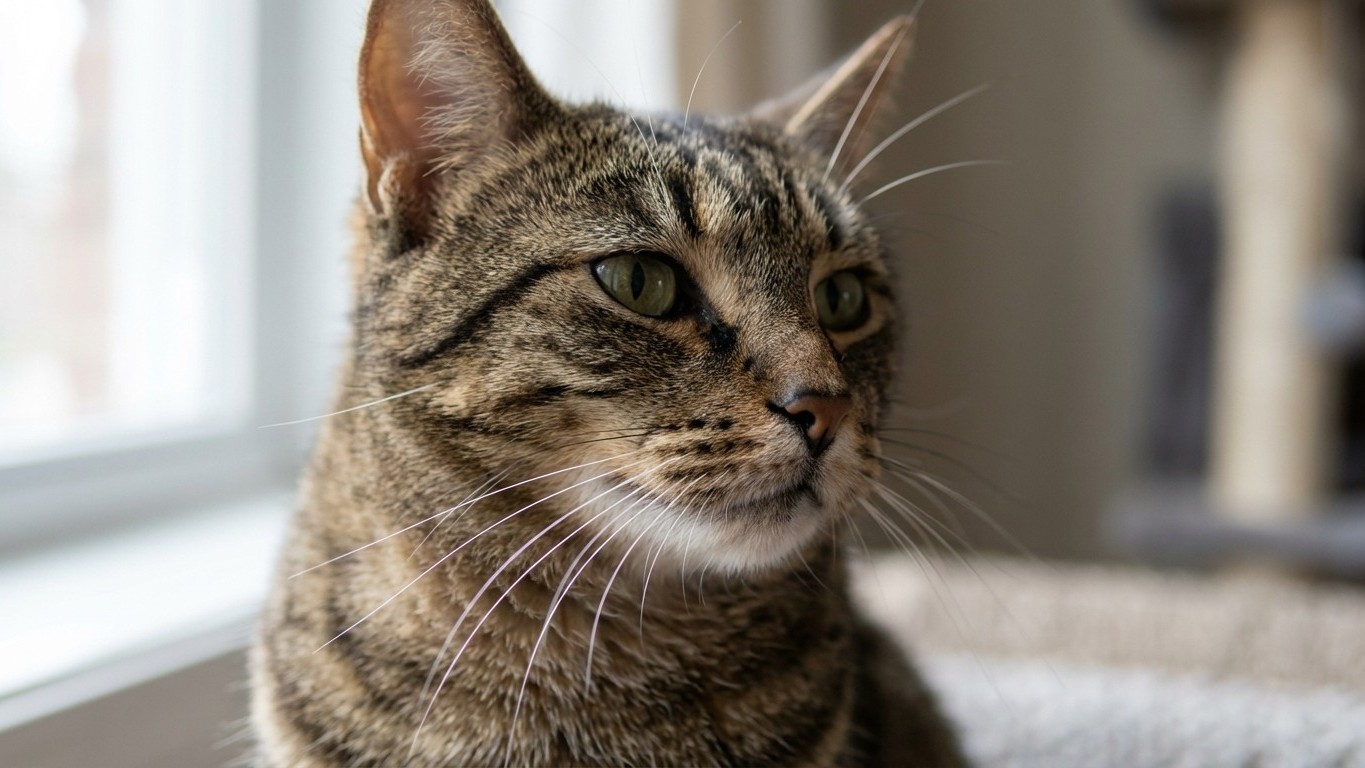
Those fine, almost invisible hairs scattered across your cat’s muzzle, above their eyes and even on their legs are doing far more than decorating their face. Whiskers, or vibrissae as scientists call them, are sophisticated sensory instruments that give cats a near-constant stream of information about the world around them. Lose them, and a cat would genuinely struggle to navigate even the most familiar room at night.
Key takeaways
- Whiskers aren’t just for measuring gaps—they detect vibrations, air currents, and pressure changes with extraordinary sensitivity
- In the dark, whiskers essentially take over from eyes, creating a real-time spatial map that helps cats hunt and navigate
- Cutting whiskers or pressing them against a cat’s face causes genuine discomfort and disorientation
More than just long hairs
The common assumption is that whiskers help cats measure whether they can fit through a gap. That’s true, but it’s the least interesting thing they do. Each whisker is rooted about three times deeper than a regular coat hair, embedded in a follicle packed with blood vessels and nerve endings. The technical name, vibrissae, comes from the Latin vibrio, meaning to vibrate, and that etymology tells you everything. These hairs aren’t passive; they pick up vibrations, air currents, and pressure changes with extraordinary sensitivity.
A cat’s whiskers are roughly as wide as its body, which does help with those famous gap-measuring moments. But the real magic happens through something called proprioception. Tiny muscles at the base of each whisker can move the hairs independently, fanning them forward when a cat is curious or investigating prey, and flattening them back when frightened or defensive. You can Actually read your cat’s mood by watching this movement, which is one of those things you notice and then can never unsee.
There are typically 24 whiskers arranged in rows on each side of a cat’s muzzle, though this can vary slightly by individual. The upper rows can move independently of the lower ones, giving the cat a kind of adjustable, three-dimensional sensory grid rather than a single flat sensor.
How a cat “sees” in the dark
Cats are crepuscular hunters, most active at dawn and dusk when light is low. Their eyes are extraordinary, yes, but vision alone doesn’t account for how precisely they can track a mouse across a pitch-black room. Whiskers fill the gap. As a cat walks, subtle air currents disturbed by nearby objects bounce back and register on those nerve-rich follicles. The result is something closer to echolocation than touch: a continuously updated spatial map of the immediate environment.
When a cat is closing in on prey in the dark, the whiskers sweep forward in a movement called the “whisker sweep” or more technically, a mystacial sweep. At very close range, when the eyes struggle to focus (cats can’t see clearly within about 30cm), the whiskers essentially take over, detecting the shape, texture and movement of whatever is directly in front of them. This is why cats sometimes appear to lose a toy they’ve knocked under a cushion even when it’s literally touching their paws. Their close-up vision is genuinely poor; the whiskers do the work that eyes can’t.
Above the eyes, the supraorbital whiskers serve a slightly different purpose. They trigger a blink reflex when something brushes them, protecting the eyes from debris. Think of them as biological eyelash extensions with their own nervous system.
Why whisker fatigue is a real welfare concern
Here’s something that surprises a lot of cat owners: whiskers can get tired. The condition known as whisker fatigue (or whisker stress) occurs when the vibrissae are repeatedly overstimulated, usually by the sides of a narrow food or water bowl pressing against them at every meal. The nerve endings in those follicles are so sensitive that constant contact can become genuinely uncomfortable, even distressing.
Signs that your cat might be experiencing this include pawing food out of the bowl onto the floor before eating it, hesitating at mealtimes despite being hungry, or approaching the bowl and then walking away. Switching to a wide, shallow dish, sometimes called a whisker-friendly bowl, can make a noticeable difference for some cats. It’s one of those small changes that looks minor but can meaningfully improve a cat’s daily comfort. If you’ve noticed any of these behaviours in your own cat, it’s always worth mentioning to your vet to rule out any underlying dental or mouth issues first.
The carpal whiskers on a cat’s front legs often get overlooked entirely. These shorter hairs on the back of the foreleg help cats judge the movement and position of prey they’ve caught with their paws. For a hunting cat, these are genuinely valuable. For a domestic cat whose most complex catch is a feather toy, they’re still processing information about grip and object movement every time they play.
What you should never do
Trimming a cat’s whiskers is one of those things that seems harmless and turns out to be quite the opposite. A cat with trimmed whiskers can become disoriented, bump into objects, and show signs of anxiety. The whiskers don’t need grooming, cleaning, or interference of any kind. They shed naturally and regrow, but during the regrowth period a cat may seem briefly less confident navigating its environment.
It’s also worth thinking about how we handle cats around the face. Rough stroking against the direction of the whiskers, or holding a cat’s face in a way that bends those hairs, is likely uncomfortable in a way the cat can’t tell you about directly. The flattening of whiskers against the face is one of the clearest stress signals in feline body language, and it’s something worth paying attention to during any interaction.
We share our homes with cats, mostly under the impression that we know them reasonably well. But those quiet hairs twitching at the edge of your cat’s muzzle are processing a version of the world we can barely imagine: a continuous, real-time sensory feed built from air, vibration, and touch. Makes you wonder what else they’re quietly noticing that we’ll never know about.
Sources : turpentinecreek.org | greycatsanatomy.com