
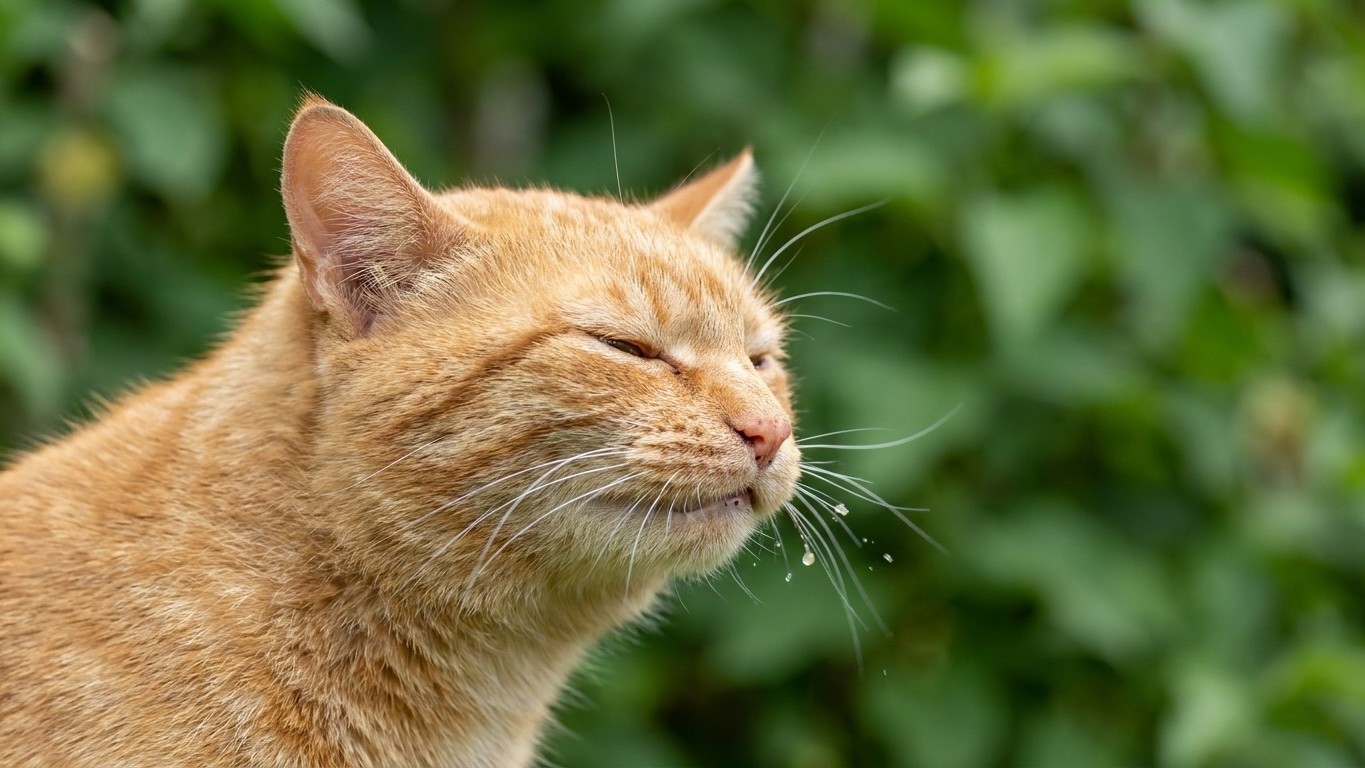
A cat that suddenly sneezes in explosive fits after every trip round the flowerbeds isn’t being dramatic. Nine times out of ten in cases like this, a grass seed or awn has lodged itself in the nasal passage, and because of how these seeds are built, it won’t simply fall back out on its own.
The culprit is usually what’s known as a grass awn or foxtail, the barbed seed head that some wild grasses produce to help themselves burrow into soil. The foxtail is designed by nature to embed itself in the soil, and like a fishhook, it very easily makes its way in but is designed to never back out. Once a cat inhales one of these while sniffing about in long grass, the same mechanism that lets it drill into earth means it can only travel one direction inside the nose: forward. Foxtails have backward-facing barbs that allow them to travel in only one direction, forward, and once inhaled into a nostril, they cannot be expelled by sneezing. Instead, they continue migrating deeper, causing escalating irritation, injury, and eventually infection.
This is precisely why a case like the one in the headline can turn frightening so fast. What looks like a bit of hay fever in your moggy is actually a barbed splinter working its way steadily backwards through delicate tissue, and every day it’s left unchecked, the odds of a straightforward removal drop.
Key takeaways
- A seemingly innocent sneezing fit could signal a barbed grass seed burrowing deeper into your cat’s nasal cavity
- Unlike dogs, cats are often overlooked as vulnerable to foxtail injuries, leaving owners unaware of the real danger
- Waiting to see if symptoms resolve on their own could allow the seed to migrate into the chest cavity, potentially requiring emergency surgery
Why cats are more vulnerable outdoors than you’d think
Cat owners often assume foxtail injuries are a dog problem, given how frequently retrievers and spaniels come home limping with a swollen toe. Foxtail-associated conditions are more commonly observed in dogs than cats, but can potentially adversely affect domestic, feral, and wild animals. Cats spend plenty of time nose-down in undergrowth chasing scents, batting at insects, or simply having a good sniff around the garden, and that curiosity is exactly what puts them at risk.
According to International Cat Care, the charity that specialises in feline health, the most common nasal foreign bodies in cats are plant material such as blades of grass or grass seeds (grass awns). One clinical review found that vegetable matter accounts for the overwhelming majority of these blockages. Clinical studies indicate that approximately 81% of such obstructive materials consist of vegetable matter, primarily grass awns and seeds, while roughly 14% are mineral matter, and less than 5% are artificial or synthetic materials like plastics. So the sneezing fit after a garden ramble isn’t a fluke; it’s the single most likely explanation vets will investigate.
Late spring through summer is peak season, when dry grasses shed their seed heads most freely. Seasonal clusters typically occur in summer and early autumn when grasses form their seeds, and during this time, the incidence of nasal foreign bodies increases significantly in veterinary practices. A garden that looked perfectly innocent in April can turn into a minefield of barbed seeds by July, tucked into ornamental grasses, overgrown borders, or that patch you keep meaning to strim.
The warning signs that separate this from an ordinary sniffle
Distinguishing a lodged seed from a run-of-the-mill cat cold matters, because the two look remarkably similar at first glance. Feline upper respiratory infection is one of the most common causes of sneezing and nasal discharge in cats, caused by herpesvirus or calicivirus (and often both). The tell is in the pattern. A viral sniffle tends to affect both nostrils and often comes with watery eyes or lethargy. A lodged awn is far more likely to be one-sided.
- Violent, repeated sneezing fits that start suddenly, out of nowhere
- Discharge or bleeding from just one nostril, not both
- Pawing at the face, head shaking, or rubbing the nose along furniture
Foxtail injuries almost always involve a single nostril, and if the discharge or bleeding is one-sided, that specificity is a useful diagnostic clue. One frustrating quirk of these cases is that symptoms can settle for a while before flaring back up, tricking owners into thinking the problem has resolved itself. The symptoms may disappear after a few hours, only to return intermittently. That lull is not good news. It usually means the seed has shifted position, not vanished.
What happens at the vet’s, and why timing matters so much
Finding a sliver of grass buried in a cat’s nasal cavity is genuinely tricky work, which is part of why these cases get missed initially. Ordinary X-rays are often useless here. Many common foreign bodies, specifically radiolucent materials like plant matter, grass awns, or plastic fragments, are completely invisible on a standard X-ray. Vets typically need to reach for more sophisticated tools instead.
The gold standard is rhinoscopy, essentially keyhole surgery for the nose. This procedure requires general anesthesia, and a small fiberoptic endoscope is passed up the nose into the nasal cavity to look for problems such as inflammation, infection, tumors, ulceration, bleeding, or foreign material such as plant debris; if foreign material is found, it can sometimes be removed using a tiny attachment on the endoscope. This is why any suspected nasal foreign body needs a same-day or next-day vet visit rather than a wait-and-see approach at home, an anaesthetic and specialist kit are almost always required, not a pair of household tweezers.
Delay carries real consequences. The longer a foreign body remains in the nasal passage, the more inflammation, swelling, and potential infection develops, making removal progressively more difficult. In rare, worst-case scenarios, an inhaled awn doesn’t stay in the nose at all. Veterinary researchers have documented cases where a grass awn migrates right through into the chest cavity, causing fluid to build up around the lungs, a complication that can require specialist thoracic surgery to resolve. It sounds extreme for something as small as a seed head, but the barbed, one-way design is exactly what makes that journey possible.
Keeping garden walks safe without keeping your cat indoors
None of this means banning your cat from the garden, thankfully. It means being a bit more alert during grass-seed season. Give a quick check around the face and paws after your cat has been rootling in long grass, especially anywhere with ornamental pampas grass, barley, or unmown patches where seed heads have dried and hardened. If you notice a sudden, one-sided sneezing fit that doesn’t ease off within a day, don’t wait it out at home hoping it clears. A same-day vet appointment, with imaging or rhinoscopy on the table, gives your cat the best odds of a quick, uncomplicated fix rather than weeks of chronic inflammation, or worse. Strimming back the wilder corners of the garden before midsummer is a small chore that can spare your cat an anaesthetic, and spare you a nasty scare.
Sources : petpoisonhelpline.com | southernazvets.com