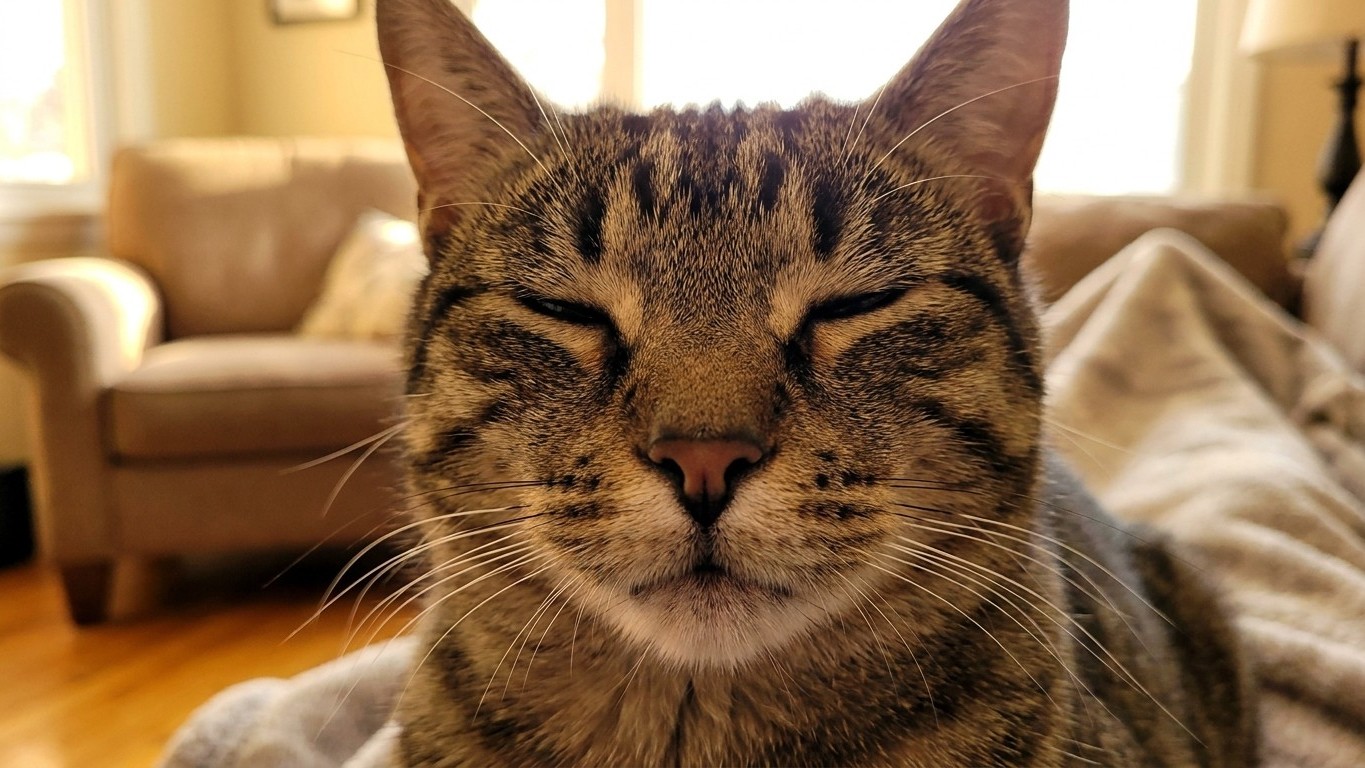
Your cat locks eyes with you from across the sofa, holds your gaze with an unnerving stillness, then slowly, almost theatrically, lets their eyelids drift shut and open again. For years, most of us assumed this meant they were simply nodding off. The truth, as it turns out, is far more touching than that, and science has the receipts to prove it.
Key takeaways
- A slow blink from your cat is a deliberate, conscious gesture—not an involuntary reflex like human blinking
- Scientists discovered cats slow-blink back at humans who slow-blink at them, and even approach strangers who use this technique
- The opposite signal—a hard, unblinking stare—means something completely different and should never be ignored
The slow blink is your cat’s version of a smile
Cats blink slowly as a form of nonverbal communication, often interpreted as a sign of trust and affection toward humans or other animals. The parallel with human expression is striking: the partially closed eyes and slow blinking you see in a relaxed cat is similar to how human eyes narrow when smiling, and it is interpreted as a kind of cat smile. So when your cat gazes at you and lets those heavy lids fall, they are not fighting sleep. They are, in their own quietly dignified way, telling you that they like you.
Slow blinking is thought to be used by cats to indicate a sense of calm and a positive emotional state. It involves the partial or complete closure of the eyelids, performed slowly and lasting for longer than half a second. That timing matters. A normal involuntary blink happens in a fraction of a second. The slow blink is deliberate, a conscious gesture, not a reflex. Unlike the rapid blinking seen in humans, which is typically involuntary, the feline slow blink is a conscious gesture.
The deeper explanation links back to vulnerability. Closed eyes mean “I don’t need to watch you for threats.” It’s the same reason cats expose their belly to trusted humans, it demonstrates they feel safe. For an animal whose survival instincts are still wired for vigilance, choosing to shut their eyes in your presence is a quiet but profound act of confidence in you.
What the science actually shows
According to peer-reviewed research, it’s the feline equivalent of saying “I trust you.” In 2020, psychologists at the University of Sussex conducted the first scientific study on cat slow blink meaning. The study, published in Scientific Reports, ran two separate experiments to test whether cats genuinely respond differently to humans who slow-blink at them.
In the first experiment, owners slow-blinked at 21 cats from 14 different households. Once the cat was settled and comfortable in one spot in their home environment, the owners were instructed to sit about a metre away and slow-blink when the cat was looking at them. Cameras recorded both the owner’s face and the cat’s face, and the results were compared to how cats blink with no human interaction. The results showed that cats are more likely to slow-blink at their humans after their humans have slow-blinked at them.
The second experiment pushed the findings further. This time, it wasn’t the owners doing the blinking but the researchers, who’d had no prior contact with the cat. For a control, the cats were recorded responding to a no-blink condition, in which humans stared at the cats without blinking. The researchers performed the same slow-blink process as the first experiment, adding an extended hand towards the cat. And they found that not only were the cats more likely to blink back, but that they were more likely to approach the human’s hand after the human had blinked. A completely unfamiliar person, using nothing but a slow blink, could open the door to contact with a cat who had never met them before. That is a remarkable result.
From the study, the slow blink sequence appears to be an indicator of positive emotion in cats. Researchers have also speculated about the neurological underpinnings at play. Oxytocin, known for its influence on social bonding and trust, may be present in the brain during interactions involving eye narrowing, enhancing the cat’s feelings of relaxation and connection. Studies have shown that increased oxytocin levels are associated with positive social behaviours in mammals.
Why a stare without a blink means something completely different
Here is where cat body language gets genuinely nuanced, and where misreading the signal can go wrong. The slow blink and the hard, fixed stare are opposites. When a cat gives a hard, unblinking stare paired with stiff body language and piloerection along the back and tail, they are telling the other party that if they do not back off, there will be a confrontation. That is not a cat relaxing. That is a cat issuing a warning.
While we consider eye contact friendly, cats view it as assertive, threatening, and intimidating. This is why if you’re trying to get your cat’s attention by calling their name and looking in their direction, the cat may choose to ignore you completely. The same logic explains why strangers who confidently hold a cat’s gaze often find the cat retreating, while someone who looks away or avoids direct staring gets chosen for a lap visit. Cats will be more likely to approach someone who is not paying attention to them because they view them as less of a threat.
Reading the full picture matters. Look at their overall body language: relaxed muscles, slow blinking, and a calm demeanour suggest affection, while dilated pupils, tense posture, and flattened ears may indicate aggression or anxiety. If staring is accompanied by any of those latter signs, do not attempt to slow-blink your way out of it. Give the cat space.
One thing worth keeping in mind: if staring is accompanied by disorientation, bumping into objects, sudden behaviour changes, or excessive vocalisation, especially in older cats, contact your veterinarian. These can be signs of vision loss, cognitive decline, or hypertension. Behavioural shifts in cats should always prompt a check-up, because cats are notoriously good at masking Discomfort until it becomes serious.
How to blink back, and why you should try it
Try narrowing your eyes at them as you would in a relaxed smile, followed by closing your eyes for a couple of seconds. You’ll find they respond in the same way themselves and you can start a sort of conversation. The key is to keep it soft and unhurried. Think drowsy, not squinting. The goal is to communicate ease, not concentration.
If you frequently blink slowly at your cat, they may start to reciprocate this gesture. This mutual exchange can strengthen the bond between you and your feline friend, creating a sense of understanding and companionship. You can try it with unfamiliar cats too. A 2020 study from the University of Sussex found that cats are more likely to approach humans who slow-blink at them, suggesting that this form of eye communication fosters positive relationships.
There is also a welfare dimension to this that extends well beyond the living room. Cats that responded to human slow blinking by using eye closures themselves were rehomed quicker than cats that closed their eyes less. Research conducted at Cats Protection’s National Cat Adoption Centre in Sussex found that cats that showed an increased number of and longer eye closures in response to human slow blinks were rehomed faster, and that nervous cats tended to spend more time producing slow blink sequences in response to human slow blinks. These results suggest that the cat slow blink sequence is perceived as positive by humans and may have a dual function, occurring in both affiliative and submissive contexts. the slow blink isn’t just a sign of contentment; it may also be the way an anxious cat tries to de-escalate tension with a human they don’t yet fully trust. The same gesture, two different emotional origins — a reminder that even in feline communication, context is everything.
Sources : bigthink.com | optimistdaily.com