
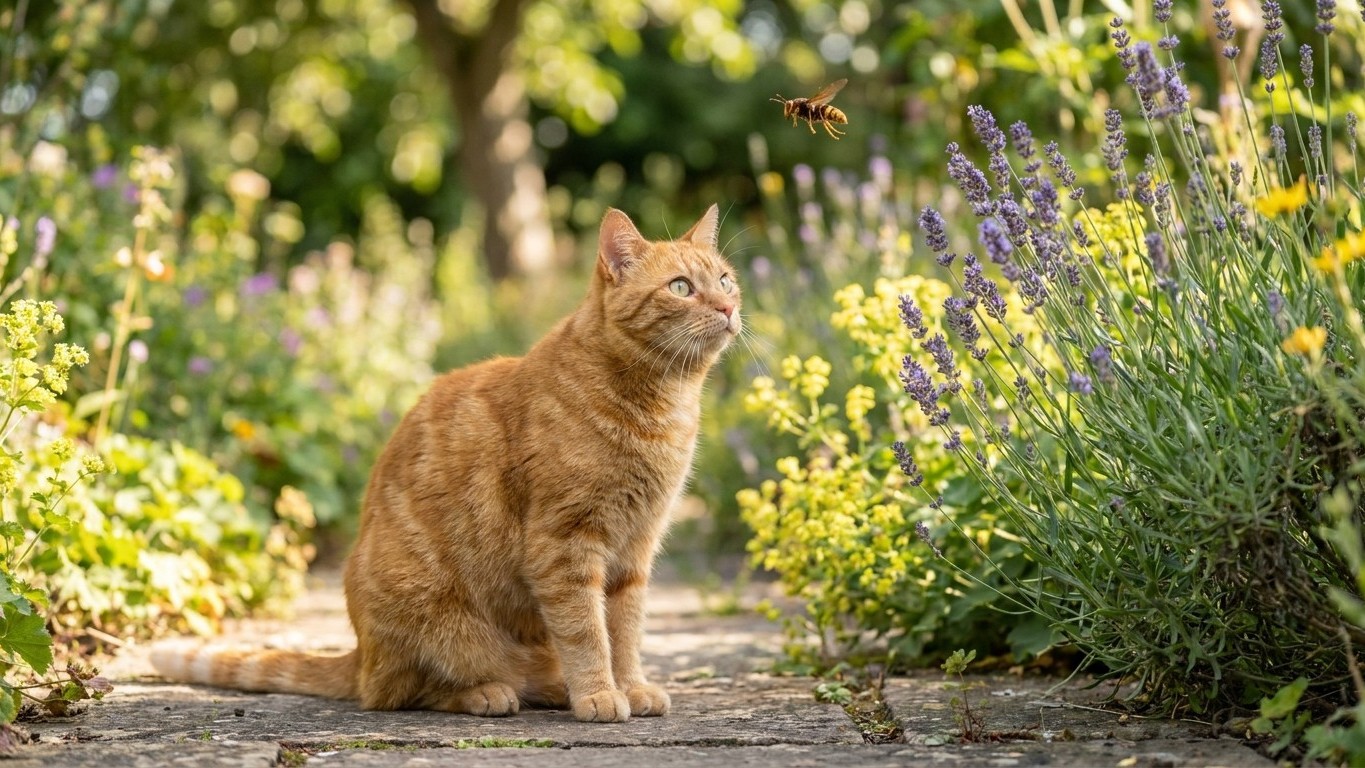
Asian hornets are moving into British gardens in numbers that would have seemed alarmist just three years ago. And now, as summer 2026 tracks among the hottest on record, the concern has shifted from “will they settle here?” to “how do we protect our pets, our bees, and ourselves?” Cats, with their irrepressible instinct to bat at anything that buzzes, are now genuinely at risk of a nasty sting, or worse.
Key takeaways
- Asian hornet nests have exploded from 24 in 2024 to 161 confirmed across Britain—and they’re moving inland faster than experts predicted
- A single cat sting is usually manageable, but multiple stings or stings to the face and throat can be fatal without immediate vet treatment
- Simple changes like sealing bins, planting hornet-repelling herbs, and trimming vegetation can dramatically reduce nest risk in your garden
From coastal curiosity to inland reality
The invasive yellow-legged Asian hornet (Vespa velutina nigrithorax) arrived in the UK in 2016. For years it was contained to scattered coastal sightings, each nest swiftly hunted down. That chapter appears to be closing. Last year, there were 544 Asian hornet sightings with 161 nests confirmed, more than double the previous annual peak. The species is no longer a fringe problem.
Nest numbers increased from just 24 in 2024 to 161 across Britain. A single nest can generate dozens of queens, meaning one Overlooked colony could spawn 30 additional nests the following season. That exponential maths should make anyone with a garden sit up. Experts warn the heat could trigger an increase in activity among Asian hornet queens, which are already increasing in numbers across southern England. “What makes 2026 particularly concerning is the acceleration we’re now seeing in both sightings and geographical spread,” one specialist noted. “We’re no longer talking about isolated coastal incidents. Sightings are appearing much further inland, and many experts now believe the focus has shifted from eradication to long-term management.”
A study of Asian hornets found about 1,400 different species in their guts. University of Exeter researchers tested samples from France, Spain, Jersey and the UK, finding eaten prey included a wide range of bees, wasps, flies, beetles, butterflies, moths and spiders. Of the top 50 invertebrate prey species identified, 43 are known to visit flowers, and among these were Europe’s three main crop pollinators: the European honey bee, the buff-tailed bumblebee and the red-tailed bumblebee. Your garden’s whole pollinating ecosystem, in short, is on their menu.
The real risk to your cat, and what to watch for
Cats are natural-born hunters of anything small and airborne. A hovering hornet is practically an invitation. The problem is that Asian hornets, while not especially aggressive toward humans going about their day, will defend themselves fiercely when threatened, and a cat swatting at one definitely counts as a threat.
Pets such as dogs, cats, rabbits, and other small mammals may be at risk if they accidentally come near a nest, attempt to swat or play with a hornet, or are stung during outdoor activities. Smaller pets are likely more vulnerable due to their size relative to the venom dose, and multiple stings could prove serious or fatal without intervention. A single sting on an adult cat is usually painful but manageable. Multiple stings, which can happen if a cat stumbles near a nest, are a different matter entirely.
The symptoms of being stung are generally mild unless your pet has an allergic reaction. Some swelling is common with localised pain and irritation, but your pet will need immediate veterinary treatment if they have an extreme reaction. If your pet has been stung in the mouth or has multiple stings to the face and throat, this can be life-threatening. A swollen throat or airways will cause difficulty breathing, so take your pet to the vet immediately. Always contact your vet if you suspect your cat has been stung by any hornet, do not wait to see if things improve on their own.
One important distinction worth knowing: wasps and hornets don’t leave behind a stinger, unlike bees, which means an Asian hornet can sting repeatedly. Unlike bees that can sting only once and then die, hornets can sting multiple times. This makes a defensive encounter near a nest especially dangerous for a curious cat who hasn’t backed off fast enough.
Protecting your garden without panicking
The good news is that a few straightforward changes to your garden routine can make a real difference. Asian hornets are drawn to food sources and sheltered nesting spots, remove those, and you become a much less attractive destination.
Sealing your rubbish bags and putting them into a bin prevents the smell of rotting food from attracting hornets. Compost bins also attract hornets, so keeping them sealed is very important. If possible, move your bins away from your home and garden. It’s the sort of advice that sounds almost too simple, but it genuinely works to reduce foraging activity near your home.
Certain plants have a scent that is off-putting to hornets. Plants such as spearmint and lemongrass will deter them, as well as support pollinators such as bees and butterflies. Position them in areas where you most want to be rid of hornets, such as around the edges of patios or by any seating areas. A happy side effect: both plants are easy to grow in pots, thrive in the British summer, and smell wonderful to humans.
Asian hornets can make nests in trees and hedges. To stop them establishing a nest in your garden, consider trimming back trees and hedges to reduce nest spots (checking first that you are legally able to trim), and pick up dead plant debris that could shelter hornets and fill in holes in the ground to stop an underground nest. The eaves and soffits of your property can form cracks over time, which give Asian hornets perfect entry points. Sealing cracks with filler, then sanding and painting once dry, is a simple preventive measure.
If you want to go a step further, there are many different types of traps available, but traps specially made for Asian hornets are the best, because other traps can catch bees and other important insects. Your trap should be hung in a tree at head height, in a sunny area away from deep shade where hornets are unlikely to forage.
If a nest is suspected, it’s extremely important never to approach or attempt to remove it yourself, as Asian hornets can become aggressive when disturbed. This applies to your cat too, keep them indoors during peak activity in late summer and early autumn, particularly if you have spotted hornets nearby.
Report every sighting, it still matters
If you think you have seen a yellow-legged hornet, report it using the free Asian Hornet Watch app, available for Android and iPhone, on the online notification form or by emailing alertnonnative@ceh.ac.uk. A photograph and the location of the sighting must be included. This takes about two minutes and genuinely helps the National Bee Unit track the spread.
There is also a surprising ally in this battle: our own native hornet. Recent reports suggest that native European hornets can tackle their invasive counterparts and kill them by biting their heads off. So if you spot a large, brownish, striped insect in your garden and it turns out to be a European hornet rather than an Asian one, resist the urge to panic. While the Asian hornet is a dangerous invader, European hornets tend to feed on all the most common garden and farmland pests, so their presence should be welcomed and not feared.
The Asian hornet is not the apocalyptic “murder hornet” of tabloid nightmares, that title belongs to a different, much larger species not present in Britain. But it is a serious and growing presence in UK gardens, one that poses a real threat to pollinators, a genuine danger to curious cats, and an accelerating challenge for wildlife authorities. Knowing your enemy, keeping your outdoor space tidy, and reaching for your phone to report a sighting rather than a newspaper to swat the thing: that is the practical shape of coexisting with this new arrival.
Sources : itv.com | yourpetsdaily.co.uk