
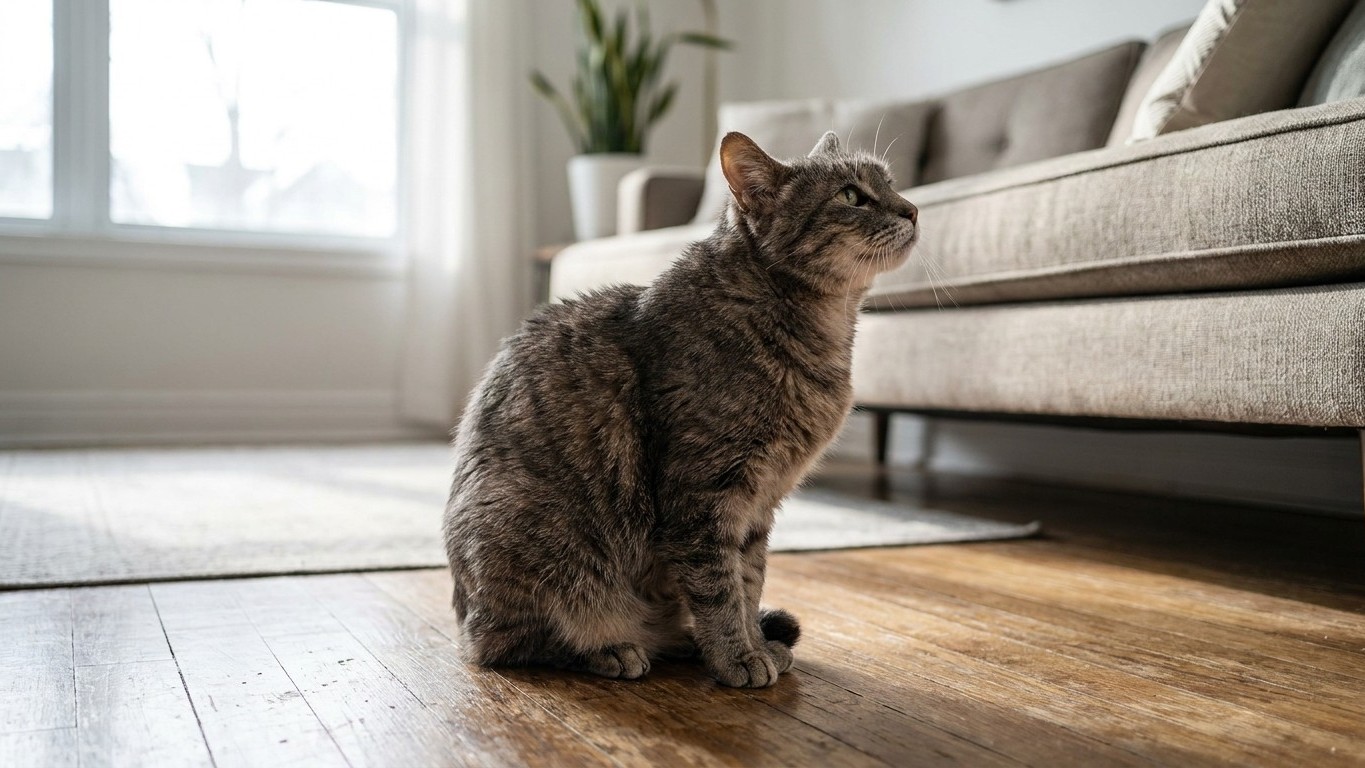
The cat stopped jumping on the sofa. Not dramatically, not overnight, just quietly, gradually, one day at a time. His owner assumed he’d simply grown older, perhaps a touch lazier. It took a vet appointment, an X-ray, and a matter-of-fact diagnosis to reveal the truth: he had been in pain for years. This story, heartbreaking in its ordinariness, plays out in homes across Britain every single day.
Key takeaways
- 82% of cats over 14 have arthritis, but only 13% show obvious limping—what are the other signs?
- That behavioral change you dismissed as aging? It might be your cat begging for pain relief
- A simple ramp costs almost nothing, but means everything to an arthritic cat
The silent epidemic hiding in plain sight
Arthritis is a well-known condition in both humans and pets, but has only recently become more recognised in cats, mostly because they are so talented at hiding the signs. That talent is not a quirk, it is an ancient survival mechanism. A wild cat that visibly limps is a vulnerable cat. So they don’t limp. They adapt, compensate, and carry on. Stoically. Silently. Right under your nose.
The numbers are genuinely startling. One study of 100 cats showed that 82% over the age of 14 had evidence of osteoarthritis on radiographs (X-rays), and even in cats aged older than six years, 61% had X-ray evidence of osteoarthritis in at least one joint. And yet, only 13 out of the 100 cat owners in that study reported seeing any lameness in their pets. Thirteen. Out of a hundred. That gap between what was happening inside their cats’ joints and what owners actually noticed is where all the suffering lives.
Recognising osteoarthritis in cats is difficult for pet owners and even for experienced veterinarians. Cats, unlike most dogs, can tolerate bone and joint problems due to their small size and natural agility, and they can hide their pain very well. The disease most often takes hold quietly, progressing over months and years rather than announcing itself with a yelp or a limp.
Why “he’s just getting old” is the most dangerous assumption you can make
Behaviours that have historically been thought of by owners as “normal ageing” changes in cats are now acknowledged as potential signs of underlying osteoarthritis. Decreased activity and reluctance to jump up on household furniture are signs that are now well recognised as consequences of arthritic changes. This is the trap. When a ten-year-old cat stops leaping onto the kitchen counter, the human brain reaches for the most comfortable explanation: he’s older, slower, less interested. It feels reasonable. It is almost always wrong, or at least incomplete.
Signs of osteoarthritis are more subtle in cats than in dogs. Signs of the disease include weight loss, loss of appetite, decreased activity level, change in attitude, grumpier or quieter than usual, decreased grooming, urinating or defecating outside the litter tray, and not being able to jump as easily as before. That last litter box detail trips people up particularly badly. A healthy cat makes the up-and-over step into the litter box easily, but an arthritic cat can view this simple hop as an impossible leap. Pain from stiff and sore hips, knees, and elbows can cause a cat to develop a litter box aversion and seek relief on less physically demanding locations, like a soft rug. What looks like a behavioural problem or a bout of spite is, in reality, a cat Trying to Tell You something, in the only language available to it.
Grooming changes are another clue most owners miss. When an arthritic cat’s joints no longer flex smoothly, self-grooming becomes an uncomfortable or impossible task. Arthritic cats may show a decrease in grooming frequency or be less thorough, and depending on whether their pain is local or generalised, a cat may neglect a specific body area, the hind legs, above the tail, or have an overall unkempt appearance. A slightly greasy coat, a matted patch near the tail: easy to attribute to laziness, in reality a pain response.
And then there’s the personality shift. Some arthritic cats become much less happy with being handled, touched, or picked up. This is often put down to the ageing process but is actually often due to pain or discomfort. The cat who used to purr on your lap and now bats your hand away hasn’t turned grumpy with age, he’s asking you, in the only way he can, to please stop.
What happens at the vet, and what it means for your cat
Lameness is not commonly reported by owners. In a study of 28 cats with osteoarthritis, less than half limped, but almost three-quarters didn’t want to jump, and two-thirds jumped a shorter distance. This is why the vet visit matters so much. An accurate arthritis diagnosis requires a detailed history of your cat’s at-home behaviour and a thorough physical examination to identify joint swelling and discomfort signs. Your observations at home, the couch they’ve stopped jumping onto, the way they hesitate at the bottom of the stairs — are genuinely clinical data. Write them down before the appointment. Vets find it invaluable.
The most common joints to develop osteoarthritis in cats are the elbows and hips, although shoulders, hocks (ankles), and knees can also develop the disease. Arthritis in the backbone and the sternum is also common. X-rays will usually be needed to confirm the picture, though it’s worth knowing that in cats, painful joints don’t necessarily mean there will be corresponding joint changes on X-rays, which is why the overall clinical assessment matters as much as the imaging.
Treatment of arthritis in cats focuses on reducing pain, improving mobility, and slowing disease progression. A multimodal approach, using multiple therapies together, typically provides the best results and helps cats maintain a good quality of life. Options increasingly available to UK vets include prescription pain relief, joint supplements containing omega-3 fatty acids, and a newer monoclonal antibody treatment. Solensia (frunevetmab) targets and neutralises nerve growth factor, a key player in pain signalling. It is administered via monthly injections and has been shown to significantly reduce pain and improve mobility in cats with osteoarthritis, with fewer side effects compared to traditional NSAIDs.
At home, the adjustments are straightforward. Providing a ramp up to places they like to rest, a litter box with one low side for easy access, and keeping Everything your cat needs, food, water, litter, on one floor of the house can make a genuine difference to daily comfort. A small ramp to the sofa costs next to nothing. To an arthritic cat, it’s the difference between exclusion and belonging.
What you can do starting today
The signs of arthritis in cats are often dismissed as the animal naturally slowing down in its old age. But according to the Cornell Feline Health Center, cat owners shouldn’t assume that changes they see in their older cats are the unavoidable consequences of ageing and therefore untreatable. That shift in thinking, from “he’s just old” to “he might be in pain and we can help” — is the most important thing any cat owner can do.
Watch for the couch. The litter box. The grooming. The way he flinches when touched near his hips. Even what we perceive as mild symptoms of joint pain, including slowing down, stiffness, or becoming grumpy, may need treating. If your cat is over seven and you’ve noticed any of these changes, book a vet appointment, not to panic, but to know. Because arthritis in cats is not reversible, but proper management can slow its progression and improve quality of life, and with appropriate treatment, many cats remain comfortable and active for years.
One detail worth holding onto: studies show that over 90% of cats above the age of 12 have radiographic evidence of arthritis. That is nearly every elderly cat. The question isn’t really whether your ageing cat has arthritis, statistically, the odds are firmly stacked in that direction. The question is whether you catch it early enough to give him the relief he deserves.
Sources : zoetispets.com | vetlens.com