
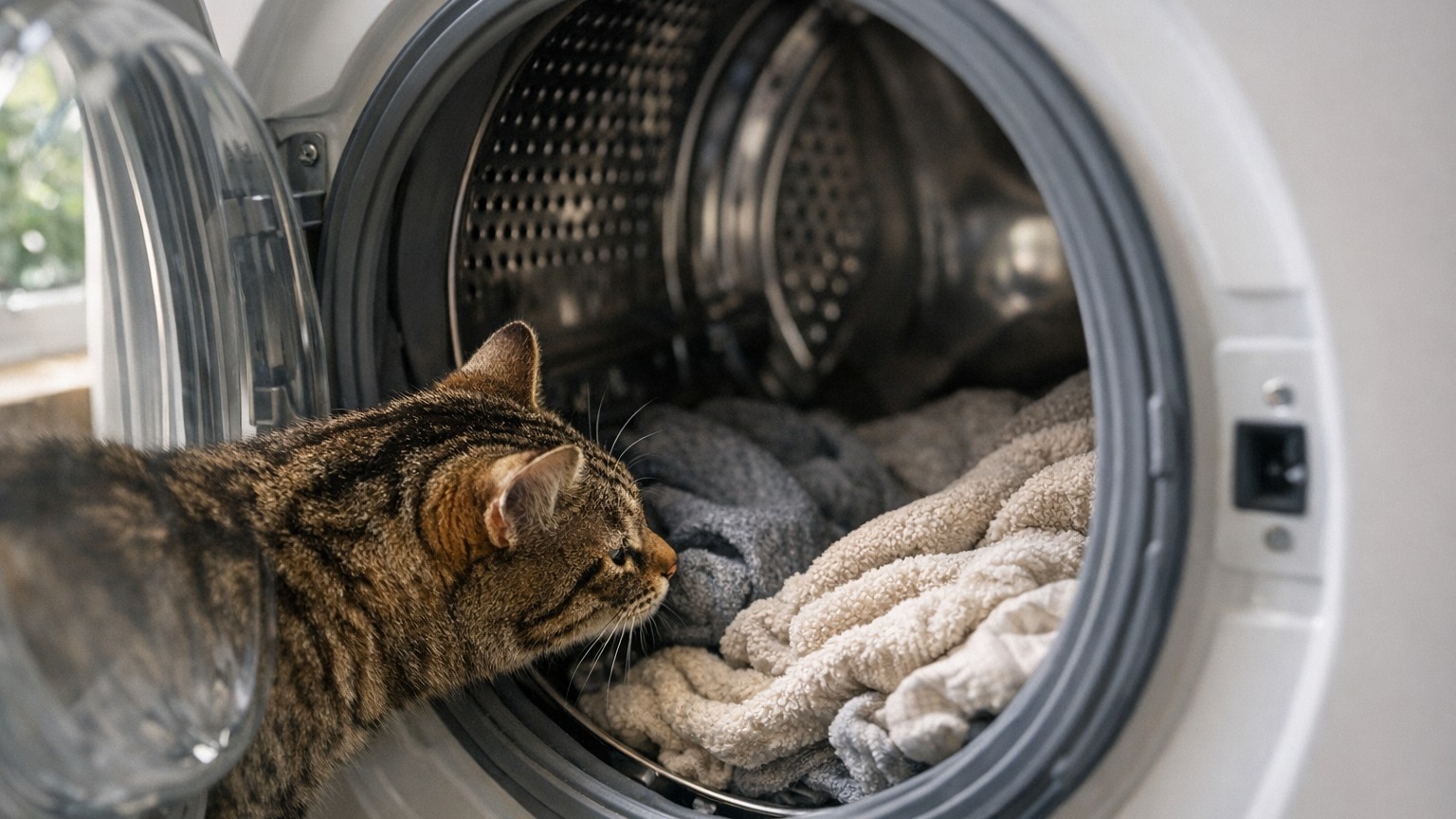
The washing machine drum is dark, enclosed, warm from the previous cycle, and smells of fabric softener. To a cat, that is not a household appliance, it is a five-star den. Most of us know, in the abstract, that cats sometimes climb into washing machines. But knowing it and truly feeling it are two entirely different things, and for many owners, it takes one terrifying near-miss before the habit of always checking becomes instinctive rather than intentional.
Key takeaways
- Your cat sees the washing machine as a five-star den—but what happens when you press start?
- A cat that goes unusually quiet isn’t acting normal—it’s sending a distress signal
- Real-world rescues have required firefighters with drills; some pets don’t survive
Why your cat sees a washing machine as the perfect hiding spot
Cats are hard-wired to seek out small, enclosed spaces. Rather than being exposed to the clamour and possible danger of wide-open spaces, they prefer clearly delineated areas, a behaviour rooted in kittenhood, when snuggling with mother and littermates in tight quarters released endorphins, reducing stress and producing genuine comfort. A drum-style front-loader, sitting open and inviting in the utility room, ticks every single box.
The National Research Council has determined that a cat’s thermoneutral zone sits between 30°C and 38°C, making an enclosed space still warm from the last cycle an almost irresistible napping prospect. Add to that the fact that cats’ sense of smell is around 14 times more acute than humans’, and they can detect their owner’s scent on clothing even after washing, making that tumble of laundry feel familiar and safe.
Cats love dens, and this is precisely why the washing machine has become such a popular napping spot. The problem, of course, is that a den does not spin at 1,200 rpm with two litres of Biological detergent.
What a quiet cat is really telling you
A cat gone unusually quiet is one of the details that pet owners most often dismiss as normal, and it is almost never normal. A “talker” that goes silent can be signalling distress just as clearly as a quiet cat that suddenly yowls at night. The silence is the signal. Cats hide for many reasons, ranging from entirely normal behaviour to signs of illness, pain, or stress, but when a cat who doesn’t usually hide suddenly starts seeking out concealed spaces and avoiding interaction, that change is worth paying attention to.
Even domestic cats carry instincts from their wild ancestors. When they feel ill or vulnerable, their natural survival response is to hide to avoid predators and reduce potential threats. In the wild, a sick or injured cat may become easy prey, so concealing signs of weakness is a survival mechanism, and hiding allows cats to manage pain and discomfort quietly. The washing machine is exactly the kind of place this instinct leads them: dark, enclosed, away from foot traffic, and oddly warm from the previous cycle.
Sudden or prolonged hiding, particularly if your cat also shows other changes such as reduced appetite, lethargy, or avoiding the litter tray, may indicate that something is wrong and should be assessed by a vet. Always consult your vet if a change in behaviour concerns you, the sooner, the better.
The real scale of the danger
There is no chance of a cat surviving in a running washing machine full of water. Tumble dryers are almost as dangerous, especially when they get hot. These are not theoretical risks. In one documented incident, Portsmouth firefighters were called to free a cat that had trapped its leg in a washing machine door. The crew had to use a drill to dismantle the door and release the animal, who was believed to have broken its leg, before the owner took the pet to a local vet surgery for treatment.
A Nottingham case that made national headlines told a similar story: a nine-month-old cat named Bobby survived a spin cycle, but only after the owners heard an unusual banging sound mid-wash. Bobby had apparently been hiding under a blanket in the machine when his owner turned it on, and a vet said the animal would likely survive, but suffered from shock and needed IV fluids. The margin between a very lucky near-miss and a tragedy was, in that case, a quilt thick enough to muffle the sound of the drum.
A ride inside the dryer could cause head and body injuries. Also, heatstroke. And if the machine completes its cycle before anyone notices, the outcome is invariably fatal. Even if a cat is rescued quickly after being trapped in a running machine, they can experience respiratory irritation or stress — and aspiration of soapy water, if it has occurred, cannot be managed at home. Emergency veterinary attention is non-negotiable in any such situation.
Turning awareness into habit
June is, counterintuitively, one of the riskier months for this. Washing machine doors are left open after cycles to air the drum and prevent mould, a sensible practice that leaves the perfect entry point accessible for hours. Cats Protection advises that small spaces are naturally attractive to cats, and that owners should block off any areas where a cat could become trapped and keep the doors of household appliances such as the washing machine or tumble dryer firmly shut.
Always check washing machines and tumble dryers before switching them on. You can easily overlook your cat in amongst the clothes, so the only way to be certain your cat isn’t inside is to see them somewhere outside the machine. That last point bears repeating: seeing the laundry pile does not confirm the cat is absent. Many modern machines also have child lock features that can be useful to keep adventurous cats out.
If your cat consistently gravitates towards the laundry area because they feel safe and secure there, try replicating that feeling in a dedicated enclosed space, a cardboard box or an enclosed cat bed placed nearby, ideally with a heated insert, can redirect the behaviour entirely. A sticker placed directly on the appliance as a visual reminder to check before switching on costs nothing and takes ten seconds to apply.
The one habit that veteran cat owners will tell you matters most is this: before you press start, account for every animal in the house. Not by calling their name and assuming silence means safety. Silence, as we have seen, may mean exactly the opposite.
Sources : dialavet.com | amyshojai.com