
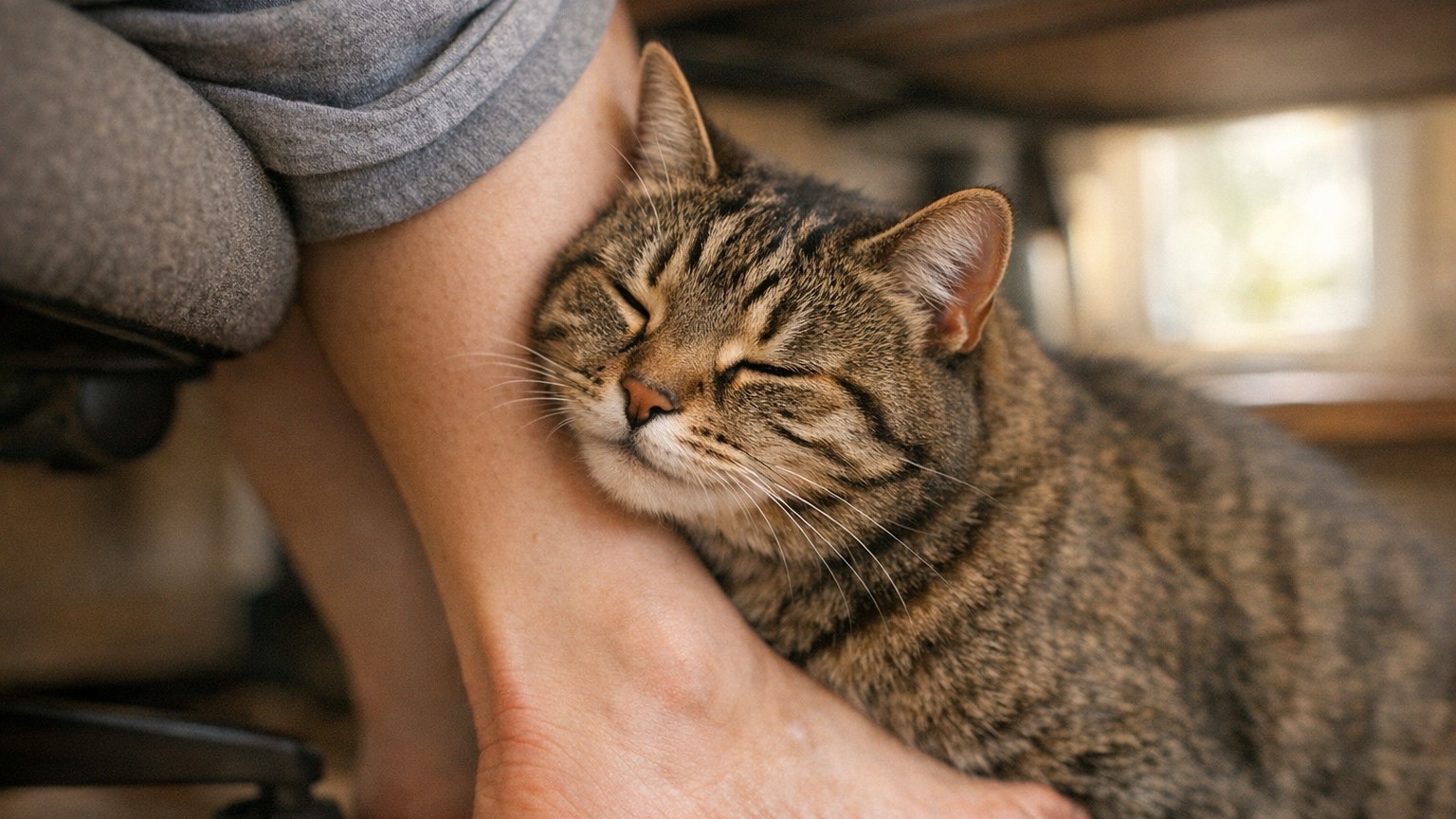
My cat Mochi does it every single morning, without fail. The moment I sit down at my desk, she saunters over, presses her cheek against my ankle and drags the length of her face along my leg. For three years, I smiled, called it love, and carried on with my coffee. Then a routine visit to the vet changed how I understood every moment of it, and I felt, oddly, a pang of guilt for having so completely misread her.
Key takeaways
- Cats have scent glands on their face and body—when they rub you, they’re marking you as part of their ‘safe family group’
- Bunting is an act of profound trust; cats expose themselves to danger by bringing their face close to another creature
- What looks like cute affection is actually complex social communication rooted in ancient feline survival instincts
What your cat is actually doing when it rubs against you
The behaviour has a proper name: bunting. Rubbing, also called bunting or allorubbing, is one of the most common feline behaviours, it happens when a cat presses or drags parts of their body, especially their cheeks, head, or sides, against you, another animal, or an object. It feels like a cuddle, and in part, it is. But the full picture is considerably more layered than a simple gesture of fondness.
Cats have scent glands on their cheeks, chin, top of their head, and base of their tail. These scent glands contain pheromones. When cats rub their face or tail against humans, other animals, or even household items, they are leaving these pheromones behind. Those chemical signals are completely undetectable to us. We walk around blissfully unaware that we are, in effect, labelled.
Here is the part that stung a little: when a group of cats live together, they form a group scent or “colony odour.” We leave the house almost every day, disrupting that group scent. They rub on us and use their scent glands to make us smell like the family again. So every time Mochi rubbed against my legs after I came home from work, she was essentially correcting a problem. I had come back smelling of the outside world, and she was fixing that. It was generous, really, if slightly proprietorial.
This allows your cat to reclaim you, and it’s thought that these behaviours release endorphins, which gives your cat a sense of calm, happiness, and safety. The act benefits the cat as much as the relationship. The practice of bunting stems from the behaviour that arises when kittens are very young and seek stimulation from their mother by rubbing and kneading, so there is something ancient and deeply comforting encoded in it.
Not just territory: the trust dimension
Many people inaccurately assume that any time a cat engages in rubbing or bunting, it is merely marking them as territory. Scent communication is far more complex than that. Cats use scent to mark their territory, yes, but they also do it to create comforting familiarity, show respect, create a common colony scent (important for survival and cat colony harmony), and self-soothe.
Bringing their head so close to another cat’s teeth and claws makes a bunter extremely vulnerable, cats will typically only engage in this behaviour when they feel safe and trust the recipient. Researchers studying feral cat colonies have determined that mutual head bunting occurs primarily between closely bonded individuals, such as littermates or mothers and their offspring. When a cat chooses to do this with you, a large and frankly unpredictable biped, that is a meaningful declaration of trust. My guilt started to dissolve a little at this point.
There is also a social signalling dimension that extends beyond the home. Feral and stray cats living in a colony often rub against each other to leave their pheromones on the group. This creates a communal scent, which helps identify intruders and promotes peace within the group. Cats can associate other cat pheromone smells with mating, aggression, and health status, which helps them navigate the hierarchy of their colony. Your domestic cat, lounging on the sofa with apparent indifference to all of this, is drawing on precisely the same instincts.
Lions also use bunting as a form of greeting and territorial marking, they will often greet each other with this head bunting behaviour when returning to a pride after a hunt. Your cat greeting you at the front door is, in a very real sense, doing exactly what a lion does after a successful hunt. Perspective, as they say, is everything.
When rubbing becomes a reason to worry
Here is where the vet visit became genuinely useful, and where a little knowledge can be the difference between “aw, sweet” and a trip to the emergency clinic. Not all head-pressing in cats is bunting. Head pressing is when a cat firmly presses their head against walls, floors, or other solid objects, and it is often a sign of something serious, like brain disease, liver problems, or even poisoning. Bunting is soft, brief, and usually happens while your cat is moving about. Head pressing is firm, repetitive, and tends to happen when a cat is still or seems disoriented.
A cat that is head pressing usually looks uncomfortable, mentally dull, disoriented, or otherwise unwell. It is considered a neurological warning sign until proven otherwise. Problems linked with this sign include brain inflammation, trauma, toxins, liver disease with hepatic encephalopathy, severe metabolic disturbances, and brain tumours. Some cats also show pacing, circling, sudden behaviour changes, blindness, seizures, or trouble walking. If you ever observe this, do not wait to see if it resolves on its own, contact your vet immediately.
Excessive bunting can also indicate that a cat is feeling anxious or stressed, perhaps because of the presence of an intruder cat in the garden or a change in the scent profile of the house due to the arrival of a new kitten, a dog, a baby, or even new furniture. A sudden, marked increase in rubbing behaviour is worth paying attention to, not as something alarming in itself, but as a conversation opener with your vet about whether anything in your cat’s environment might be causing distress.
Reading the whole gesture
We tend to positively reinforce rubbing behaviour by responding with affection in return. If a cat rubs against your legs and you immediately provide food or attention, the cat quickly learns to use rubbing as a functional tool to solicit what they want. This is not manipulation, it is a cat being remarkably good at reading cause and effect. The behaviour started as scent communication and has evolved, in domestic life, into a sophisticated request system.
When your cat rubs against you, they are leaving behind pheromones to help identify you as part of their “safe group.” Feline behaviour expert Zazie Todd notes that pheromone “F4” is used specifically for marking humans and familiar animals, a sign of friendship and trust. So what I had read as simple affection was, in fact, something more deliberate and more profound: an ongoing act of social maintenance, repeated daily, to keep me within the circle of safety that my cat has drawn around herself.
The reason I felt awful, briefly, was the realisation that I had been on the receiving end of an elaborate, biologically ancient act of trust, and had simply called it “being cute.” The good news is that the response I gave (leaning down, scritching behind the ears, talking nonsense) was, apparently, exactly right. A cat rubbing against you is one of the richest and most meaningful behaviours in the feline world — a blend of communication, affection, scent sharing, curiosity, and emotional bonding, all wrapped into one sweet gesture. Understanding it does not make it less sweet. If anything, it makes it considerably more so.
One last thing worth knowing: if you live with only one cat, the urge to rub and mark may not be as great as in multi-cat households. But cats’ behaviour can change over time, as they age and mellow out, the desire to be soothed by your touch can increase. An older cat that suddenly becomes more demonstrative may simply be leaning into the comfort of the bond you have built together over years. That, I find, is rather lovely.
Sources : pethealthclub.com | ladynpet.com