
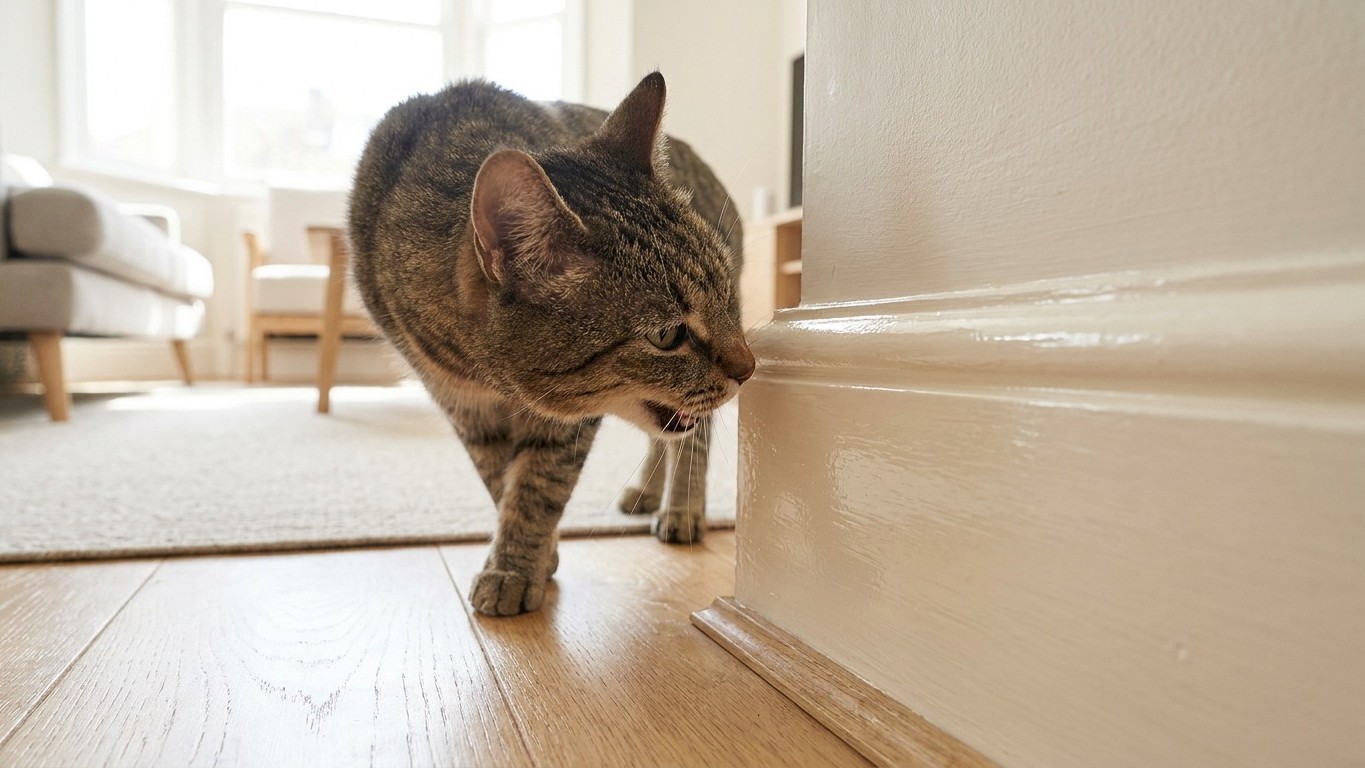
The paint brushes were barely rinsed, the skirting boards looked immaculate, and within a few hours, a curious cat had quietly licked enough wet paint from the freshly coated woodwork to leave a telltale stain across the inside of her mouth. That discovery, alarming as it is, is far more common than most pet owners realise. Skirting boards sit at exactly cat-nose height. A fresh coat of paint on them is, to a curious feline, simply a new smell worth investigating at close range.
Key takeaways
- Skirting boards sit at exactly cat-nose height—and freshly painted ones are irresistible to curious felines
- Paint that feels dry is still dangerous: full curing takes days, and fumes continue to off-gas long after your touch test passes
- Oil-based gloss contains solvents that can cause respiratory problems, vomiting, and in severe cases, life-threatening chemical pneumonitis
What the mouth tells you
Signs of paint ingestion in cats can include paint visible on the haircoat or around the mouth, vomiting, drooling, lethargy, changes in behaviour, and in severe cases, blindness or seizures. A stained palate or gums is often the first thing an owner notices, and it is a clear signal that the cat has done more than sniff, she has actively licked the surface.
The severity of what follows depends almost entirely on which type of paint was used. Paints, varnishes, and stains come in a wide variety of formulations, many of which are dangerous to cats. Water-based paints include latex, acrylic, tempera, and poster paints, while oil-based paints are typically used where more durable coverage is required. In British homes, traditional skirting board gloss is often oil-based, and that high-shine finish most people associate with woodwork has long been a standard choice for interior trim.
Oil-based paints and varnishes contain solvents that can be inhaled into the lungs and cause breathing difficulties, and vomiting and diarrhoea are also commonly associated with their ingestion. Oil paints can be harmful to cats if ingested, as they may contain toxic components like heavy metals or solvents. The solvent content is what makes them particularly problematic compared to water-based alternatives. Petroleum products that commonly affect small animals include fuels, solvents, and paints with a petroleum base, and petroleum-derived products like turpentine are more likely to be inhaled into the lungs, where they can cause chemical pneumonitis, a potentially life-threatening inflammatory condition.
Water-based paints are a different matter, though not entirely harmless. Paints without lead are much safer and usually cause little more than mild gastrointestinal upset, but some contain a low concentration of glycols, including ethylene glycol, an antifreeze ingredient that is very dangerous to cats when ingested in concentrated form. Water-based paints may irritate a cat’s skin and mucous membranes, but they are not expected to cause toxicity or poisoning in typical small-exposure scenarios. That distinction matters when you are trying to decide how urgently to act.
The problem with “dry to the touch”
Here is the mistake almost everyone makes: assuming that because paint feels dry, it is safe. Even when a surface feels dry, paint can continue to release fumes for several days. Some formulas may dry to the touch in as little as one hour, though full curing can take up to 30 days. Those are very different things. “Dry to the touch” means the surface no longer transfers paint to your finger. “Cured” means the chemical process is complete and the paint has hardened into a stable, inert film.
For cats, the gap between those two states is the danger zone. If paint or varnish gets on a pet’s skin, fur, or paws, small amounts can be ingested during self-grooming. A cat brushing along a freshly painted skirting board, picking up paint on her coat and then grooming herself, is exposed in exactly this way, even if the board looked dry when she walked past it. Paint fumes are primarily composed of volatile organic compounds (VOCs), which can be released into the air during and after the painting process, and these chemicals can have varying degrees of toxicity for both humans and pets.
Pets should be kept out of painted rooms until the paint is completely dry and any fumes have dissipated, typically at least 24 to 48 hours. For traditional oil-based gloss on skirting boards, that window stretches considerably further. With traditional paints, keeping the room off-limits for two to three days minimum is the recommended approach. Letting the cat back in the same afternoon, with oil-based gloss still actively off-gassing at room level, is precisely the scenario that leads to a stained mouth and a panicked call to the vet.
What to do if your cat has already licked paint
Stay calm first. A small taste or touch of paint is unlikely to cause significant clinical signs. But the word “unlikely” still requires monitoring, and the type of paint matters enormously for how worried you should be.
Be prepared to provide detailed information about the paint, including the type, amount, and time of ingestion when consulting a vet. Watch for signs including vomiting, drooling, lethargy, and changes in behaviour. Do not attempt to make the cat vomit. Attempting to induce vomiting may cause paint or varnish to be inhaled into the lungs, resulting in much more serious complications. It may be helpful to rinse your pet’s mouth with lukewarm water, encourage your pet to drink water, or offer a small snack, which may help dilute the paint in the stomach and reduce the risk of gastric upset.
If paint is visible on the fur or paws, it can be washed off with mild liquid dish soap or carefully trimmed with clippers, but scissors should not be used, as there is a risk of cutting the skin. Paint thinners, mineral spirits, or other solvents should never be applied to the skin without consulting a veterinarian first.
Acrylic paint ingestion in cats can cause delayed symptoms including vomiting, lethargy, agitation, and loss of appetite, and the toxic components can irritate the gastrointestinal tract and may affect the nervous system. That word “delayed” is the one to keep in mind, a cat can appear perfectly fine for 24 to 48 hours before showing signs. If your cat has ingested paint, particularly oil-based paint, contact your vet the same day regardless of whether she currently seems well. Always let a vet guide your next steps.
Choosing paint that does less harm
Water-based paints, which have lower VOC levels, tend to be less harmful than oil-based paints. If you are concerned about a pet’s wellbeing, opting for low-VOC or VOC-free paints is safer for both humans and animals. In UK homes, water-based paints have the advantages of being more environmentally friendly, lower odour, more child- and pet-friendly, and quicker drying. Water-based satinwood and eggshell finishes are now widely available, including in formulations that rival the durability of traditional oil-based gloss.
Problematic paints for pets include those containing polyurethane, formaldehyde, ammonia, acetone, fungicides, and biocides, all of which are toxic. Reading the label before buying is the one step most people skip entirely. VOCs can be found even in varieties labelled “breathe easy,” and to be genuinely safe for pets, paint needs to be completely VOC-free rather than simply low-VOC.
One thing worth knowing: certain pigments found in specialist and artist paints, such as cadmium red or yellow, are classified as hazardous materials. Household gloss is unlikely to contain such pigments, but custom-tinted paints and specialist decorative finishes can be a different story. If you are mixing bespoke shades, it is worth checking with the supplier whether the pigment system changes the safety profile of the base paint.
The real lesson from a stained mouth and a long evening of worry is not complicated: the cat cannot read the label, and she cannot tell the difference between a skirting board that smells interesting and one that has cured for 48 hours. Even with safer products, it is important to keep pets out of freshly painted areas until the space is fully dry and well-ventilated, and paint should be fully cured before pets are allowed back into the area. If you are using anything oil-based at floor level, consider spending one night somewhere else and giving the room a proper airing. Your cat’s liver will thank you for it.
Sources : justanswer.com | dialavet.com