
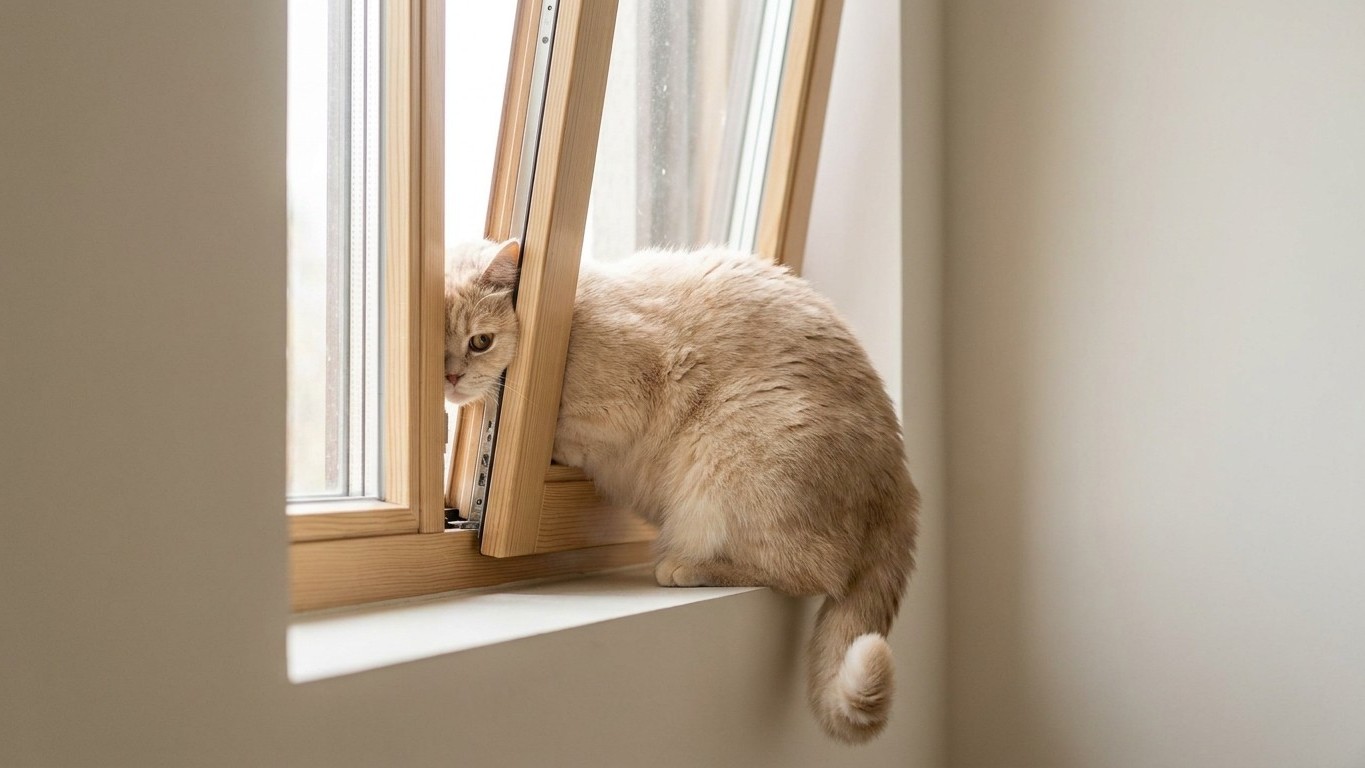
Every May, as temperatures inch upward and British households crack open their windows for the first time in months, veterinary surgeries brace themselves. Not for the usual surge of grass-pollen allergies or stung paws, but for a specific, entirely preventable emergency that sends cats to the clinic in minutes. The culprit is the tilted window: that innocent, slightly-ajar position we leave it in to let air circulate while we nip out. For a curious cat, it is not ventilation. It is a trap.
Key takeaways
- A common European window design has become a deadly trap for curious cats, with a clinical condition named after it
- Collapse can happen in minutes, but trapped cats often appear fine after rescue—masking life-threatening internal injuries
- Simple, affordable protective devices can eliminate this risk entirely, yet most cat owners have never heard of it
The tilt window: an everyday object with deadly potential
One of the most overlooked hazards in modern homes comes from tilt windows, also known as Kippfenster, a style of window that tilts inward from the top, creating a narrow gap that seems harmless but can be a deadly trap for cats. The design is common across European-style housing, including many modern UK flats and new-builds, where tilt-and-turn mechanisms have become standard.
A cat’s attempt to get outside through a tilted window typically ends with the animal managing to squeeze its head and upper body through the gap, but then getting stuck with its hindquarters in the slanted opening. Any attempts to free itself only worsen the situation, causing the cat to slide further down into the gap. The geometry of the opening means that the bottom of the frame acts like a wedge, tightening its grip the more the animal struggles.
The risks depend on both the part of the body trapped and the length of time the cat has been stuck. If the chest is blocked, the animal faces asphyxiation as the ribcage is compressed. If the abdomen is caught, organs are compressed and blood cannot circulate normally, which can lead to necrosis of internal tissues, and crushing in the abdomen can also rupture blood vessels and cause internal haemorrhage. This is not a slow deterioration. Depending on the angle and the cat’s body weight pressing down against the frame, collapse can occur within minutes.
The condition has its own clinical name, “Kippfenster syndrome”, and presents a notable risk of injury and even death for cats living in areas where bottom-hung windows are common, particularly in Germanic countries such as Germany, Switzerland and Austria. But the problem is by no means limited to the continent. Tilting windows, tilt-and-turn windows or hopper windows represent a danger that many UK cat owners are simply not aware of.
Why spring and early summer are the most dangerous months
Cases of feline window accidents tend to spike during warm weather months when windows are open and outdoor spaces like terraces are in use more often. A 2025 peer-reviewed study published in the Journal of Feline Medicine and Surgery, analysing over 1,100 cases of cats treated for falls at a Berlin veterinary hospital, found that seasonal peaks occurred in summer, accounting for 77% of incidents, with most taking place at night.
The night-time peak has a logical explanation. The higher frequency of accidents during evening and night-time hours may reflect the working patterns of cat owners, who often leave their cats unsupervised during the day with windows closed for security reasons. When owners return home in the evening, windows and balcony doors are more frequently opened for ventilation, increasing the risk of falls and entrapments. So that well-intentioned decision to leave the window tilted before bed is precisely when the danger is highest.
Young, old, overweight, or indoor-only cats are at a higher risk of accidents around windows. Young cats in particular combine relentless curiosity with poor spatial awareness, they are more likely to be adventurous and push their limits, and they lack the experience with hazards found in older cats, making up a larger percentage of victims. A kitten born indoors in the winter months will be exploring its environment with fresh eyes just as the windows start opening in April and May. The timing is cruel.
What happens inside the body, and why it looks deceptively fine
The trauma from tilt window entrapment occurs when cats become accidentally trapped, often around the thoracolumbar area, leading to varying degrees of organic hypoperfusion that can affect various structures, including the spinal cord, muscles, nerves and kidneys, depending on the severity of the trauma. The comparison in the medical literature is sobering: in human medicine, a condition observed during earthquakes is termed “crush injury”, when a body part is trapped under heavy pressure, preventing blood flow and causing tissue ischaemia. Upon removal of the compression, muscle and neurological disturbances may occur, along with severe systemic effects including acute kidney injury. A tilt window exerts exactly this kind of crush force on a small animal.
The really dangerous part is what happens after you free the cat. Cats are barely able to signal that they are in pain or injured. The shock and adrenaline released during entrapment often lead the cat to appear calm or even to walk around after being released. Owners frequently assume all is well. It is not. Neurological abnormalities can range from mild deficits to complete paralysis, and typically both hind limbs are affected, though deficits in a single limb or all four are also possible. These signs may only emerge hours later, long after the window has been shut and the incident mentally filed away as a near-miss.
Always take your cat straight to a vet after any tilt window incident, even if they seem perfectly normal. The prognosis depends greatly on the severity of the injuries, the time of diagnosis, and the response to treatment. With immediate veterinary care, the prognosis can be favourable — but if the cat is found late or complications such as blood clots develop, the outlook worsens significantly.
Practical steps every cat owner should take before summer
The good news is that this is entirely preventable with a small amount of preparation. Never leave windows in a tilted position when your cat is unsupervised. If you need ventilation, tilt the window only when you are at home and able to intervene, when you’re out, keep them closed. For those who rely on tilt-and-turn windows for airflow, several specialised protection devices are available, including safety grills that cover the gap when a window is tilted, window stoppers that limit how far it can open, and protective blocks that prevent the creation of a dangerous narrow opening.
Standard fly screens offer no real protection and should never be relied upon, cats can easily tear through screening materials or push frames out of their position. If you are a renter and need landlord permission for permanent fixtures, most landlords will accept temporary, non-damaging solutions — it is worth asking, because the alternative could mean an emergency vet bill and a very unwell cat.
If you do find your cat trapped, never pull them free forcefully, as this can worsen injuries. Instead, gently support their body weight while carefully manoeuvring them. If the cat is wedged in the window gap, adjust the window position slightly to create more space, doing this gradually to avoid additional trauma. Then wrap them in a blanket and drive directly to the nearest vet.
One detail worth knowing: the average fall height in documented feline window cases is between 8 and 15 metres, with the majority of cats landing on hard surfaces. But tilt window syndrome is distinct from falling, a cat can be dangerously trapped in a first-floor window just centimetres off the ground. Height is irrelevant when the window itself is the weapon.
Sources : quora.com | pmc.ncbi.nlm.nih.gov