
Most cat owners heading to the vet have the same ritual: pop the cat carrier on the back seat, clip the seatbelt loosely around it if they’re feeling organised, or simply leave it to slide around the boot. That last approach is now firmly on the wrong side of the law. In 2026, enforcement attention on Highway Code Rule 57 has intensified across the UK, and what many owners dismissed as a vague guideline is now being treated as a serious road safety requirement, one with financial consequences that can run into the thousands.
Key takeaways
- A quiet but serious UK law is being enforced in 2026 with penalties that dwarf your vet bill
- Most pet owners don’t know their insurance becomes void if an unrestrained animal causes an accident
- The difference between a legal and illegal cat carrier setup takes less than two minutes to get right
What the law actually says
Rule 57 of the Highway Code requires that when in a vehicle, dogs or other animals are suitably restrained so they cannot distract the driver or injure themselves or other occupants if the car stops quickly, and explicitly lists a seat belt harness, pet carrier, dog cage or dog guard as acceptable methods of restraint. The word “other animals” is the part most cat owners overlook. Cats, rabbits, and any pet being transported need to be safely restrained. A carrier tossed unsecured onto a back seat does not meet this standard. A cat roaming freely around the car absolutely does not meet it either.
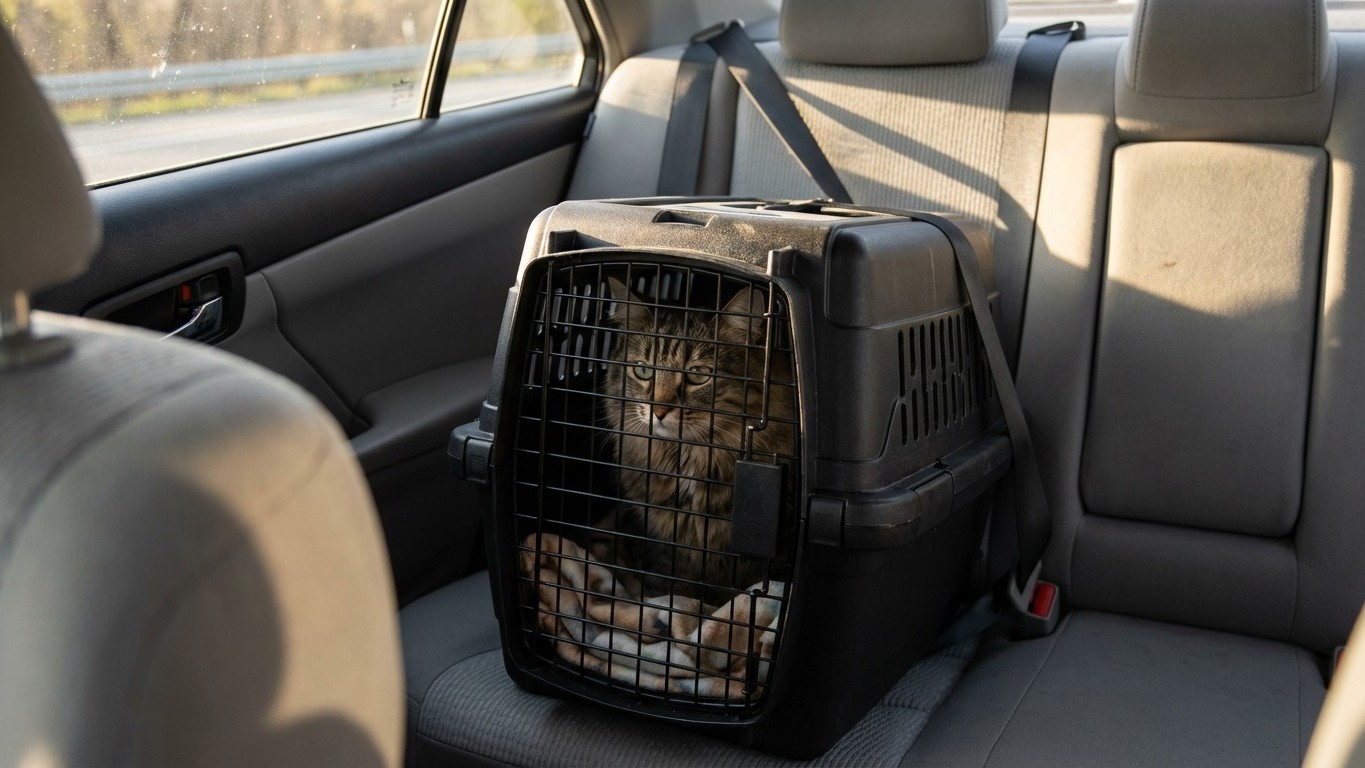
For small dogs and cats, a pet carrier is the recommended solution, but that carrier must itself be secured with a seatbelt or wedged firmly in the footwell behind the front seats, so it cannot slide or flip over. The carrier being there is only half the job. The carrier being fixed in place is the legal requirement.
A third of drivers have never even heard of Rule 57 of the Highway Code, and given how rarely it makes headlines compared to speeding or phone use, that’s not entirely surprising. But ignorance of the rule offers no protection when police decide to act on it.
The penalties: from an on-the-spot fine to court
While there is no direct penalty for breaching Rule 57 itself, police will use it to prosecute for more serious driving offences if a pet is unrestrained. If an unrestrained animal distracts the driver, police can issue an on-the-spot fine of £100 and 3 penalty points. That’s the lighter end of the scale. If the matter goes to court, fines can reach a maximum of £5,000, up to 9 penalty points on the licence, and even a driving ban or compulsory re-testing.
The insurance angle is the more pressing concern for most owners. If a driver is involved in an accident and their pet was unrestrained, most UK insurers will rule that the driver was acting negligently, invalidating the insurance policy entirely. That means not just no payout for the car, but potential personal liability for all costs and damages arising from the accident. For a quick trip to the vet, the financial exposure is disproportionate to the two minutes it would take to clip the carrier in properly.
A study found that nearly two thirds (64%) of UK motorists are unaware that driving with an unrestrained pet could lead to a fine of up to £5,000, and less than half (48%) of pet owners know that driving without properly restraining their animal could invalidate their car insurance. Those figures suggest a widespread and entirely avoidable problem.
How to transport your cat correctly
Getting this right is genuinely straightforward. For smaller animals like cats, a travel cage, crate or carrier is best, placed in the boot or secured on the rear passenger seats with the seatbelt. Smaller carriers can also go in the passenger footwells, but never on the front seats because of the airbag risk.
Cats can be anxious travellers. A strong plastic cat carrier that allows for privacy, with ventilation holes, works well, and lining it with a soft blanket the cat uses at home makes the environment familiar and carries their scent. The carrier should be firmly secured in the car, and since car seats can be uneven, placing a blanket under the carrier creates a level surface so the cat feels steady. These aren’t just comfort measures — they also keep a panicked cat from shifting the carrier’s weight distribution during sharp braking.
Cats may find it easier to go in carriers if they are allowed to use one as a sleeping or hiding place at home. Leaving the carrier out between vet visits, with a blanket inside, means the cat associates it with rest rather than dread. Fewer distressed cats means fewer drivers distracted by howling from the back seat, which is, ironically, exactly what Rule 57 exists to prevent.
Why this matters beyond the fine
The physics of a car accident are worth holding in mind. A cat weighing around 4kg, travelling in an unsecured carrier at 30mph, becomes a projectile exerting many times that force on impact. Having loose animals in the car can cause serious injuries to themselves and other occupants if they are propelled forwards when the car comes to a stop. This is not hypothetical, it’s the same principle that led to mandatory child car seats.
Simple methods like collar leads attached to a seatbelt, or mere luggage guards, are generally considered insufficient to comply with Rule 57. A carrier needs to be genuinely fixed. If in doubt about the most appropriate restraint option for your specific cat or carrier, your vet is a good first point of contact, they see animals post-accident, and they’ll have a clear view on what actually works.
One detail worth knowing for emergencies: if you break down on the motorway hard shoulder, Rule 275 of the Highway Code states you should leave animals in the vehicle, or in an emergency, keep them under proper control on the verge, meaning on a short lead close to you so they cannot wander. A cat loose in a car during a breakdown stop is a separate hazard entirely, which is another reason why a well-secured, enclosed carrier is the only sensible option for feline travel.
Sources : gbnews.com | petz.uk