
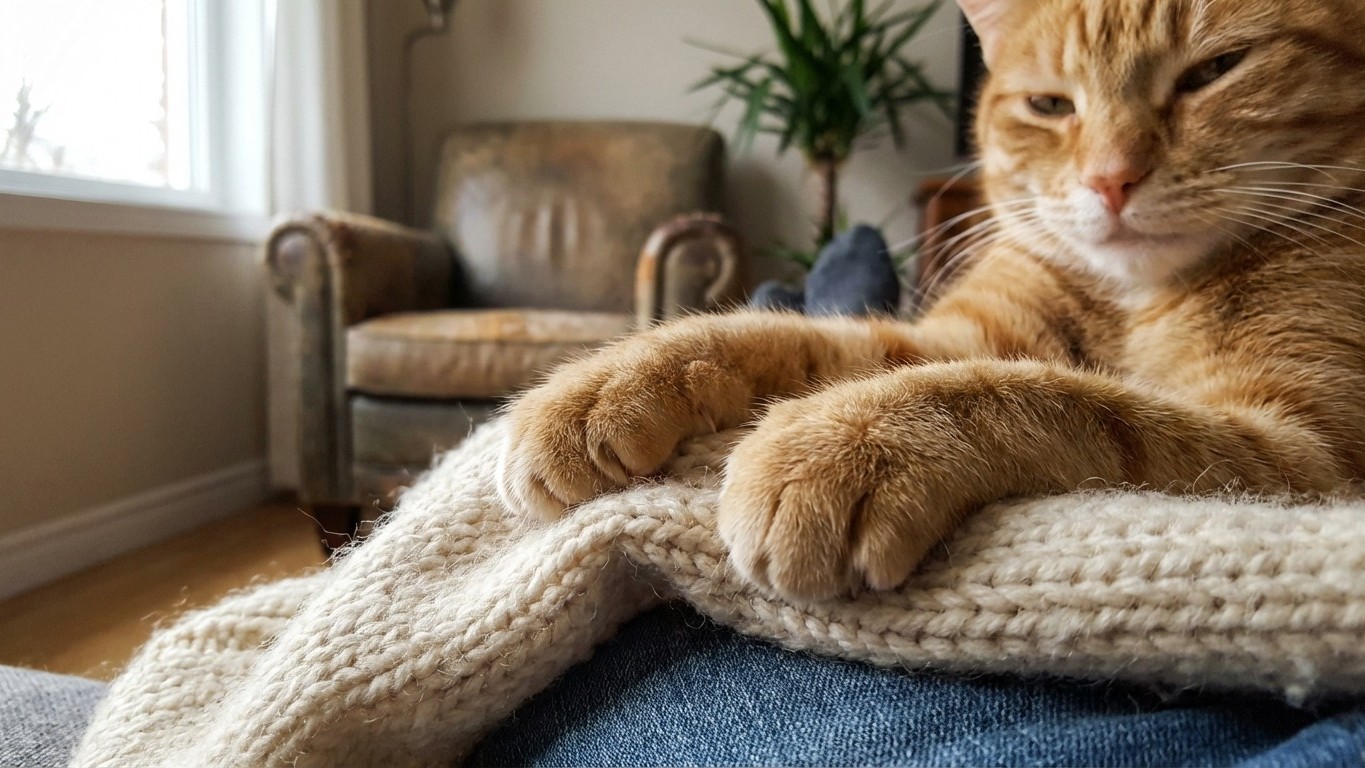
Every evening, as you settle onto the sofa with a cup of tea, your cat appears, climbs onto your lap, and begins that slow, rhythmic pressing of paws. Push, release, push, release. It’s one of the most endearing things a cat does, yet remarkably few owners understand what it Actually-works/”>Actually communicates about their feline companion’s wellbeing. The good news? Vets say it reveals quite a lot.
Key takeaways
- Kneading is actually your cat treating you like family—here’s the science behind why
- When sudden changes in kneading patterns might be your cat’s way of signaling something’s wrong
- The hidden reason cats knead harder when they feel safest with you
The Science of “Making Biscuits”
The behaviour has been nicknamed “making biscuits” for obvious reasons, kneading is the rhythmic motion cats make by pushing their paws into a soft surface, alternating between left and right paws. It looks Exactly like a baker working dough. But the origins of this habit go deeper than any culinary metaphor.
Cats first begin to knead when just tiny kittens, still nursing from their mother. Kneading is associated with suckling, which helps stimulate a mother cat’s milk supply through the release of oxytocin, and likely evolved for this reason. Here’s the part that surprises most people: the behaviour carries far beyond kittenhood into adult life, and it does so for a very specific reason tied to our relationship with our cats. According to Dr Lauren Finka, cat behavioural expert from Cats Protection, “Kneading is a really interesting behaviour in that it hasn’t been researched in-depth scientifically. There could be a lot we don’t know regarding its function.” What we do know, though, points to something genuinely touching.
Kneading, meowing, and purring are all things that humans unknowingly encourage cats to maintain in their repertoire. Free-living domestic cats that aren’t socialised towards humans don’t tend to perform these behaviours when they leave the nest. To them, those behaviours are something they mostly only do when they’re around their littermates and their mother. So when Your Cat Kneads your lap at 8 o’clock every evening, they are, in the most literal sense, treating you like family.
What It Tells You About Your Cat’s Emotional Health
Kneading on your lap is a cat’s way of saying “we’re affiliated” or “you’re in my social group”, or, to be very human about it, “you’re my person.” That’s a significant statement from an animal not exactly famous for wearing its heart on its sleeve.
The American Association of Feline Practitioners (AAFP) explains that kneading is often associated with feelings of contentment and relaxation in adult cats. It’s a behaviour commonly observed when they are in a state of comfort, such as when they’re settling down for a nap or enjoying affection from their human companions. Experts suggest kneading may even release the bonding hormone oxytocin. Essentially, your cat isn’t just feeling safe, she’s actively generating that feeling of safety through the action itself.
There’s also a territorial layer to this. Cats have scent glands in their soft paw pads, and when they knead, these glands release pheromones. Kneading on their mother releases pheromones associated with bonding, identification, health status, or many other messages. If it’s your lap that they favour, they’re probably covering you with their scent. This doesn’t only let other cat competitors know that you’re off-limits; it also means that when they sleep on your lap, you smell familiar. You are, quite literally, being claimed. Most of us consider this a compliment.
The regularity of it matters too. Kneading is more common in cats with strong bonds to their families. If it happens every evening, Without fail, that routine itself is a signal of a settled, secure cat, one who feels her environment is predictable and safe. Cats thrive on routine, and a cat who kneads on schedule is telling you the household emotional temperature is just right.
When Kneading Becomes a Health Warning Sign
Here’s where it gets genuinely useful to pay attention. Most of the time, evening kneading is healthy and normal. But a sudden change in this behaviour deserves a closer look. If your cat kneads excessively or suddenly kneads less than usual, it could mean that they don’t feel well. Because kneading is a comforting action, cats who feel stressed or are experiencing pain may knead to soothe themselves.
Certain medical conditions can increase the frequency or intensity of kneading in cats. Anxiety or stress can lead to more pronounced kneading as cats seek comfort. Additionally, conditions that cause discomfort or pain, such as arthritis, might lead cats to knead more as a way to soothe themselves. It’s also important to consider that increased kneading could be a sign of neurological issues where repetitive behaviours become more common.
Kneading in cats is typically a normal behaviour, but it may become concerning under certain conditions. If kneading is accompanied by signs of distress, such as excessive meowing, changes in appetite, or unusual aggression, it could indicate underlying health issues. Additionally, if the kneading becomes obsessive or interferes with normal activities, it may be a sign of anxiety or discomfort. If paired with stress signs like tail flicking or rapid breathing, they may be trying to calm themselves. The kneading hasn’t changed its meaning, it still signals a need for comfort, but the underlying reason has shifted from contentment to distress. A vet visit is always the right call when behaviour changes suddenly or significantly.
Living With a Biscuit-Making Cat: Practical Advice
The main complaint owners have about kneading is an entirely understandable one: claws. The better a cat feels, the harder she is likely to knead. Which means a particularly joyful cat can leave your thighs looking like you’ve been helping with a bramble harvest.
The solution is straightforward. Keep your cat’s nails trimmed short to prevent injury to your skin and damage to your furniture from kneading. You can also place a blanket on your legs and stomach to provide a barrier between your skin and your cat’s claws if her kneading is uncomfortable for you. This allows you to preserve your bond with your cat while allowing her to perform a natural behaviour.
One thing vets and behaviourists agree on firmly: never punish a cat for kneading. You should never yell at or punish your cat. Remember that kneading is a natural behaviour, and your cat needs an acceptable outlet to express their instincts. Redirecting is always better than reprimanding. Reward kneading where the claws are kept to a minimum by showing more attention via patting or handing out a food treat when your cat is kneading the way you would like them to. Cats are perfectly capable of learning claw etiquette with a little patience and positive reinforcement.
If your cat doesn’t knead at all, incidentally, there’s no cause for concern. Some cats don’t knead at all. Just like people, cats are individuals and like to show that they are comfortable or affiliated with you in their own ways. Every cat has its own vocabulary of affection.
The evening kneading ritual, then, is one of the clearest windows into your cat’s inner world. A healthy cat who kneads your lap with regularity is showing you trust, contentment, and that deep, ancient sense of belonging that goes all the way back to her first days of life. The sharp claws are just part of the deal, and honestly, given what they’re trying to say, a blanket on your lap feels like a small price to pay.