
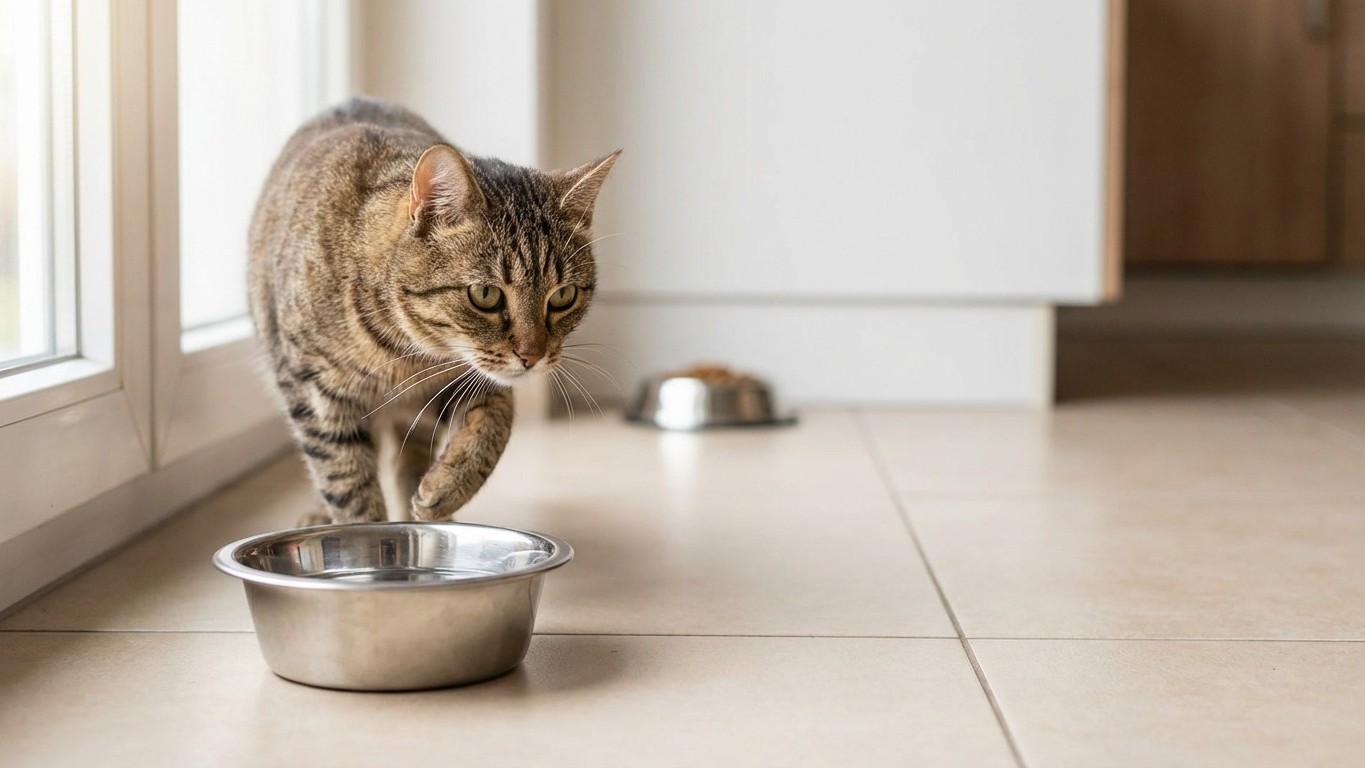
Cats are notoriously suspicious of their water bowls. If yours sniffs at it, walks away, and then later yowls dramatically as though they’re being slowly dehydrated in a desert, you’re not imagining the contradiction. The truth is, domestic cats have a genuinely complicated relationship with water, and understanding why completely changed how I approach my own cat’s hydration, and how I think about feline health more broadly.
Key takeaways
- Cats evolved in arid environments where they drank from prey, not puddles—a instinct that still drives their behaviour today
- Whisker stress from narrow bowls, bowl location, and even chlorine taste can all cause cats to reject water completely
- Running water fountains and wet food dramatically increase hydration in cats who won’t drink from static bowls
The wild ancestor problem
Here’s where things get biologically interesting. The domestic cat descends primarily from the African wildcat (Felis silvestris lybica), a creature that evolved in arid, semi-desert environments. These ancestors got most of their moisture from prey, not from standing water sources. Raw meat is roughly 70% water, which means a cat hunting mice and birds in the Saharan margins was Drinking Without ever approaching a puddle. That Instinct didn’t vanish when cats moved onto our sofas.
Because of this evolutionary background, cats have a naturally low thirst drive compared to dogs or humans. Their bodies are designed to concentrate urine efficiently, extracting as much moisture as possible before excretion. The problem? That efficiency was calibrated for a diet of wet prey, not the dry biscuits that fill the majority of British cats’ bowls today. Standard dry kibble contains around 10% moisture. A mouse contains around 70%. The maths is uncomfortable, and chronic mild dehydration in cats fed exclusively on dry food is a genuine welfare concern that vets see regularly.
Why your cat distrusts the bowl itself
Even when cats do want water, the bowl can be the obstacle. Cats have sensitive whiskers that register pressure and spatial information with impressive precision. A narrow or deep water bowl forces their whiskers to press against the sides while Drinking, a sensation many cats actively dislike. This is called whisker stress (or whisker fatigue), and while it sounds faintly absurd, it’s a real behavioural issue that explains why some cats prefer to stick a paw in the bowl and lick the water off their foot, undignified, but genuinely more comfortable for them.
Then there’s location. In the wild, water sources near food could signal contamination (a dead animal nearby would pollute the water). Many cats therefore instinctively prefer their water bowl placed away from their food bowl, and quite a few will reject water that tastes of chlorine or plastic. A stainless steel or ceramic bowl, placed a metre or two from the food station, often makes an immediate difference. My own cat, a stubborn tortoiseshell called Mabel, went from barely touching her bowl to drinking properly once I moved it to the other side of the kitchen. A small change, embarrassingly effective.
The running water revelation
Movement matters enormously. Cats are drawn to running water with a persistence that borders on obsession, watch any cat discover a dripping tap and you’ll see exactly what I mean. The evolutionary logic is sound: moving water is less likely to be stagnant or contaminated. It also catches light differently, which may help cats visually locate it, since their close-up vision isn’t their strongest suit.
Pet water fountains exploit this preference directly, and for many cats they genuinely improve daily intake. Circulating, filtered water tends to taste fresher and carry less of the flat chlorine note that tap water sitting in a bowl can develop over a few hours. I was sceptical, it seemed like an expensive gimmick, but the evidence from cat owners is consistent enough that most feline behaviour specialists now recommend them for cats who drink poorly. If you’re considering one, look for a model with a filter and a quiet pump motor; some fountains are loud enough to put a cautious cat off entirely. Always check with your vet before making significant changes to your cat’s diet or hydration routine, especially if there’s any existing kidney or urinary condition in the picture.
Wet food is the other lever worth pulling. Switching from dry-only to incorporating wet food, even once a day, can meaningfully increase a cat’s moisture intake without requiring them to change their drinking Behaviour at all. For cats with early kidney disease or a history of urinary crystals, this can genuinely matter. Your vet can advise on the right balance for your individual cat’s health profile.
When low water intake becomes a health concern
There’s a difference between a cat who drinks less than you’d expect (often fine, especially on wet food) and one who is actively showing signs of dehydration. Skin tenting, where you gently lift the skin at the scruff and it doesn’t spring back quickly — is one sign. Sunken eyes, lethargy, and very dark or strongly-smelling urine are others. Cats with kidney disease, diabetes, or hyperthyroidism may actually drink excessively, which is equally worth noting. Any sudden change in drinking habits, either way, warrants a vet visit. This isn’t a situation for home remedies or a wait-and-see approach.
Older cats are especially vulnerable. Kidney function naturally declines with age in cats, and senior cats often need more moisture in their diet even as their appetite and thirst cues become less reliable. A cat over ten is worth monitoring more carefully, and regular check-ups with water intake noted in conversation with your vet are a reasonable precaution.
What strikes me most about all of this is how much cat behaviour that looks like pickiness or indifference is actually just evolutionary logic playing out in an environment cats were never designed for. Mabel isn’t being difficult about her water. She’s being a cat, a desert animal in a terraced house in South London, doing her best. The question worth sitting with is how many other small adjustments we could make that would speak her language rather than expecting her to adapt to ours.