
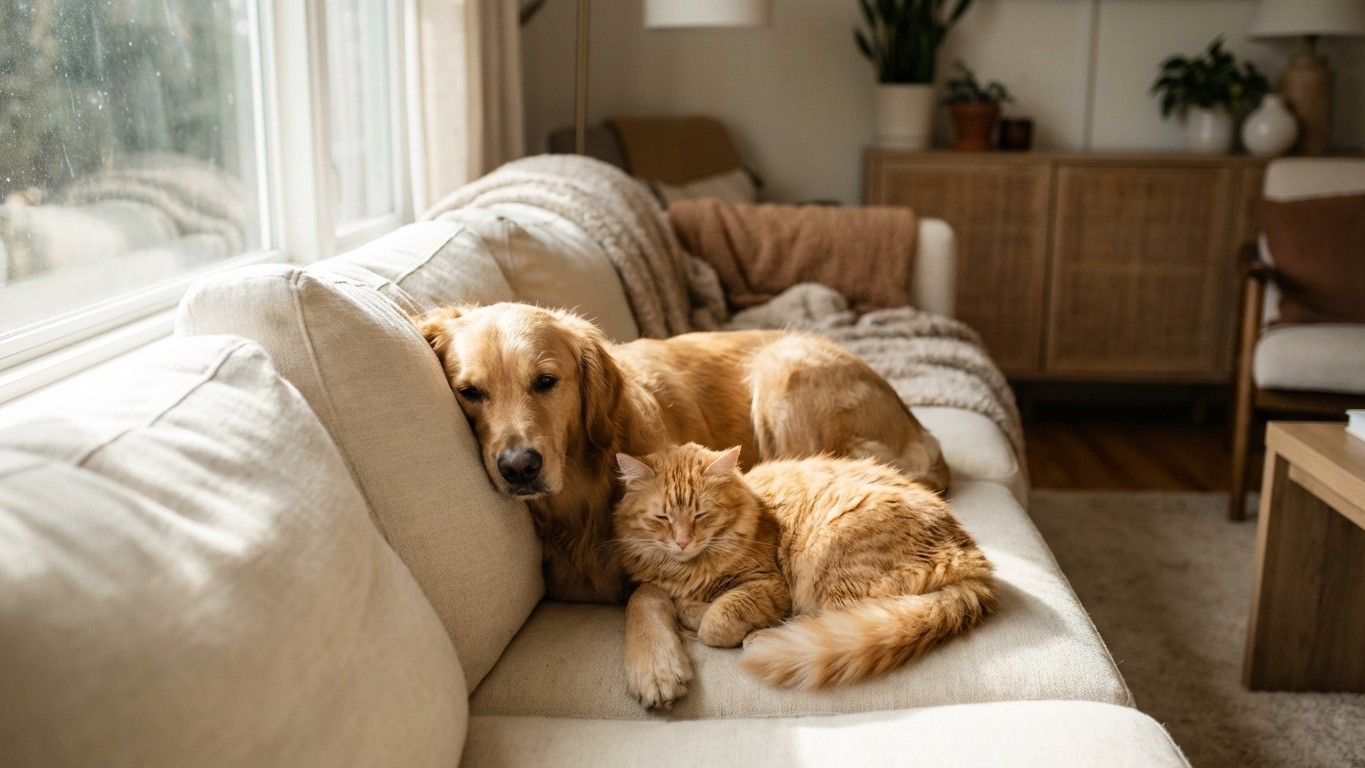
Bringing a dog into a home that already belongs to a cat (or vice versa) is one of the most common multi-pet dilemmas in British households. Get it right, and you’ll have two animals who sleep in the same sunny patch on the sofa. Get it wrong, and you’ll spend months playing referee. The good news is that with the right breed choice and a structured introduction process, peaceful cohabitation is genuinely achievable for most owners.
The key insight that gets lost in most breed lists is this: cat-friendliness isn’t a fixed trait stamped into a dog’s DNA. It’s a combination of genetic temperament, individual history, early socialisation, and how the introduction itself is managed. Breed selection matters, but it’s only one piece of the puzzle.
Why Choosing the Right Breed Matters for a Cat-Friendly Home
Not all dogs relate to smaller animals the same way. Some breeds were developed over centuries specifically to chase, flush out, or even dispatch prey animals that look, move, and smell remarkably similar to a domestic cat. A Greyhound clocking 45 mph after a lure, a Terrier bred to bolt rats from burrows, a Husky with strong pack predator instincts, these aren’t character flaws, they’re job descriptions written in genetics. Ignoring that when choosing a dog is setting yourself up for a very stressful household.
Choosing a breed with a naturally lower prey drive, a more sociable temperament, or a history of working alongside other animals genuinely shifts the odds in your favour. The dog breeds guide explores how lifestyle factors should drive breed selection more broadly, but when cats are in the picture, temperament compatibility becomes the central criterion rather than an afterthought.
Which Dog Breeds Are Known for Getting Along with Cats?
Top Breeds That Tend to Cohabit Peacefully
The breeds below consistently appear in veterinary and behaviourist recommendations for multi-pet households. They share traits worth examining: generally lower prey drive, sociable or adaptable temperaments, and a tendency to treat smaller household members as companions rather than targets. This isn’t a guarantee, every dog is an individual, but these starting points genuinely reduce the risk.
- Golden Retriever — famously gentle, eager to please, and typically unfazed by feline attitudes
- Labrador Retriever — sociable and food-motivated, which helps enormously during training
- Cavalier King Charles Spaniel — bred as a companion dog, tends to seek friendship rather than chase
- Bichon Frisé — small, playful, and generally lacks the predatory intensity of working breeds
- Poodle (all sizes) — highly intelligent, easily trained to respect boundaries, adaptable
- Basset Hound — low energy, slow-moving, and rarely bothered enough to chase anything seriously
- Pug — too interested in napping and eating to develop sustained feline obsessions
- Maltese — gentle lap dogs with minimal prey drive
- Beagle — scent-driven rather than sight-driven, and sociable with other animals when well socialised
- Border Collie — high intelligence allows strong training response, though herding instinct needs managing
What Makes a Temperament Cat-Compatible?
Three temperament traits predict cohabitation success better than breed name alone. The first is prey drive: how intensely does the dog respond to fast-moving small animals? A dog that freezes and stares at a running cat, pupils wide, whole body rigid, is showing you something important. The second is trainability and impulse control, a dog that responds reliably to a “leave it” command can be taught to override initial instincts. The third, often overlooked, is emotional sensitivity. Dogs that become anxious or aroused very easily tend to escalate encounters with cats, even without predatory intent. A confident, calm dog is a safer housemate than a nervous, reactive one.
Breed temperament is shaped by function. Herding breeds like Border Collies may not want to harm a cat, but their instinct to chase and circle can terrify a feline. Spaniels and retrievers, bred to work closely with humans and other animals, tend to default to curiosity rather than pursuit. Sight hounds, Whippets, Greyhounds, Salukis, have the fastest prey-to-chase response of any group, though many ex-racing Greyhounds are successfully rehomed into cat households after careful assessment. The individual always trumps the generalisation.
Puppy or Adult Dog: Does Age Change the Equation?
The age debate is genuinely nuanced. Puppies are often easier to socialise with cats because they haven’t yet solidified predatory habits, and cats are more likely to assert dominance over a small, wobbly pup than to flee from one. Early positive exposure to cats during the socialisation window (roughly 3 to 14 weeks) can establish a foundational familiarity that lasts a lifetime.
Adult dogs, though, aren’t a lost cause, far from it. A calm, well-trained adult dog with a known history of living with cats can actually be a safer bet than an unpredictable puppy who might lunge excitedly simply from the thrill of a new moving thing. Rescue organisations often cat-test their dogs specifically so adopters know what they’re working with. If you’re considering adopting an adult dog, asking about that assessment is worth doing before you commit. For a broader look at how age and lifestyle factors interact with breed choice, the best dog breeds guide for families with children covers complementary ground on matching dogs to household dynamics.
Key Steps for a Successful Dog-Cat Introduction
Preparing Your Home Before the New Arrival
Before the dog even sets a paw through the front door, your cat needs resources that are completely dog-proof. That means elevated feeding stations the dog cannot reach, a litter tray in a location the dog cannot access, and at least one “cat-only” zone where the dog is never permitted. A baby gate with a small cat-flap cut into the lower panel is a practical solution that gives cats free movement while keeping the dog sectioned off.
Scent swapping before the first face-to-face meeting is a step that’s easy to skip and genuinely useful. Leave a blanket or toy from the cat in the dog’s space and vice versa. Both animals will spend time processing each other’s scent chemistry long before any visual encounter, which takes some of the shock out of the first meeting.
The First Meeting: What to Do (and What Not to Do)
The single biggest mistake owners make is letting the dog off-lead for the first meeting. The cat bolts, the dog chases, the cat hides for three weeks, and the relationship starts from a place of fear. Keep the dog on a lead and allow the cat to approach entirely on its own terms. If the cat chooses not to appear for the first few days, that’s completely normal and shouldn’t be forced.
Watch the dog’s body language with real attention. A dog that glances at the cat and then looks away is offering a calming signal, which is positive. A dog that fixes on the cat with a hard stare, lowers its head, or goes still with tension in the body is showing predatory focus. Redirect immediately, a food reward given for disengaging from the cat creates a positive alternative behaviour. Over multiple short, controlled sessions, the novelty of the cat diminishes and the dog’s arousal level typically drops.
Signs to take seriously: lunging, snapping at air, whining with intense fixation, or any attempt to corner the cat. These aren’t phases that pass on their own, they require a behaviourist’s input.
Managing Day-to-Day Life in a Multi-Pet Household
Consistency builds trust faster than any single technique. Feed both animals at the same times each day but in separate locations, so neither feels competitive pressure around food. Give the dog adequate exercise, a tired dog is a calmer dog, and a calmer dog is a safer housemate. The cat’s vertical territory (shelves, cat trees, window perches) should be maintained and expanded where possible, since height is a cat’s primary safety mechanism.
Over weeks and months, most cat-and-dog pairs establish their own unwritten rules. The dog learns which rooms belong to the cat, the cat learns that the dog’s presence doesn’t signal danger. Some pairs become genuinely close. Others maintain a polite, functional distance. Both outcomes represent success.
Breeds and Profiles to Approach with Caution
High Prey Drive Breeds
Certain breeds carry such strong instinctual responses to small, fast-moving animals that cohabitation with cats requires exceptional management and is sometimes not advisable. Siberian Huskies, Alaskan Malamutes, and most sight hounds have been shaped by millennia of selection for exactly the behaviour that puts cats at risk. This doesn’t mean every individual is dangerous, it means the margin for error is much smaller, and the owner’s commitment to training and supervision must be correspondingly higher.
Working terriers (Jack Russells, Airedales, Patterdale Terriers), dogs bred specifically to hunt and kill small animals, are another category worth careful thought. Some do live happily with cats they’ve known since puppyhood. Others will never reliably suppress that drive. A frank conversation with a breed-specialist rescue or an experienced behaviourist is worth having before bringing any high-drive dog into a home with cats.
Training and Behavioural Support
For dogs with moderate prey drive or those who showed initial tension during introductions, reward-based training with a qualified animal behaviourist (look for someone accredited through the Animal Behaviour and Training Council) can make a substantial difference. The goal isn’t to suppress the dog’s instincts entirely but to build reliable impulse control, so that the dog chooses to disengage when asked, even when stimulated. This work takes weeks, sometimes months, and requires consistency from everyone in the household. If multiple family members are involved, the best dog breeds guide for families with children has useful context on managing complex household dynamics with dogs.
Older dogs who have had negative or uncontrolled experiences with cats in the past may carry those associations and need more structured desensitisation. Always consult a vet first if a dog shows aggressive behaviour, since some reactive behaviour has a medical component that’s worth ruling out.
Common Questions About Dog-Cat Cohabitation
Which breeds adapt to cats most naturally? Golden Retrievers, Cavalier King Charles Spaniels, Poodles, and Labrador Retrievers are consistently cited as among the most adaptable, combining low prey drive with strong trainability. That said, individual personality always needs assessing alongside breed tendency.
How should you introduce a new dog to a resident cat? Gradually, over days or weeks, using scent swapping first, then visual contact through a barrier (baby gate or glass door), then supervised on-lead meetings in the cat’s own space. Reward calm behaviour from the dog heavily. Never force the cat to interact before it chooses to.
What signals suggest a dog might attack a cat? Hard, fixed staring, body lowered and still, tail rigid (not necessarily wagging), sudden lunging, or snapping. A dog that cannot be recalled away from the cat by voice or food reward is showing a level of drive that needs professional help.
Does a puppy really adjust better than an adult dog? Often, yes, but an adult dog with a known, cat-friendly history can be a more predictable and safer choice than an unknown quantity of a puppy. Age matters less than individual temperament and history.
Going Further: Resources and Next Steps
The decision to add a dog to a cat household is one of the most consequential choices a pet owner makes, and it deserves proper research. If you’re still working out which type of dog fits your lifestyle most broadly, the dog breeds guide is a strong starting point for matching breed characteristics to your daily reality. Households with older adults as well as cats will find complementary guidance in the dog breeds guide for seniors, which focuses on low-stress, low-maintenance breeds that often happen to be excellent cat companions too.
Whatever breed you choose, the quality of the introduction process matters as much as the dog’s genetic disposition. The animals can’t manage this relationship by themselves, they need you to set the conditions that make trust possible. Most cats and dogs, given time, patience, and decent management, find a way to share a home. A few even find a way to share a sofa. That first image of your dog and cat curled up together is not the starting point. It’s the reward for doing it properly.