
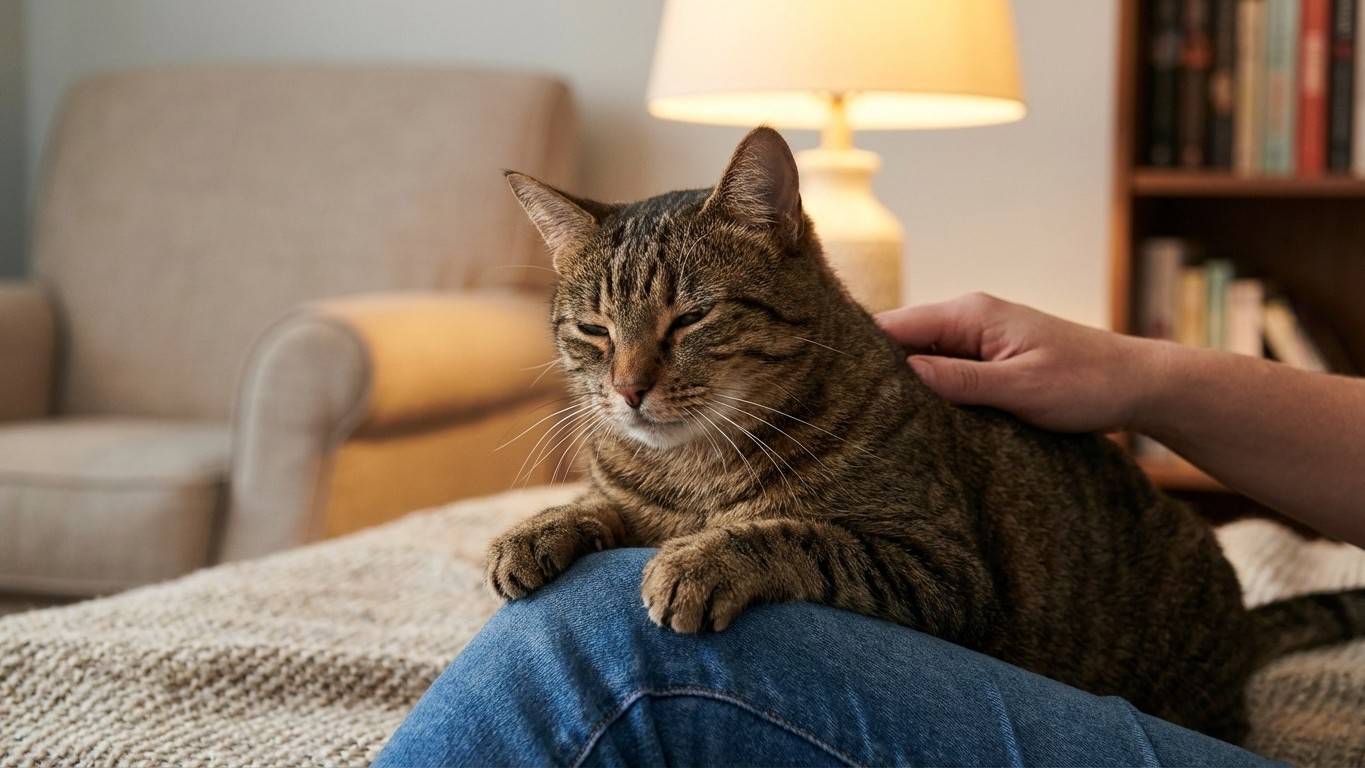
That slow, rhythmic pushing of paws against your thighs, alternating left and right with an almost hypnotic regularity, if you share your life with a cat, you know exactly what this looks like. And if you’ve ever wondered whether it means something beyond “my cat is being cute”, the answer is yes. Quite a lot, Actually.
Key takeaways
- Kneading starts as a survival reflex in kittens but transforms into something far more meaningful in adult cats
- Your cat is literally marking you as family through scent glands in their paws while creating a safe, comfortable space
- The evening timing and slow blinks that accompany kneading reveal exactly how deeply bonded your cat feels to you
Where the behaviour comes from
Kneading, sometimes called “making biscuits” by devoted cat owners across the internet, begins in the first hours of a kitten’s life. Newborn kittens push rhythmically against their mother’s belly to stimulate milk flow. The pressure activates the mammary glands, and the kitten gets fed. Simple, vital, ancient. What’s striking is that this reflex doesn’t disappear once a cat grows up and no longer depends on its mother for food. It gets repurposed.
Adult cats carry the behaviour forward into their domestic lives, redirecting it towards the things and beings they associate with comfort, safety, and warmth. Your lap, is being treated like the feline equivalent of a beloved mother’s belly. Some people find that image endearing. Others, particularly those on the receiving end of unclipped claws, find it slightly less so.
There’s a second origin story worth mentioning. Before cats became our sofa companions, their wild Ancestors would knead grass or leaves to create a soft resting spot, or to check for hidden hazards before settling down. So your cat may also, on some ancient level, be preparing you as a suitable sleeping surface. Which is oddly flattering, if you think about it.
What your cat is actually telling you
The evening timing you’ve noticed isn’t random. Cats tend to knead when they’re relaxed, warm, and feeling socially bonded. After a day of napping, watching birds through the window, and generally existing on their own terms, the evening often brings a shift towards closeness, and kneading is one of the clearest Signals that your cat considers you a safe attachment figure.
Scent glands in the paws play a role here that often gets overlooked. Cats have scent glands between their toe pads, and kneading deposits pheromones onto whatever surface they’re pushing against. Your cat isn’t just expressing contentment; it’s also, in a very feline way, claiming you. Marking you as familiar, as theirs, as part of their territory in the warmest possible sense of that word.
Purring often accompanies kneading, and the two together create what behaviourists describe as a state of deep relaxation and social bonding. Some cats will also knead while staring directly at you with slow, half-closed eyes, the famous “slow blink” that cat lovers have long suspected means something positive. The research broadly supports that suspicion. A cat making eye contact, blinking slowly, and kneading simultaneously is about as demonstrative as cats get.
Not every kneading episode is about love and bonding, though. Cats sometimes knead when anxious, using the repetitive motion as a self-soothing mechanism, similar to how some people might tap their foot or fidget when stressed. Context matters. A cat kneading on a familiar lap while purring is expressing comfort. A cat kneading obsessively in a corner, especially if accompanied by other signs of distress like over-grooming or hiding, might be worth mentioning to your vet.
The claw situation, and what to do about it
Here’s the practical side of things, because however touching the behaviour is, twenty minutes of needle-sharp kneading through thin trousers is an experience that tests even the most devoted cat owner’s patience.
The most straightforward approach is to keep your cat’s claws regularly trimmed. A vet or Veterinary nurse can show you how to do this safely at home, and most cats tolerate it reasonably well once they’re accustomed to the routine. Cats should never be declawed, this is a surgical procedure that involves removing the last bone of each toe, and it causes lasting pain and behavioural problems. Thankfully, it’s illegal in the UK, and trimming remains the sensible, welfare-conscious alternative.
A thick blanket kept specifically on your lap for evening sessions can make the experience far more comfortable Without disrupting the ritual for your cat. Some cats will accept a soft cushion or folded jumper between themselves and your legs. The key is not to push the cat away sharply or punish the behaviour, that creates confusion and erodes exactly the trust the cat is trying to express through kneading in the first place.
If you want to gently discourage particularly vigorous sessions, moving your cat to a comfortable spot beside you rather than on you, while still offering strokes and warmth, tends to work better than any more abrupt intervention.
Should you ever be concerned?
For the vast majority of cats, kneading is simply a healthy, happy behaviour that tells you your relationship with your pet is a good one. That’s worth savouring. Cats are often mischaracterised as aloof or indifferent, but behaviours like kneading tell a different story, one of attachment, trust, and a deep sense of ease in your presence.
That said, any sudden change in behaviour is always worth paying attention to. If a cat that used to knead regularly stops doing so, becomes less physically affectionate, or shows other changes in routine, a vet check is a sensible step. Changes in behaviour are often the earliest sign that something physical or emotional is off, and cats are notorious for masking discomfort until it becomes quite significant.
So the next time your cat settles onto your lap on a quiet Tuesday evening and begins that slow, deliberate rhythm, you’re not just a convenient warm surface. You’re the closest thing your cat has to home. Whether that makes the claw situation more tolerable is, of course, entirely up to you.