
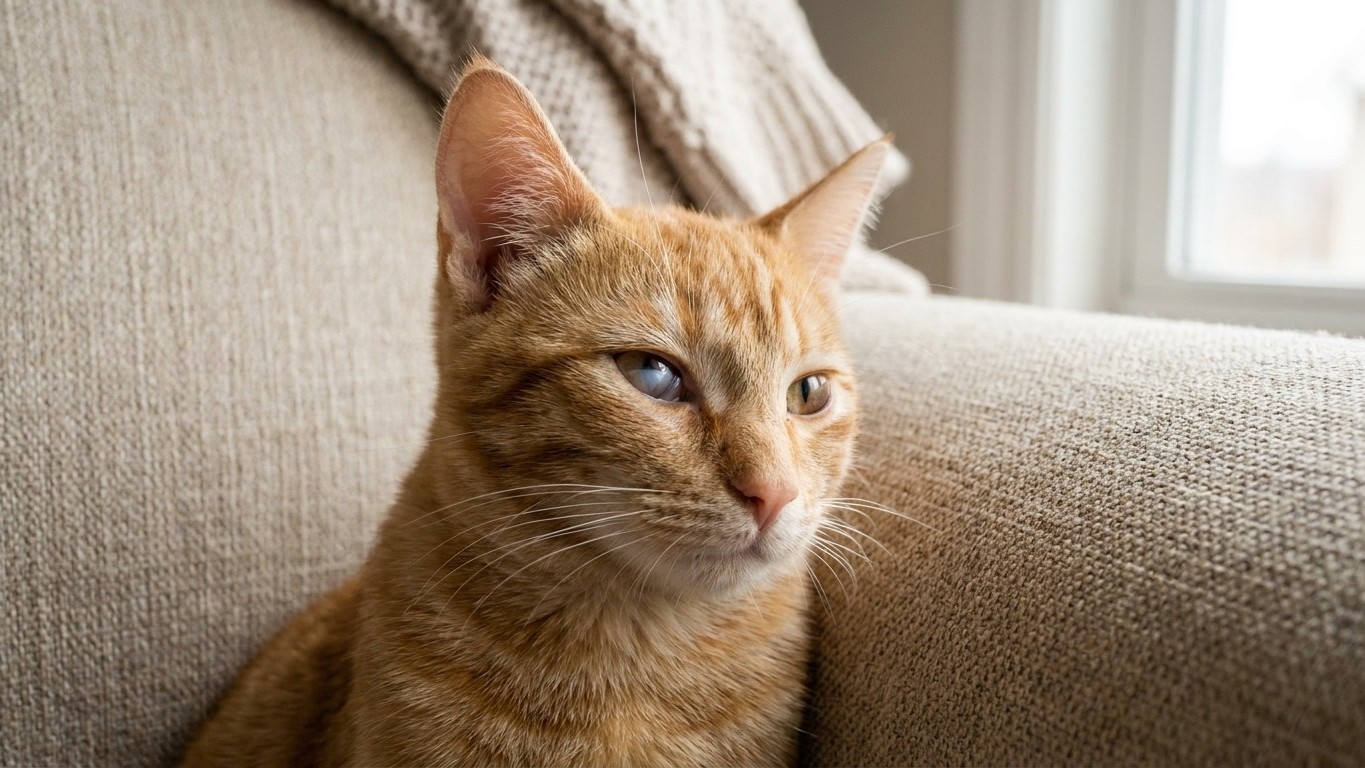
That milky white film wasn’t conjunctivitis, an infection, or dry eye. It was Haw’s syndrome, a condition where the cat’s third eyelid rises up and covers part of the eyeball, and it almost always points to something happening in the gut, not the eye socket. No amount of eye drops was ever going to fix it, because the eye itself was perfectly healthy the whole time.
Cats have a structure most owners never think about until it suddenly becomes visible: a nictitating membrane, tucked away in the inner corner of each eye. The third eyelid in cats and in other species is a critical component in keeping the eye protected, and it becomes raised to physically protect the eye and help distribute tears across the surface. It’s usually invisible, hidden away doing its quiet job. When it creeps up and stays up on both eyes, that’s when vets start asking about litter tray habits rather than reaching for antibiotic drops.
Key takeaways
- That cloudy white film on your cat’s eye might be Haw’s syndrome—a condition that has absolutely nothing to do with the eye itself
- A newly adopted kitten with this condition spread it to three other cats in the same house within two weeks—revealing a contagious trigger
- The fix isn’t eye drops; it’s solving what’s happening in your cat’s digestive system, and vets use a clever 20-minute test to confirm it
Why the eye drops were doomed from the start
The confusion is understandable. A whitish film across the eye screams “eye problem” to most of us. But Haws syndrome is an elevation of the third eyelid in both eyes, and this transparent eyelid moistens and covers the eye for protection. Crucially, Haws syndrome is not associated with diseases inside or outside of the eyeball, nor the socket. That’s the sting in the tail for anyone who’s already bought a bottle of drops: you can flush, soothe and medicate the eye all day long, and the membrane will stay put until whatever triggered it settles down elsewhere in the body.
So what actually causes it? Vets still don’t have a full answer, but the pattern is consistent enough to be useful. The exact cause of Haws syndrome is unknown, also called idiopathic, but it may be caused by a temporary change in the nerve function of the third eyelid, and it’s most commonly seen following an episode of diarrhoea or gastrointestinal disease such as having worms. A 2024 study published in Veterinary Record looked at this in detail and found something genuinely intriguing: the condition is likely triggered by a contagious gastrointestinal pathogen that presumably affects the gut microbiota and thereby influences the sympathetic nervous system via the gut‒brain axis. something disrupts the gut, the gut talks to the nervous system, and the nervous system tells the third eyelid to rise. It’s a strange, roundabout piece of biology, and honestly, it’s one of the more fascinating quirks I’ve come across in feline anatomy.
That same study recruited ten cats with sudden bilateral third eyelid protrusion for testing, and the findings back up what vets have suspected for years. Diarrhoea was noted in four of 10 cats, and tests for the presence of Giardia were positive in four of nine tested cats. Interestingly, one household outbreak showed just how contagious the underlying trigger can be: a newly adopted kitten with haws syndrome and diarrhoea caused the condition to develop in the other three cats from the same multicat household within 4‒11 days. If you’ve got multiple cats and one develops this white film, keep a close eye on the others too.
How your vet actually confirms it
A good vet won’t just glance and diagnose. There’s a proper test involved, and it’s rather clever. Your veterinarian may do a phenylephrine challenge, where phenylephrine eye drops are applied to the eyeballs to see if the third eyelids return to their normal position within 20 minutes; if they do, then Haws can be confirmed. This rules out other, more serious causes of a raised third eyelid, things like corneal ulcers, foreign bodies, or Horner’s syndrome, which can look similar but need entirely different treatment.
Age matters too. Haw’s syndrome is uncommon and tends to affect young adult cats, under two years of age. If your cat falls into that bracket and has had a recent tummy upset, the pieces start fitting together quickly. The good news, and it really is good news, is that the eyes themselves come to no harm. Haw’s syndrome doesn’t affect the cat’s eyesight, as the structures inside their eyeballs are normal, though if the third eyelid is covering a lot of the eye it can obscure their vision. Your cat isn’t in pain either; the discomfort, if there is any, lives in the gut, not the eye socket.
What treatment actually looks like
Here’s where owners often feel a bit deflated after spending money on the wrong thing: there’s frequently nothing to prescribe for the eye at all. Typically, this condition is self-limiting and resolves on its own. The real work goes into the gut. That might mean a faecal test for parasites, a course of dewormer, or supportive care for diarrhoea, whatever the underlying trigger turns out to be. There’s no specific treatment for Haws syndrome itself, but the outlook is good as it generally resolves by itself once any underlying gastrointestinal issues are successfully treated.
Patience is genuinely part of the treatment plan here, more than people expect. In one study, the average duration for the third eyelids to return to their normal position was 47 days, though it’s important to note that this data was based on a limited number of cases. That’s over six weeks of a slightly odd-looking cat before things settle. If the membrane is still up well beyond that window, or if only one eye is affected rather than both, that’s your cue to get back in the vet’s chair, because a one-sided film usually means a genuine, local eye problem after all.
The lesson from that £48 bottle of drops isn’t that eye drops are useless, they’re vital for real infections and injuries. It’s that a symmetrical white film across both eyes in a young cat is the body’s way of pointing a finger firmly at the digestive system, and no amount of soothing the surface will quiet that signal until the gut gets sorted first.
Sources : dialavet.com | bvajournals.onlinelibrary.wiley.com