
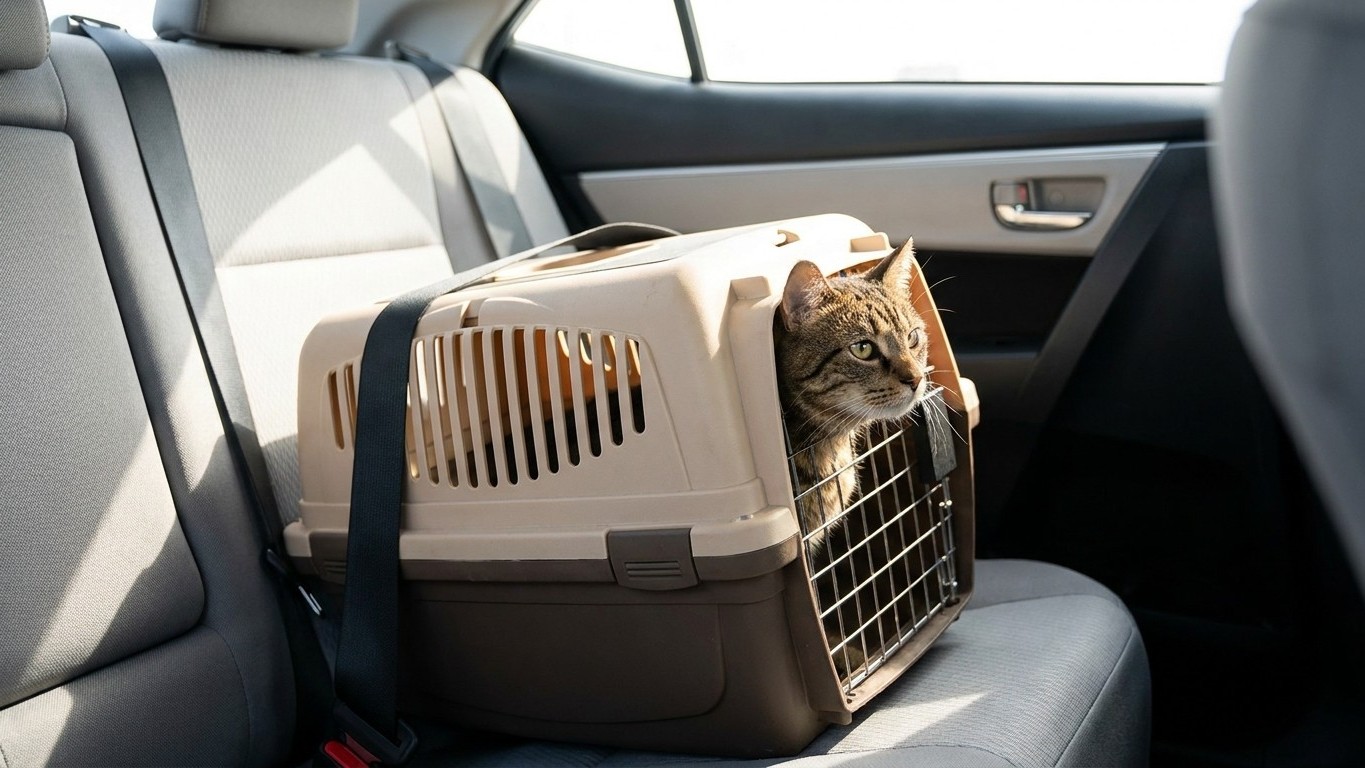
Rule 57 of the Highway Code makes no distinction between a boisterous Labrador and a mild-mannered tabby. Anything from a cat to a hamster falls under Rule 57 of the Highway Code, which says that whilst there is nothing wrong with taking your furry friend out for a drive, they must be secure in the car. That “just for the vet” carrier you keep folded in the cupboard is, legally speaking, supposed to come out for every single car journey your cat takes, not just the dreaded annual jab.
Plenty of owners genuinely believe the rule only applies to dogs, or only kicks in on motorways, or is some vague suggestion rather than something with teeth. None of that is true, and the confusion is exactly why so many cats end up travelling loose across the parcel shelf or curled on the back seat, blissfully unaware they’re breaking the law alongside their driver.
Key takeaways
- Cats loose in cars aren’t just unsafe—they’re breaking the Highway Code and could trigger £5,000 fines if they cause an accident
- Your insurer can deny claims if an unrestrained pet is listed as a contributing factor to a crash
- In a collision, a four-kilogram cat becomes a projectile with enough force to injure children and break windscreens
What the Highway Code actually says
Rule 57 states that when in a vehicle, dogs or other animals must be suitably restrained so they cannot distract the driver or injure themselves if the car stops quickly, and suggests a seat belt harness, pet carrier, dog cage or dog guard as acceptable methods. Here’s the twist that catches people out: it is not technically an offence to travel with an unrestrained pet, but it could count against you if you have an accident. The rule itself carries no fixed penalty notice you’ll be handed on the spot for a loose cat alone.
But that’s cold comfort, because the moment a wandering cat causes so much as a wobble of the steering wheel, the story changes completely. While there is no direct penalty for driving with an unrestrained pet, motorists could face charges of driving without due care and attention if they get distracted by their animals behind the wheel. A charge of this nature could come with a fine of £1,000 and penalty points, but if the case goes to court drivers could face fines of up to £5,000 and nine penalty points on their licence. Full Fact, which fact-checks viral claims for a living, confirms the mechanism rather than debunks it: the offence carries the possibility of an unlimited fine, possible disqualification from driving and between three and nine points on your licence, with the exact penalty depending on how culpable you were.
There’s a second sting most owners never see coming. Motorists distracted by their pet being loose in the car risk breaching the Highway Code, invalidating insurance or being in trouble with the police. Insurers can, and do, point to an unrestrained animal as a contributing factor when assessing a claim after a crash, which means the £400 excess you were braced for could suddenly become the full repair bill, out of your own pocket.
Why a loose cat is genuinely dangerous, not just untidy
I’ll admit my instinct with any anxious cat is to want to comfort them, and letting them clamber into my lap feels kinder than shutting them in a box. It isn’t. A cat’s flight response doesn’t switch off because you’re doing 40mph on the A34. Sudden braking, a rattling exhaust, a dog barking from another car, any of it can send a frightened cat scrabbling for the pedals, the gearstick, or your ankles at precisely the wrong moment.
The physics are unforgiving too. Vets and road safety bodies describe an unrestrained animal in a crash as effectively becoming a projectile. If an accident happens, the animal can be thrown forward and injured, acting like a missile within the vehicle and hitting other occupants. A cat weighing four or five kilograms travelling at motorway speed carries far more force on impact than most people imagine, enough to injure a child in a booster seat or break through a windscreen. That’s before you even factor in the cat’s own chances of survival, which drop sharply without a carrier.
None of this is theoretical scaremongering dressed up as journalism. Drivers can be fined up to £5,000 for travelling with their pets on the road, a warning that becomes especially relevant every summer as families set off on staycations with cats and dogs in tow. Cats Protection, the UK’s leading feline welfare charity, has also thrown its weight behind wider road safety measures for cats, underlining just how seriously the sector takes animals on Britain’s roads.
Getting it right without a fuss
None of this requires expensive kit or a personality transplant for your cat. A hard-sided carrier remains the gold standard for short hops to the vet or the cattery, but it needs securing properly rather than sliding around the boot or footwell.
- Wedge the carrier low and central, ideally in the footwell behind a front seat, so it can’t tip or slide during braking
- Thread a seatbelt through the carrier’s handle where possible, rather than trusting friction alone
- Cover the carrier loosely with a light towel to reduce visual stimulation on longer, busier journeys
- For house moves or holidays, consider a soft carrier with mesh panelling clipped into the back seat via the headrest straps
Cars, cabs and even breakdown recovery vehicles all expect the same standard. If your vehicle needs to be towed, breakdown recovery drivers will generally allow pets into the recovery vehicle, and you can use the restraint from your own car, or a pet carrier or crate, to keep your pet safe. A carrier that lives permanently in the boot, rather than being dug out of the loft twice a year, makes this second nature rather than a scramble.
One detail that surprises most cat owners: the law treats felines differently from dogs the moment they leave the car altogether. Under section 170 of the Road Traffic Act 1988, motorists must stop and report an accident involving dogs, horses, cattle and several other animals, but cats and wild animals aren’t included, despite guidance advising drivers to report any animal accident to the police. It’s a quirk of legislation that campaign groups have spent years trying to change, and a reminder that when it comes to cats and roads, the rules are still catching up with how much we actually care about them.
Sources : pictures-of-cats.org | scotsman.com