
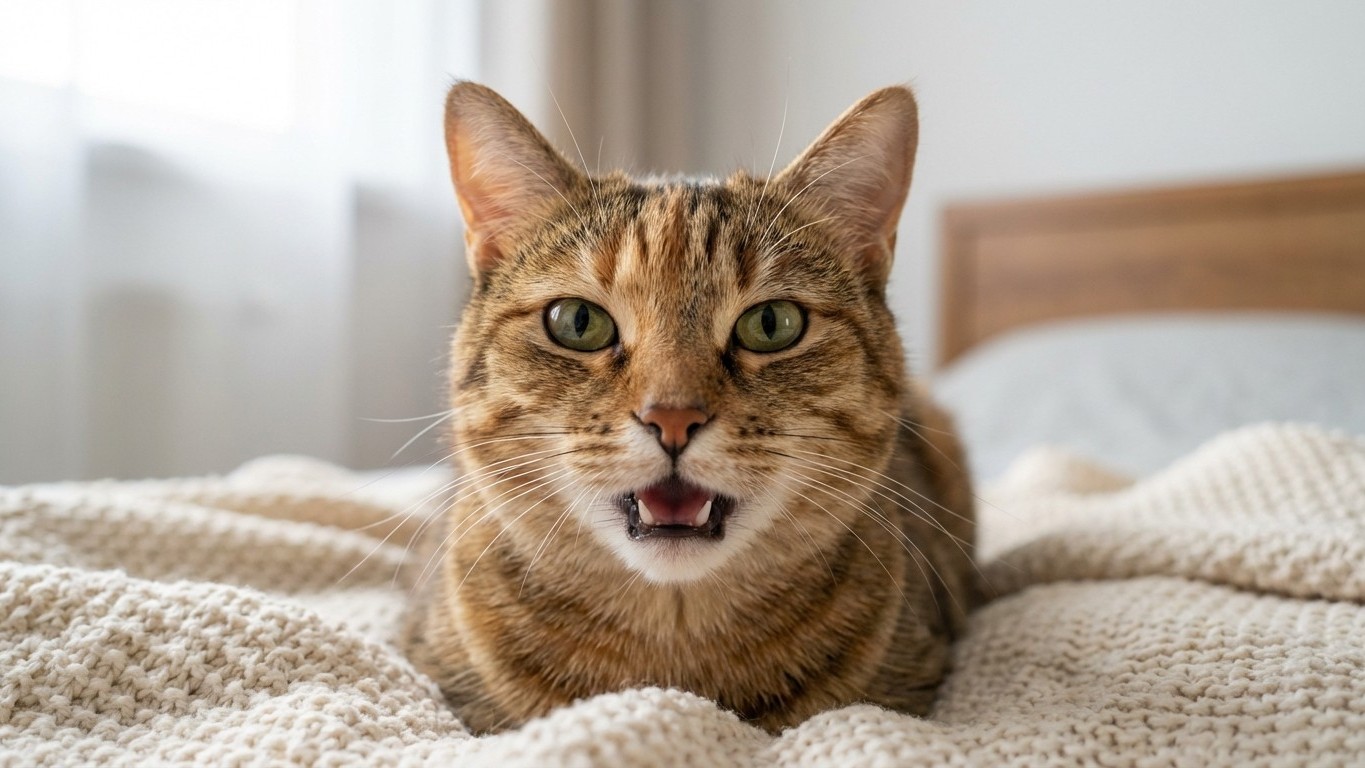
You’re sitting on the sofa when your cat saunters over, locks eyes with you, and lets out a small, rolling, musical sound, not quite a purr, not quite a meow. You probably smiled and assumed it was contentment. But that little sound has a name, a distinct physical mechanism, and a meaning that behaviourists say is entirely separate from the purr. Your cat just trilled at you, and understanding the difference matters more than you might think.
Key takeaways
- Scientists have only recently recognized that cats use at least 21 distinct vocalizations, yet most owners confuse trills with purrs
- Trilling is almost exclusively positive communication, unlike purring which can signal both contentment and distress
- A kitten learns to trill from its mother between 2-7 weeks old—when your adult cat trills at you, it’s treating you like family
The mechanics: two sounds, two completely different actions
Purring is a continuous, low-frequency rumbling sound, whereas trilling is a short, repetitive, high-pitched sound. That distinction isn’t just about pitch, it goes right down to how each sound is physically made. The act of purring is produced with a closed mouth, continuously during both the inspiration and expiration phases of respiration. The trill, by contrast, is far more fleeting. To produce a trill, a cat keeps his mouth closed and pushes air through the vocal cords, resulting in a short and pleasant vocalization.
A 2020 study described the cat trilling noise as “garnishment, produced with a soft voice like the purr.” But don’t let that similarity fool you. Unlike purring, which is a continual noise, trilling is characterised by short, repetitive, high-pitched noises. Think of the purr as a sustained hum your cat produces almost involuntarily, sometimes even while asleep. The trill is deliberate, directed, and socially purposeful, closer to a spoken word than a background feeling.
Perhaps the most telling difference is what each sound can mean emotionally. A purr is a low, continuous, rhythmic tone produced during breathing. While most people recognise purring as a sign of contentment and pleasure, purrs can also mean that a cat is scared, sick, or in pain. The trill carries no such ambiguity. Unlike the universal purr, which can signal both contentment and distress, trilling is almost exclusively positive. That’s a genuinely striking contrast, one sound is emotionally complex, the other is remarkably reliable.
What your cat is actually saying
“It’s a form of communication expressing a variety of feelings or desires, including saying hello, asking for attention or displaying contentment,” says Lottie, a trainee animal behaviourist, who Explains that a trill is usually a positive declaration. In practice, that plays out in very specific ways depending on what the rest of your cat’s body is doing at the same time. “If your cat trills when you walk in the door, it’s a hello and they probably want you to stroke them and act excited to see them in return. If they trill while standing near their food bowl, it could mean ‘feed me’. If the trill is accompanied by affectionate rubbing against you and their tail is standing up straight, it’s a warm gesture. If your cat’s tail is slowly swishing left and right while they trill then it could be a sign they want to play.”
The social roots of the trill run deep. Chirps and trills are how a mother cat tells her kittens to follow her, when aimed at you, it probably means your cat wants you to follow them, usually to their food bowl. There’s something rather touching in that: your adult cat is essentially treating you the way its mother once treated it. This sound is more commonly heard between a mother cat and her kittens, making its use with humans a significant sign of trust.
Research backs this up with a rather lovely experiment. Scientists in Brazil studying 74 cats tried to figure out which sounds cats used in pleasant versus unpleasant situations. They divided the group in half, giving the “pleasant” group a snack, and the “unpleasant” group a pretend ride in a car. Only the snack group trilled. The cats who Thought they were going for a ride in the car did not trill. Simple, clean, and rather definitive.
The surprising science of feline vocal complexity
Among carnivorous animals, domestic cats have the most extensive vocal repertoire, due to their social organisation, nocturnal activity, and long periods of contact between the mother cat and her kittens. And yet, for most of history, we’ve lumped that complexity into a handful of categories: purring, meowing, hissing. The trill has only recently received serious scientific attention. One group of scientists recognised how little we know about cat sounds and worked together to come up with an “ethogram” of cat sounds, a catalogue of every noise cats make, with the current count at 21; they probably make more.
In a 2012 pilot study on cat vocalisations, the trill turned out to be the most common sound after the meow. Given that most cat owners have probably never consciously distinguished a trill from a purr, that’s a remarkable finding. We’ve been living alongside one of cats’ most frequent communications and largely missing its meaning.
The Swedish MEOWSIC project added another layer of nuance. That study found there is more than one kind of trill: high-pitched trills with a rising melody (called chirrs or chirrups), lower-pitched trills (grunts or murmurs), and murmurs with no “rolling R” sound at all. Cats in that study frequently combined purrs and trills, as well as trills and meows, a hybrid the researchers named, appropriately enough, a trill-meow. The cat vocal system, it turns out, has dialects.
Trilling is a natural social behaviour, and kittens begin learning key social behaviours between 2 and 7 weeks of age. Kittens housed without other adult cats after the age of 6 weeks may never learn to trill. That single fact says something profound about how the trill functions: it’s not instinct alone, it’s learned social language, passed down through feline generations.
When to pay closer attention
For the vast majority of cats, trilling is a good sign and nothing to worry about. There are no cat breeds known for trilling more frequently than others, it is a communication common to all cats, and different individual cats will trill more than others. Some cats are simply more chatty. If your cat has never trilled, that says nothing about whether it loves you or not.
That said, context always matters. If your cat is older or beginning to enter old age, you should pay closer attention, as their trilling may be an indication of something more serious. In some instances, an increase in trilling or sudden, excessive trilling can be a sign that your cat is in pain, is injured, or unwell. A cat that suddenly trills far more than usual, especially paired with restlessness or Changes in appetite, is one worth mentioning to your vet. As with any shift in your pet’s behaviour, a professional opinion is always worth seeking.
When a cat greets its owner after a period of separation, the trill often accompanies a tail-up posture and slow blinking, clear signs of trust and affection. So the next time you walk through your front door and your cat offers you that small, rolling, rolling-R sound, you’ll know exactly what it means. The question is: what are you going to trill back?