
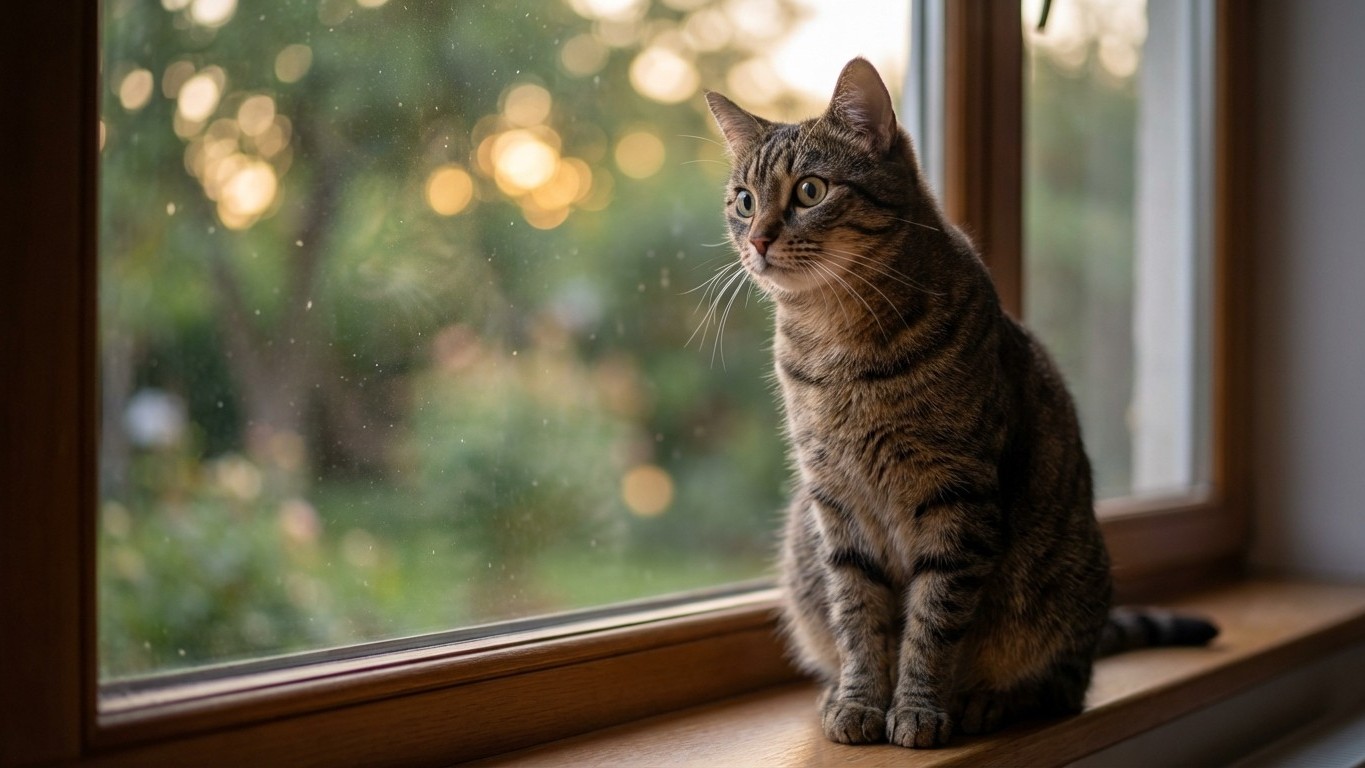
He has never once set a paw outside. No garden adventures, no bird chases, no midnight rooftop explorations. And yet, every April, the same ritual begins: the frantic laps around the living room at 11 pm, the window-staring sessions that stretch past midnight, the sudden burst of chirping at nothing you can see. If you own an indoor cat, you know exactly what this looks like. The good news? There is a perfectly logical Biological explanation for it, and your cat is not, in fact, going quietly mad.
Key takeaways
- April’s longer daylight hours rewire your cat’s internal clock, shifting when they feel alert and ready to hunt—even if they’ve never left your home
- Spring floods your cat’s senses with overwhelming sights, sounds, and smells through the window, creating an adrenaline surge with nowhere to go
- A simple 10-minute play session before your bedtime can prevent the 2 am zoomies by satisfying your cat’s ancient predatory instincts
Their Brain Is Keeping Score of the Sunlight
The explanation starts not outside your front door, but inside your cat’s brain. As the days grow longer, a cat’s internal clock responds. Increased light affects hormones like melatonin and serotonin, which influence mood, alertness, and activity levels. Think of it as a Biological domino effect: more evening light delays melatonin production, which in turn shifts when your cat feels alert and ready to move. Melatonin provides seasonal signals, with higher levels in the autumn and winter months and lower levels in spring and summer, correlating to changing hours of daylight. For a cat that spends its entire life under your roof, this shift still happens, whether there is a garden involved or not.
The science backs this up. A study published in the Journal of Veterinary Behaviour monitored indoor cats receiving natural daylight across all four seasons, and the results were striking: although under minimal influence of seasonal fluctuations in ambient temperature and humidity, the cats showed maxima in daily covered distance during spring and autumn, and minima during winter. your cat’s physical activity peaks in spring not because they sense the daffodils are up, but because the light-dark cycle is rewiring their energy levels from the inside out. Natural seasonal daylight fluctuations modulate the locomotor and feeding rhythms of indoor cats.
Cats are crepuscular by nature, meaning they are most active during dawn and dusk. As the days shorten or lengthen, you may notice differences in your cat’s behaviour, such as increased activity during darker hours. April in the UK means noticeably longer evenings, a later dusk, and evenings that feel charged with a different quality of light. Your cat’s crepuscular clock is adjusting accordingly. What looks like chaos at 11 pm is really a hunting schedule shifting to match the season.
The World Outside the Window Becomes Deafening
Light alone does not explain the full picture. April also brings what amounts to a sensory explosion for any cat positioned near a window. Spring brings more sights, sounds, and smells into your cat’s world. Open windows let in fresh air, birds become more active outside, and insects begin appearing again. All of these changes can trigger your cat’s natural hunting instincts and make them more playful or energetic.
Spring and summer typically generate the most sustained window-watching interest due to increased wildlife activity, longer daylight hours, and more frequent human movement. Cats often spend considerably more time at windows during these seasons compared to winter months when outdoor activity diminishes. To a cat whose entire territory is a flat in Stockport or a terraced house in Bristol, the sudden reappearance of birdsong and buzzing insects after months of relative quiet is nothing short of overwhelming. Cats might chatter to express excitement about seeing prey. The prospect of a hunt can give them an adrenaline rush due to overstimulation. That peculiar chattering noise your cat makes at pigeons on the ledge is not random: it is their hunting circuitry firing at full capacity with nowhere to go.
There is also the overlooked matter of smell. A cat’s sense of smell is thought to be fourteen times stronger than ours, able to smell a meal from a football field’s length away. They must be picking up an enormous number of interesting scents in the air. A cracked window on an April evening delivers a catalogue of biological information, Everything from soil microbes to the pheromones of other neighbourhood cats, that a winter-sealed home simply cannot provide. This olfactory newsletter arrives fresh every evening, and your cat reads every page.
Why It Explodes at Night Specifically
The timing, those infuriating 11 pm zoomies, is not random either. Scientists refer to these episodes as frenetic random activity periods (FRAPs). It is most commonly known as the “zoomies”, a sudden burst of hyperactivity that often includes frenzied running, pouncing, bopping, and even excessive meowing seemingly out of nowhere. The mechanism is simple: cats sleep for an average of 13 to 14 hours a day. That leaves plenty of stored energy for when they’re awake. If they haven’t expended enough energy during the day, they may have zoomies at night.
If your cat is notorious for getting the zoomies in the middle of the night, it is because they are hardwired to seek prey when the ambient temperature is at its coolest. In spring, the gap between daytime warmth and cool evening temperatures becomes more pronounced, which nudges that ancestral hunting timer into action. All day, your cat has been watching birds through the glass, absorbing the new scent information, revving an engine with nowhere to go, and by 11 pm the pressure simply needs a release. Indoor cats have fewer opportunities to chase, climb, and pounce the way their ancestors did. Those pent-up urges to hunt and play often explode into short, energetic sprints.
Many cats experience increased energy, restlessness, and curiosity in spring due to longer days, warmer temperatures, and new outdoor stimuli. Typically, the peak lasts a few weeks as temperatures rise and days lengthen, then activity gradually returns to normal. So if you are currently surviving on broken sleep, there is a light at the end of the tunnel, somewhere around mid-May.
What You Can Actually Do About It
The most effective intervention is almost insultingly simple. Try a play session before your own bedtime. Use toys that mimic prey behaviour, such as feather wands or laser pointers, to let your cat hunt and burn off energy. This helps fulfil their exercise needs and encourages better sleep patterns. A ten-minute session with a wand toy replicates the full hunt sequence: stalk, chase, catch. Without that resolution, the energy builds and surfaces at 2 am in the form of a galloping through your bedroom.
Cats tend to sleep after a big meal. Try feeding your cat their main meal just before your bedtime to encourage them to sleep through the night. Enriching the daytime environment also pays dividends: window perches positioned near bird activity, puzzle feeders, and rotating toys all help channel the spring surge into less antisocial hours. Setting up an elevated space indoors near a window so your cat can at least watch all the interesting things outside goes a long way toward meeting their heightened need for stimulation without requiring you to lose sleep over it.
A word of caution worth holding on to: occasionally, zoomies can indicate discomfort, skin irritation, or even hyperthyroidism in older cats. If your cat’s activity level suddenly changes or seems excessive, vets recommend a quick checkup to rule out medical causes. Although it is perfectly normal for cats of any age to get the zoomies, if your cat’s zoomie behaviour starts to increase in frequency or intensity, tell your veterinarian. This is especially true if this behaviour is accompanied by vocalising or weight loss, which can be signs of hyperthyroidism or diabetes. The spring surge is expected, but a sudden, extreme change always deserves a professional eye.
The more you watch your cat in April, framed against the window, pupils wide, tail twitching at a bluetit that has no idea it is being observed, the harder it is to see a house pet. What you are actually watching is a crepuscular predator running ancient software on modern hardware, responding to signals that predate your flat, your city, and your species’ habit of keeping cats indoors. The question is not really why they go wild in spring. The question is how, given everything their biology is telling them, they manage to stay this calm the rest of the year.
Sources : neaterpets.com | sciencedirect.com