
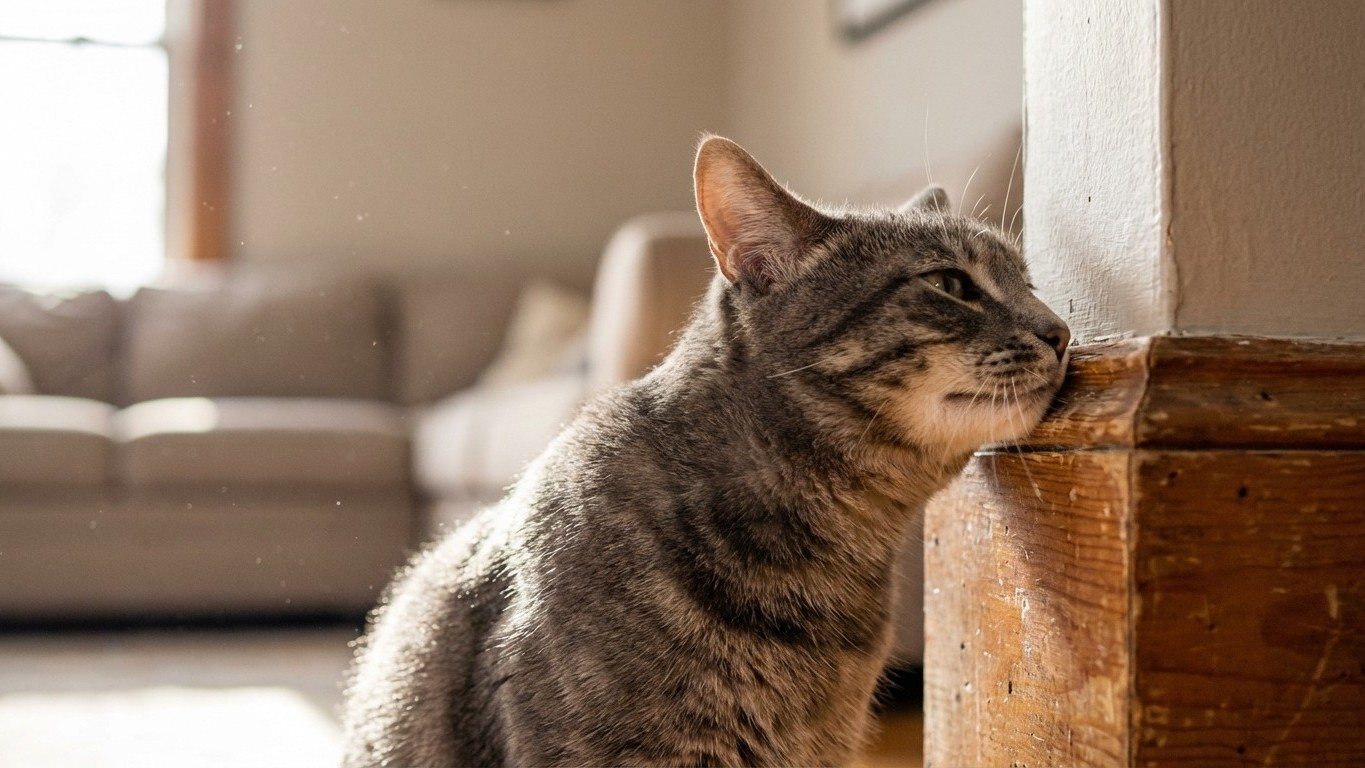
Your cat isn’t being adorably clingy when she grinds her cheek into that skirting board corner for the fourth time this morning. She’s writing a message, one that has nothing to do with love and Everything/”>Everything to do with chemistry, territory, and a surprisingly complex social system that most of us have been misreading for years.
Key takeaways
- Cats rub corners to leave invisible chemical messages, not to show you love
- Different pheromone types are deployed depending on whether they’re marking territory or bonding socially
- Sudden increases in rubbing behavior could signal stress, anxiety, or even hidden health problems
The real reason corners are so irresistible
The act of a cat rubbing its head on objects is called “bunting,” and the height of the object determines which part of the head a cat will use to leave a scent mark. Corners, specifically, are not chosen at random. Cats tend to prefer rubbing their cheeks against corners because corners provide the best grip. Rubbing against flat walls can be more difficult, so they’ll usually opt for wall and furniture corners.
When a cat rubs its head against a corner, it is marking its territory with its scent, leaving behind a unique “identity tag.” Corners, furniture, and other fixed objects are ideal markers because they are common boundary points in the home. In this way, cats can confirm the boundaries of their territory and communicate to other cats that “this is mine.”
The biology behind this is worth understanding properly. There are several scent glands located on felines that deposit pheromones when a cat rubs against an object, including the cheek and perioral gland areas, which consist of several structures that secrete pheromones around the chin, cheeks, and lips. These are invisible to us, but for another cat passing through, they function like a fully-loaded noticeboard. A cat’s sense of smell is far more powerful than ours, with about 200 million scent receptors in its nose compared to our mere 5 million, allowing cats to detect and interpret an incredible range of odours.
It’s a chemical language, not a gesture of love
Here’s where things get genuinely interesting, and where a lot of owners get it wrong. Cats deposit different facial pheromone fractions depending on the target: F3 when rubbing objects for environmental familiarity, F4 when rubbing other cats or humans as a social bonding signal. This distinction was identified by Patrick Pageat in a 1998 patent and has been adopted across veterinary behavioural medicine. So when your cat rubs a corner, she is not expressing warmth toward that wall. She is stamping it with an environmental ownership marker — something closer to a Post-it note saying “I live here” than a cuddle.
When a cat head-bunts you, what is called allorubbing, where they rub against your legs, that’s not an invitation to pick them up or pet them. It’s more like a handshake. It doesn’t mean you’re best friends, but it means that the cat is accepting of you. The distinction matters. Many owners respond to this behaviour by scooping the cat up, which can actually erode the trust the cat was just attempting to build.
Bunting may also be a form of “time stamping,” meaning that other cats may be able to determine by the age of the marking how recently another cat was there. If the mark is relatively fresh, they may want to leave the area soon to avoid conflict. Think of it as a chemical timestamp on a shared space, a way of managing social tension without ever having to come face to face with a rival.
When rubbing is about anxiety, not ownership
Some cats bunt when they are anxious. Spreading their scent around may be a way of coping or making themselves feel more comfortable in an unfamiliar environment. This is worth paying attention to at home. New or intensified rubbing after a household change, a new pet, a move, a new person, is usually stress-related scent-marking. If you’ve recently rearranged the furniture, brought home a new flatmate, or even introduced an unfamiliar bag from a holiday, expect a flurry of corner-rubbing. Your cat is essentially trying to reassert that the world still smells like hers.
When a cat is rubbing on a wall or a piece of furniture, they may be leaving signs that say “I need my space” or “this is my area where I want to be alone.” If other animals or people keep entering that space, it becomes a stress trigger, and stress in cats, especially over time, can turn into serious medical conditions, like a urinary blockage. That’s a sobering reminder that what looks like innocent decorating can sometimes be a cry for help.
There’s also a social hierarchy element that most owners never consider. A more dominant cat with a higher social rank will be the one to initiate head bunting. It’s the job of the dominant, confident cat to spread the family scent and groom the other cats. This not only serves as a sign of trust and inclusion but is a bonding activity. In a multi-cat home, watch which cat initiates the rubbing, you’re watching the social order play out in real time.
What you should (and shouldn’t) do about it
Normal bunting and corner-rubbing requires no intervention. The act of bunting releases pheromones from the facial glands, which have a calming effect on the cat and can also help reduce stress and anxiety. Letting your cat get on with it is, in most cases, the kindest response. If you want to support the behaviour constructively, providing vertical scratching posts, cat trees, and soft rubbing pads offers alternative surfaces that can satisfy the same instinctive need.
If the rubbing suddenly escalates, or if you notice it accompanied by other symptoms, please consult your vet promptly. Excessive rubbing accompanied by drooling, hair loss, redness, or changes in eating or behaviour could indicate dermatologic irritation, dental issues, or neurological problems. In those cases, what looks like a quirky habit is something that needs a professional eye.
For anxious cats in a changing household, some of these chemical makeups have been synthetically reproduced and may be used by cat owners or veterinary professionals looking to change problematic or stress-induced behaviours, products that mimic the calming F3 facial pheromone are widely available in the UK and worth discussing with your vet if your cat seems distressed rather than simply territorial.
One final, rather humbling thought: when a human scratches a cat’s cheek, the human is stimulating the same glands the cat activates during bunting. The cat may be encouraging a bidirectional scent exchange, allowing its pheromones to transfer to the human’s hand while simultaneously reading the human’s scent. Your cat isn’t just marking you. She’s reading you, too.
Sources : catsloves.com | medium.com