
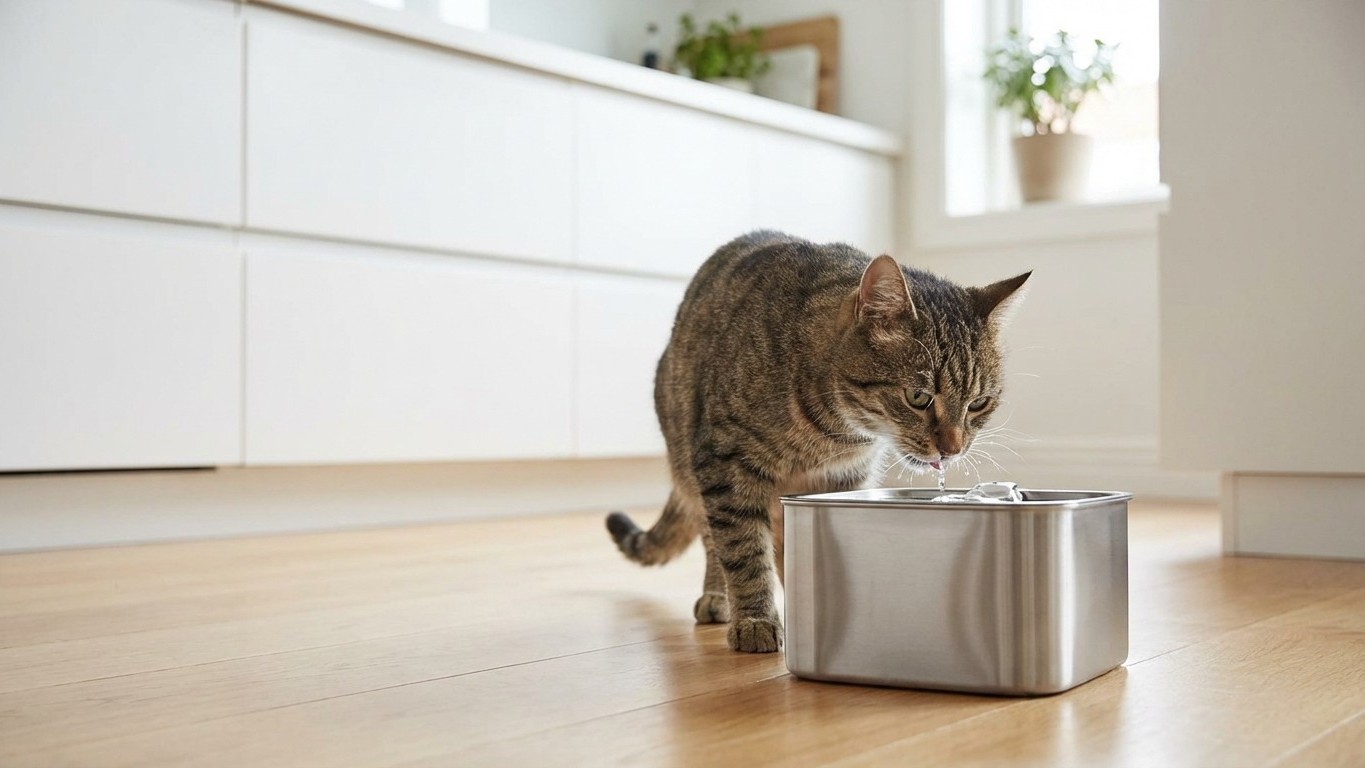
You fill the bowl. You change the water. You even move it to a different spot. And still, your cat treats it with total indifference, perhaps deigning to sniff it once before wandering off. Sound familiar? The good news is that vets have a very clear explanation for why cats so often ignore their water bowls, and the fix is simpler than most owners expect. It starts with understanding something fundamental: cats were never really designed to drink much at all.
Key takeaways
- Cats evolved in deserts to extract water from prey, not drink from bowls—and that biology hasn’t changed
- Your cat’s whiskers, bowl placement, and even the stillness of the water could be secretly sabotaging hydration
- One simple intervention keeps appearing in every vet’s advice, and it’s not what most owners try first
A desert animal living in your flat
Domestic cats are descended from North African and Southwest Asian wildcats, and living in a desert environment led these cats to adapt to the lack of water by being able to go without it for periods of time. Cats evolved as desert animals, meaning they are biologically adapted to extract moisture from prey rather than rely heavily on drinking. In the wild, a cat consuming fresh prey gets up to 70–80% of its water from meat. A bowl of still water sitting on a Kitchen floor is, evolutionarily speaking, a pretty alien concept.
These days, cats get far less moisture from their food, considering that many are fed a dry-food diet containing only 6–10% moisture, a fraction of the moisture they’d get from prey. The most significant difference between wet and dry cat food is its water content. A typical can of wet food contains upwards of 75% moisture, closely mimicking the natural diet of a feline. In contrast, dry kibble averages only 6–10% moisture. That gap matters enormously. Cats have a naturally low thirst drive. They often do not feel compelled to drink enough water to compensate for the moisture missing from a dry, kibble-based diet.
So the first and most powerful change you can make, the one vets consistently point to, is switching at least partially to wet food. Cats who eat a high moisture diet, such as canned food, often drink less water because they get part of their hydration from their meals. This isn’t a workaround; it’s actually closer to how feline bodies evolved to take in water. Wet food supports healthy hydration levels and may help supplement treatment for urinary or kidney diseases by helping to flush the system of toxins and irritants. If your cat is firmly committed to dry kibble and Refuses all attempts at reform, try mixing small amounts of wet food into dry food gradually, or offer low-sodium bone broth to encourage drinking.
Why your cat ignores a perfectly good bowl
Even cats on a mixed diet need access to fresh drinking water, and here is where most owners unknowingly create problems. One theory is that wild cats only drink from running water in order to prevent getting sick. So when water is sitting still in a bowl, they have an instinctual aversion to it. In nature, still water can be stagnant or contaminated, while running water signals freshness and safety. A stream or trickle suggests the water source is replenished and less likely to harbour bacteria or parasites.
There is also a more surprising, structural reason some cats avoid their bowls: their own Whiskers. Whisker fatigue has become a widely discussed topic in feline behaviour and product design. Multiple sources define it as sensory overload or stress caused when a cat’s highly sensitive whiskers repeatedly rub against surfaces such as the sides of deep or narrow bowls. Whiskers are not just decorative; they are nerve-rich tactile sensors that help cats judge space and movement. Constant pressure or brushing can be painful or, at minimum, very irritating. Currently, most of the evidence for whisker fatigue is anecdotal, with sometimes conflicting views between vets, behaviourists and cat owners, so it remains a debated concept. But if your cat approaches their water, hesitates, then walks away, it costs nothing to try a wider, shallower bowl.
Bowl placement is another underestimated factor. In nature, carcasses rot quickly and can contaminate nearby water sources. Cats often prefer to eat and drink in different locations, likely because evolution taught them to avoid water near “prey remains.” Placing the water bowl directly next to the food bowl, a very common habit, may actually discourage drinking. Keep water bowls in quiet, calm areas away from loud noises and other animals so that your cat feels safe. And never position a water bowl near the litter tray.
Cats may drink less water due to bowl cleanliness, stress, dental pain, or underlying medical conditions, such as kidney disease or gastrointestinal illness. A bowl that looks clean to human eyes may smell of old water, soap residue, or plastic to a cat with a far more sensitive nose. The water bowl must be cleaned and filled with fresh water daily, if not several times a day. Some cats are pickier than others, so if your cat only drinks when you put down a fresh bowl, you should clean it frequently.
The one change that makes the biggest difference
If there is a single intervention that comes up again and again in veterinary advice, it is introducing a water fountain. Some cats are drawn to the sound and motion of moving water, that is why you might find your cat batting at a faucet or trying to drink from the tub. A fountain mimics this behaviour and can trigger their Instinct to drink more frequently, which is important for their health. Several sources point out that cats may struggle to see flat, still water clearly. A perfectly calm surface in a deep, dark bowl provides little visual contrast. Motion, light reflections, and sound, all present in running water, help them locate and judge the water surface. This is one reason fountain lips, falling films, and gentle trickles work so well; they add visible edges and ripples.
Many veterinarians recommend water fountains as part of a preventative approach to urinary tract problems. Better hydration doesn’t just mean more pee. It means a lower chance of painful health conditions like cystitis, bladder stones, and chronic kidney issues. That said, fountains are not a magic solution for every cat. Controlled studies in healthy cats have not shown a consistent increase in average water intake from fountains versus bowls at the population level. However, individual cats often show strong preferences. Many guardians and veterinarians report that particular cats do drink more from a well-designed fountain. It is accurate to view fountains as one helpful option rather than a guaranteed fix.
If you do go for a fountain, material matters. The cheaper fountains are often plastic, and plastic can really hold onto bacterial growth and can be hard to clean because it is porous. Ceramic or stainless steel options are generally preferable from a hygiene standpoint. Fountains have multiple parts, pumps, filters, hoses, and trays, all of which need regular cleaning. If any part gets overlooked, bacteria or mould can grow, which defeats the point of using a fountain in the first place. If you do have one of these, highly recommend having at least one backup plain old water bowl.
When to stop experimenting and see a vet
Most veterinarians recommend that a normal, healthy cat drink about 4 ounces (roughly half a cup) of water per 5 pounds of body weight per day. This varies depending on each cat’s diet, activity level, environmental conditions, and underlying medical conditions. Smaller cats need less; larger cats more. Cats on wet food will naturally drink less than those on dry kibble, which is perfectly normal.
The signs of dehydration are worth knowing. Dehydration in cats can become serious quickly, with signs including dry gums, skin tenting, sunken eyes, vomiting, or lethargy. A quick home check: gently pinch the extra skin between your cat’s shoulder blades to form a tent-like shape. Once you let go, your cat’s skin should snap right back to normal in less than a second. If it doesn’t, contact your vet promptly. Cats with underlying health issues, such as chronic stomach upset, kidney disease, cancer, diabetes, or hyperthyroidism, are more likely to become dehydrated and need to be monitored closely if they start drinking less water.
Cats may stop consuming as much water as they usually do if they aren’t feeling well physically or emotionally. If you notice a sudden decline in their drinking habits, consult your veterinarian right away. Behavioural tweaks, fountains, bowl swaps, wet food, are genuinely useful tools, but they should never replace a proper check-up when something changes. It is worth asking: when did you last watch your cat drink? Some owners go weeks without really noticing, and a small shift in that habit can be the earliest clue that something deeper needs attention.