
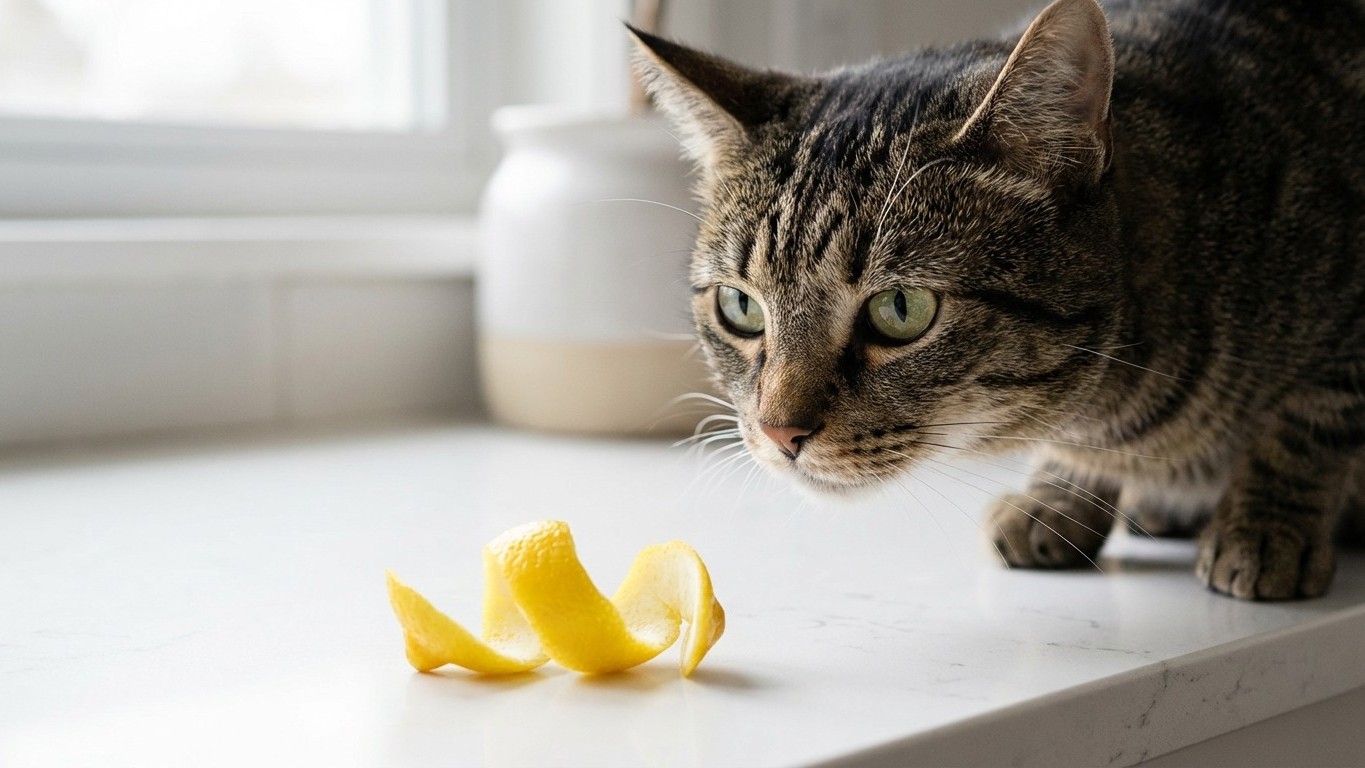
Scattering lemon peels around your kitchen worktop might seem like a clever, natural trick to keep your cat at bay. No chemicals, no fuss, just a bit of zesty citrus doing the job, right? The trouble is, the same thing that makes lemons so effective at repelling cats is precisely what makes them dangerous. Those innocent-looking scraps of yellow peel are, to your cat, something between a sensory assault and a genuine health hazard.
Key takeaways
- Lemon peels contain compounds that cats’ bodies cannot safely process, potentially causing tremors, liver damage, and collapse
- Even without ingestion, living with strong citrus scents creates ongoing stress on your cat’s sensitive nervous system
- A single curious lick might be harmless, but kittens, bored cats, and persistent chewers face real toxicity risks
Why cats loathe citrus, and why that’s actually a warning signal
Cats possess up to 200 million scent receptors in their noses, while humans only have around 5 million. So when you catch a pleasant whiff of lemon zest, your cat is experiencing something far more overwhelming. Citrus peel emits concentrated terpenes and essential oils, limonene and linalool, which are potent odorants and can be irritating to the mucous membranes of the nasal passages.
There’s a rather sobering logic to that aversion, though. In the wild, many substances with strong scents can be associated with danger or toxicity, and cats may have developed an aversion to certain strong scents, including citrus, as an instinctual response to avoid potential harm. your cat isn’t just being a diva. Evolution has quietly told them to stay away. The problem is, when you leave lemon peels scattered around your kitchen, you’re creating exactly the kind of close-contact, lingering exposure that their instincts were designed to make them flee from, not live alongside.
And here’s the part most people don’t know: not all cats react the same way to citrus scents. Some may be more sensitive to it than others, and individual preferences can vary. A cat that doesn’t bolt from the room isn’t necessarily safe. It may simply be bolder, or more curious, than average.
The real chemistry behind lemon peel toxicity
According to the ASPCA, lemon (Citrus limonia) is classified as toxic to cats, with essential oils and psoralens listed as its toxic principles, and clinical signs including vomiting, diarrhea, depression, and potential dermatitis. Those three words, essential oils and psoralens, are worth unpacking properly.
Limonene and linalool, found in lemon peels and juice, are toxic to cats and can irritate their digestive system or skin. Limonene is considered mildly toxic to cats, and when used at higher doses or in a concentrated form, can cause drooling, trembling, staggering, falling over, skin lesions, and digestive discomfort. And it gets worse than simple stomach upset. Fatal side effects have been reported in three cats after the use of an “organic” citrus oil dip, causing drooling, trembling, loss of coordination and staggering, collapse, coma, and even death. That case involved a concentrated application rather than loose peels, but it underscores what these compounds can do to a feline system pushed beyond a mild exposure.
Then there’s psoralen, which operates differently again. Lemons contain psoralens, chemicals that can cause phototoxicity. If a cat’s skin comes into contact with lemon juice or peel, sunlight exposure may trigger irritation, redness, or even burns. A cat rubbing its face or paws against a lemon peel left on the counter, and then going to sit in a sunny window, a perfectly natural sequence of events, could end up with a painfully burned patch of skin. This compound is phototoxic, meaning it can cause your cat to suffer skin burns after exposure to sunlight.
The toxic compounds in lemon can affect both the digestive and nervous systems. Because cats lack the enzymes needed to break these down, ingestion can range from causing mild symptoms such as drooling and gastrointestinal upset to severe reactions including tremors, liver damage, or even collapse in extreme cases.
The gap between “usually fine” and “genuinely safe”
Now, a note of reassurance, because panic helps no one. Cats don’t tend to eat lemon as they dislike the sour taste. A single inquisitive lick will not do your cat any harm. And most cats will not eat enough to get sick since they are usually turned off by the smell. The operative word there is “usually.” The more concerning scenario is not the cat who takes a single sniff and retreats, it’s the one who chews on a peel out of boredom, the kitten who hasn’t yet learned what to avoid, or the cat who licks at residue left on a counter surface where you squeezed lemon earlier.
The peels of lemons are particularly toxic to cats due to their high concentration of psoralen, a toxic compound that can cause severe gastrointestinal upset and other systemic problems. The peel is the most concentrated part, which is precisely the bit people tend to leave sitting around as a deterrent. While the scent of lemon may deter some cats, it’s not a foolproof method and could lead to accidental ingestion.
Cats are very sensitive to their environment, and excessive use of strong smells can cause them distress, leading to anxiety or a negative association with the space. So even if your cat never touches the peel, living in a kitchen that smells overpoweringly of something their nervous system flags as dangerous is its own form of low-grade stress. Not ideal for an animal you share your home with.
Safer ways to keep your cat off the counter
The good news is that cats are very persuadable by their environment, you just need to work with their instincts rather than against their health. Passive, non-harmful deterrents like double-sided tape, aluminium foil, or cookie sheets with water can make counters less appealing. The texture of tape on their paws and the crinkle of foil are genuinely off-putting to most cats, without any toxic risk attached.
Better still, think about why your cat wants to be on the counter in the first place. Cats are natural climbers who crave elevation and vantage points. If your cat is more driven by curiosity than hunger, it’s smart to provide alternative elevated spaces they can explore, cat trees, window perches, and wall-mounted shelves are all great options. Give them somewhere better to be, and the kitchen counter loses its appeal. Enrichment daily is beneficial for all cats and can cut down on unwanted behaviours. If your cat gets on the counters when you are preparing food or in predictable situations, that is the ideal time to offer a food puzzle, battery-operated toy, or other activity away from the kitchen.
If you’ve witnessed your cat chewing on a lemon peel, rubbing against citrus, or showing any signs like drooling, vomiting, lethargy or unusual behaviour after being near citrus, contact your vet straight away. There is no test to confirm a cat is suffering from citrus poisoning, so the vet will often have to rely heavily on the information you provide in order to diagnose your cat’s condition. Being precise about what your cat was exposed to, and when, makes all the difference. Never try to induce vomiting unless specifically instructed by your vet.
It’s one of those cases where a well-intentioned household tip, passed around online and in chatty advice columns, glosses over a real Biological reality. Lemon peels are not a neutral inconvenience to your cat, they’re a source of compounds their body cannot safely process. Perhaps the bigger question is this: how many other “natural” cat deterrents in common use carry risks we’ve simply never stopped to look up?
Sources : signaturemarbleandgranite.com | justanswer.com