
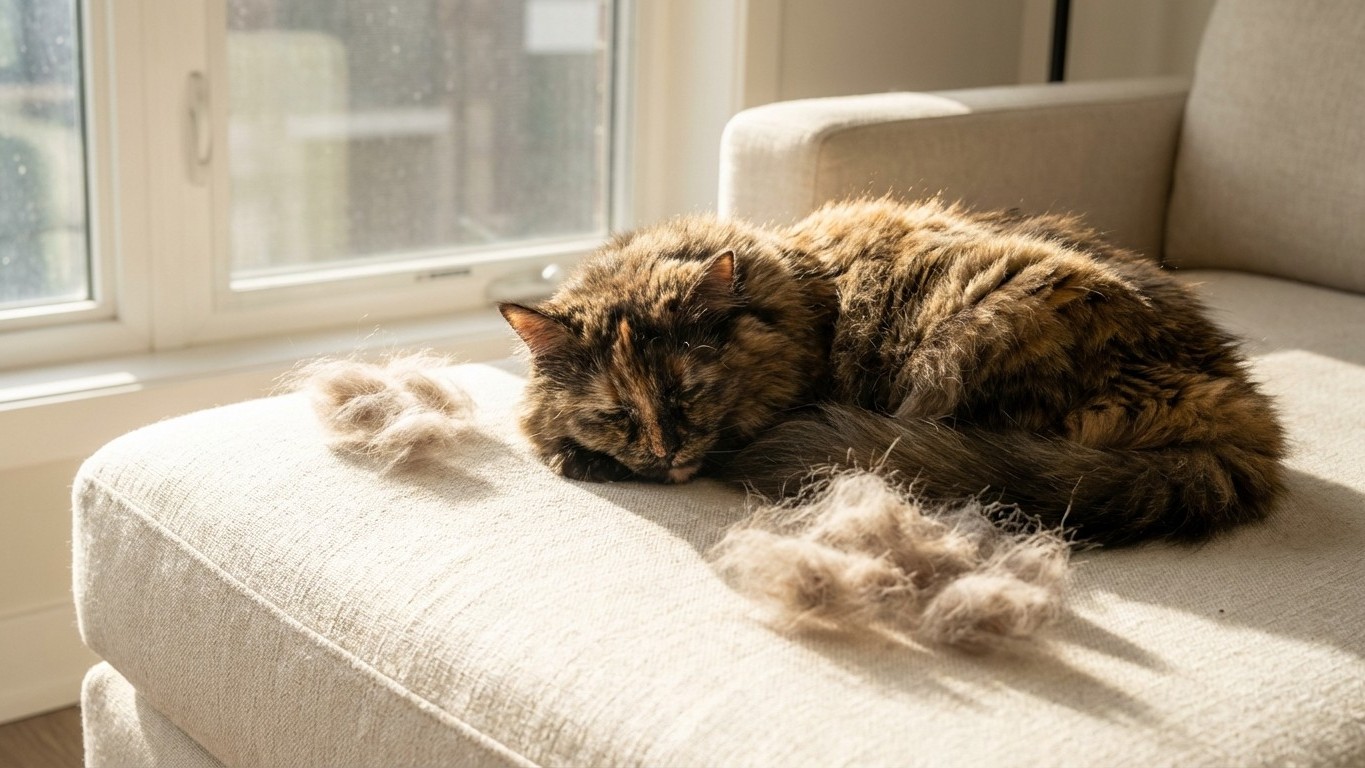
March arrives and Suddenly your sofa looks like it’s growing a second fur coat. You’re finding cat hair in your coffee, on your work shirt, embedded in the carpet, and your cat seems utterly unbothered by the whole situation. This isn’t your imagination running wild, and it’s not a sign that something’s gone wrong. What’s happening is one of the most elegant biological processes in a domestic cat’s life, and once you understand it, you’ll stop panicking and start preparing properly.
Key takeaways
- Your cat’s eyes detect the shift in daylight length, triggering hormonal changes that release the winter undercoat
- Heavy March shedding is normal, but bald patches, skin changes, and behavioral shifts warrant veterinary attention
- Strategic grooming 2-3 times weekly for short-haired cats and daily for long-haired breeds makes a dramatic difference
The Science Behind the Spring Shed
Cats are photoperiodic animals, which means their bodies respond to Changes in daylight length rather than temperature alone. As the days stretch longer through late February and into March, specialised photoreceptors in your cat’s eyes detect the shift in natural light. This triggers hormonal changes that signal to the body: winter coat, you’re done. The dense, insulating undercoat that kept your cat warm through the colder months begins to loosen en masse, making way for a lighter summer coat.
This process is called moulting, and in the wild it’s perfectly timed to the environment. Cats evolved to shed in spring and again in autumn, syncing their coat weight to seasonal demands. The trouble is, modern domestic cats live inside centrally heated homes with artificial lighting year-round. This can actually disrupt the moulting pattern, causing some indoor cats to shed moderately throughout the entire year rather than in two dramatic seasonal bursts. Outdoor cats, by contrast, tend to follow the natural cycle more faithfully, with March shedding that can genuinely astonish you if you’re not prepared for it.
The undercoat is the real culprit here. Unlike the longer, coarser guard hairs that form the visible outer layer, the undercoat is made up of soft, fine fibres that detach from the skin in vast quantities. When you stroke your cat in March and come away with a palm full of fluff, that’s the undercoat doing exactly what it’s meant to do.
When Normal Becomes Something Worth Checking
Here’s where many cat owners get tripped up: distinguishing between seasonal shedding and something that genuinely needs veterinary attention. Heavy moulting in March is, for the vast majority of cats, completely normal. But there are specific signs that should prompt you to book an appointment rather than simply reach for the lint roller.
Bald patches or thinning fur in localised areas are different from general overall shedding. If your cat is losing fur in a circular pattern, developing scaly skin, scratching obsessively at one spot, or if you can see the skin through areas that previously had good coverage, those are signals worth investigating. Similarly, if the shedding is accompanied by Changes in appetite, weight loss, excessive thirst, or lethargy, the hair loss may be a symptom of an underlying health issue rather than seasonal moulting. Skin conditions, hormonal imbalances, parasites, and allergies can all cause coat changes that superficially resemble normal shedding. Always check with your vet if you’re uncertain.
One thing worth knowing: stress can also trigger excessive fur loss in cats. A new pet in the household, building work nearby, or changes to routine can cause psychogenic alopecia, where a cat over-grooms to the point of hair thinning. If your cat’s been through any upheaval recently, that’s worth mentioning to your vet alongside the shedding symptoms.
Practical Steps That Actually Make a Difference
Grooming your cat more frequently through March is, without question, the single most effective thing you can do. For short-haired cats, a good brush two or three times a week will remove loose undercoat before it ends up on every surface you own. Long-haired breeds like Maine Coons, Persians, and Ragdolls need daily attention during peak moulting, because their fine undercoat can mat painfully if dead fur is left to accumulate near the skin. A quality deshedding tool that reaches the undercoat (rather than just smoothing the surface) will outperform a standard brush considerably, though I’d encourage you to test what your own cat tolerates, since some find certain tools unpleasant.
Nutrition plays a role that often gets overlooked. A coat that’s shedding in enormous quantities beyond the typical seasonal norm can sometimes reflect a diet lacking in omega-3 and omega-6 fatty acids, which are integral to skin and coat health. If your cat is on a good quality complete diet, this likely isn’t the issue. But if you’ve been wondering whether their food is really meeting their needs, spring moulting season is a reasonable moment to revisit the question with your vet.
Hydration matters too, and cats are notoriously poor drinkers when they rely solely on dry food. Skin that’s even mildly dehydrated can make shedding worse and coat quality poorer. Wet food, water fountains, or simply placing multiple water bowls around the house can help cats drink more without you needing to chase them around with a glass.
For the home itself, investing in a good vacuum with a pet hair attachment will save your sanity. Washing throws and blankets that your cat sleeps on regularly through March reduces the overall hair burden in your home considerably. Sticky rollers are your friend. Accept that for about six weeks, cat hair is simply part of your interior design.
The Bigger Picture Your Cat Can’t Tell You
There’s something worth sitting with in all of this: your domestic cat, curled on a radiator in a centrally heated flat in Manchester or Bristol, is still responding to the same biological cues that would have guided their ancestors through forests and grasslands thousands of years ago. The lengthening March daylight reaches their eyes, the hormones shift, and the winter coat releases, regardless of whether they’ve set a paw outside in months.
That connection to seasonal rhythm, persisting despite every comfort of modern domestic life, is rather extraordinary when you think about it. The fur on your jumper is, in its own way, proof that wildness doesn’t entirely disappear just because there’s a cat flap and a heated bed involved.