
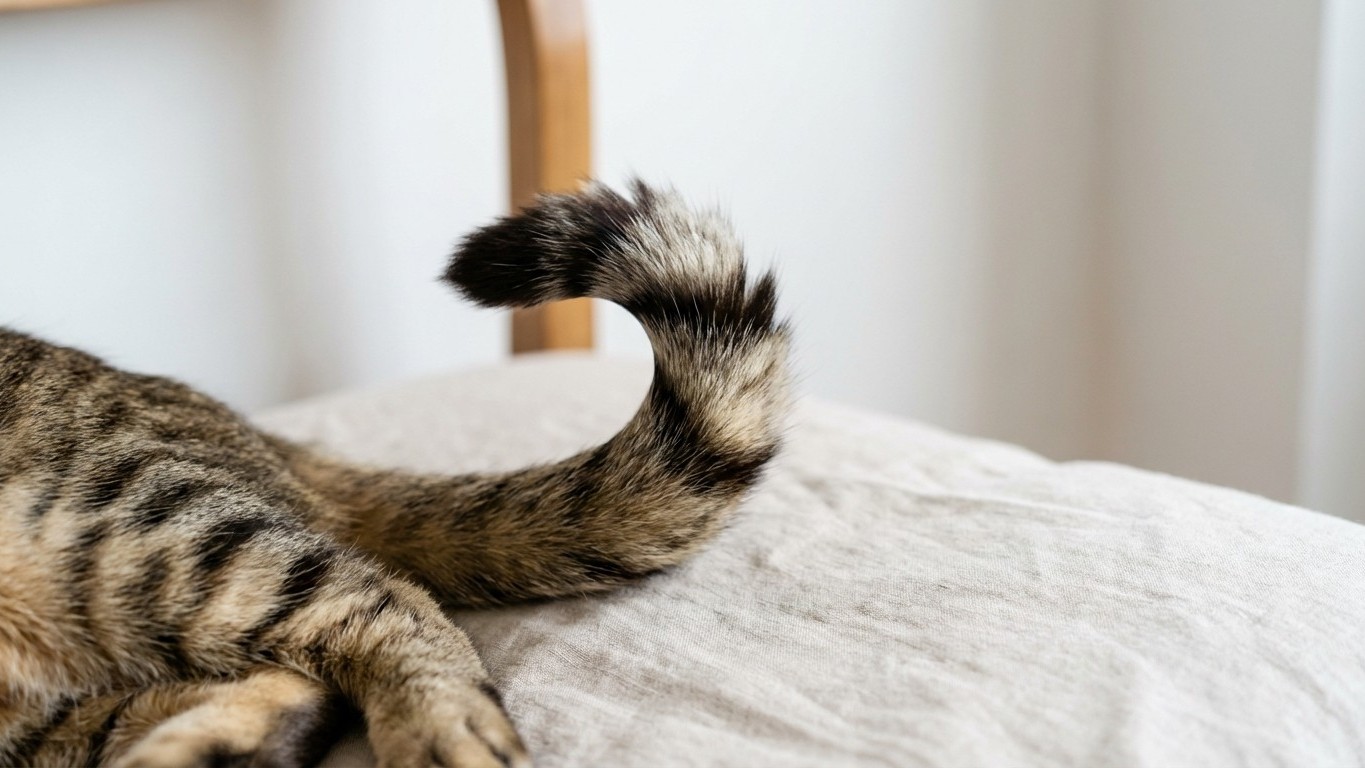
Most cat owners will tell you they can read their pet like a book. The slow blink, the kneading, the 3am zoomies, we think we know what it all means. But the tail? That’s where even the most devoted cat lover can get it spectacularly wrong. A seemingly happy, upright tail can carry a very different message depending on one subtle detail, and misreading it means you might be Missing how your cat truly feels day after day.
Key takeaways
- That ‘happy’ tail position you recognize? There’s a hidden variation that means the complete opposite—and most cat owners never notice it
- Your cat’s tail is a sophisticated mood barometer, but the middle positions are where almost everyone gets it dangerously wrong
- The specific tail behavior you’re ignoring could be your cat silently telling you to stop, but you’ve been taught to read it as contentment instead
The tail position that fools almost everyone
Picture the classic “happy cat” image: tail held straight up, tip slightly curled, trotting towards you across the kitchen. Most people interpret this as confidence, affection, a cat who’s pleased to see you. And often, they’re right. A fully upright tail is a positive signal, a greeting behaviour that cats developed specifically for interacting with humans and other cats they feel comfortable around. Kittens use it with their mothers; adult cats reserve it for those they trust.
Where it gets complicated is the tail that’s raised but curved downward at the tip like a question mark, versus the tail that’s held rigid and slightly puffed, or the tail that flicks sharply at the very end while the rest stays still. That last one is the trickster. A tail held at half-mast with a twitching or flicking tip looks, at a casual glance, like a cat who’s simply relaxed and mildly engaged. In reality, it’s one of the clearest signs that a cat is irritated, overstimulated, or heading towards a scratch or bite.
I used to stroke my own cat, Marmite, well past the point she wanted, completely oblivious to that flickering tail tip. She tolerated it, cats often do, but that’s a very different thing from enjoying it. Tolerance is not contentment, and this distinction matters enormously for a cat’s long-term wellbeing.
What feline behaviour science actually tells us
Cats communicate almost nothing through vocalisation when dealing with other cats. The meowing, chirping, and trilling? That’s largely a language they developed for us. Their true emotional vocabulary lives in the body: the ears, the whiskers, the posture, and above all, the tail. Research into feline body language has grown considerably over the past two decades, and what’s emerged is a picture of an animal with a far more nuanced signalling system than most people give them credit for.
The tail works a bit like a mood barometer. Fully vertical and relaxed signals confidence and friendliness. Puffed up and curved (the classic Halloween cat shape) signals fear and an attempt to look larger. Low and tucked signals anxiety or submission. But the middle positions, the ones that sit between these obvious extremes, are where misinterpretation happens most. A tail held horizontally and wagging slowly, for instance, can mean a cat is focused and aroused, think of a hunting cat watching a bird through the window. Enjoyable for the cat, yes, but not an invitation for a cuddle.
The sharp, repetitive flick at the tip specifically signals emotional conflict. The cat may want interaction but is reaching its limit, or it may have been wanting you to stop for some time already. Some cats will give you two or three flicks as a warning before they swipe; others go straight from the flick to action with very little ceremony. Learning to read it early is genuinely one of the most useful things you can do for your relationship with your cat.
Why this matters beyond just avoiding scratches
Chronic stress in cats is seriously underdiagnosed. Because cats are wired to mask vulnerability (a survival instinct from their wild ancestors, who couldn’t afford to appear weak), the signs of ongoing stress can be subtle enough to miss entirely. Overgrooming, hiding more than usual, changes in appetite, urinating outside the litter tray, these are all potential indicators of a cat who has been stressed for some time. And a cat whose signals are consistently misread is a cat who may feel chronically unheard in its own home.
This isn’t about guilt. Most people who miss these signals aren’t being neglectful; they simply weren’t taught to look. Dogs are far more expressive and socially demanding in ways that are hard to ignore. Cats operate differently. Their communication is quieter, more restrained, and far easier to overlook, which is precisely why understanding it takes a bit of effort.
If you’re ever unsure whether your cat is stressed, anxious, or in physical discomfort, a conversation with your vet is always the right first step. Behaviour changes can sometimes signal underlying health issues, and a vet can help you rule these out before assuming it’s purely emotional.
Small changes that make a real difference
Once you start watching the tail properly, you can’t unsee it. Stroke your cat and keep one eye on that tail tip. The moment the flicking starts, stop and give them space. No punishment, no drama, just a pause. Over time, many cats will actually start to seek out interaction more freely when they learn that “no” is respected. The relationship shifts from something they endure to something they choose.
Providing environmental enrichment also helps cats feel more in control. High perches, window access, and spaces where they can retreat without being followed are not luxuries; they’re genuine welfare needs for a species that, underneath the domesticity, still thinks of itself as both predator and prey.
The question worth sitting with is this: how many of our cats have spent years telling us something, quietly and persistently, through the language of that flickering tail tip, and how different might they feel if we finally started listening?