
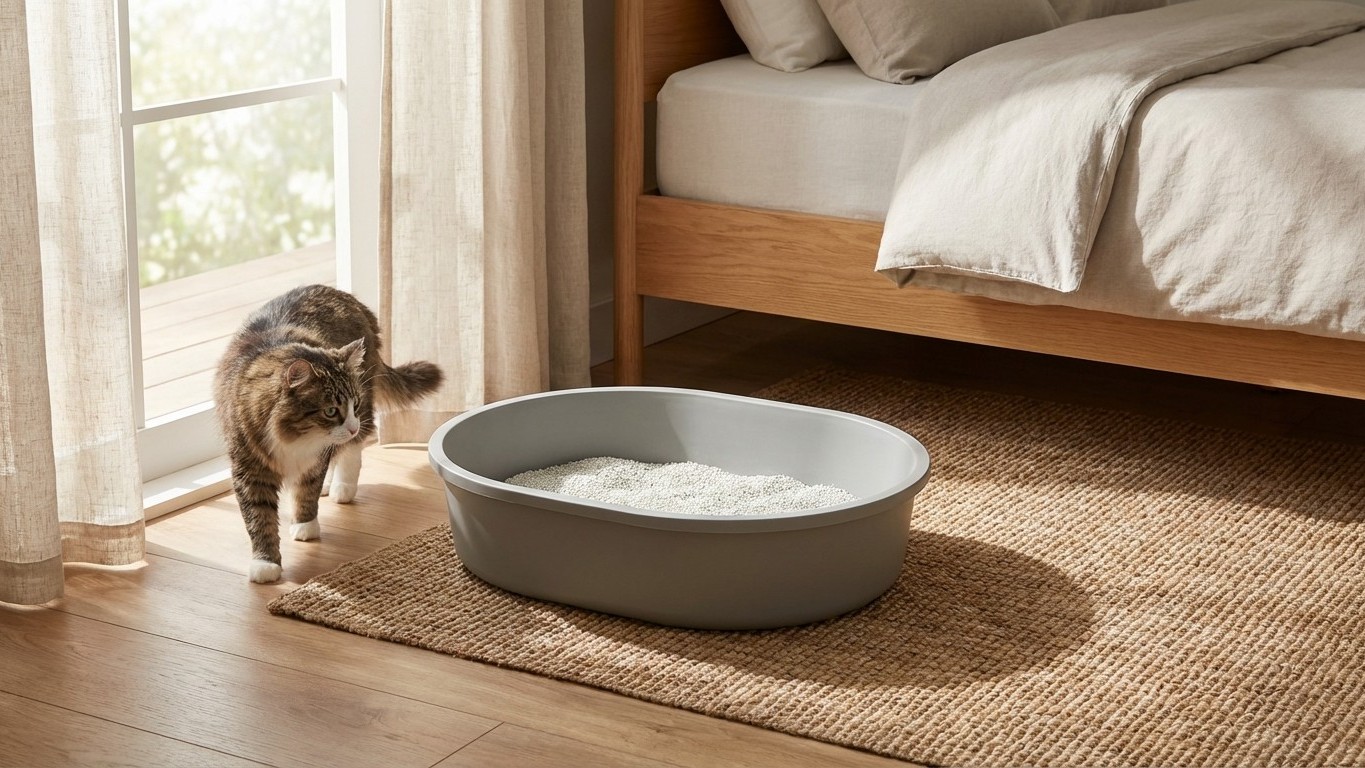
Ask most cat owners where their litter tray lives, and the answer is almost always the same: the utility room, the downstairs loo, or the basement. Somewhere tucked away. Somewhere out of sight, out of mind. It makes sense from a human perspective, but from a feline one? That choice can quietly cause weeks, months, even years of low-level stress, and occasionally turn your carpet into the preferred alternative. Cat Behaviourists have been saying this for years, and the evidence is compelling: the room you choose matters far more than most owners realise.
Key takeaways
- Why hiding the litter box might actually be stressing your cat out every single day
- The one room behaviourists recommend (and it’s probably not where you’d expect)
- The sneaky reason your cat might be avoiding the box—and how to fix it before it becomes a permanent habit
Why your cat feels vulnerable every time it uses the tray
Cats feel vulnerable in their litter boxes. Once in position, they worry about potential invaders in their territory. This is not a quirk; it is a deeply wired survival instinct. In the wild, the act of elimination leaves an animal exposed and momentarily defenceless. Domestic cats carry that instinct into our living rooms and utility cupboards whether we like it or not. A cat’s biggest fear is being cornered or ambushed in a vulnerable position, this is a powerful survival instinct, not just a quirk.
Peeing or pooping is a vulnerable moment, so cats seek out safe and peaceful areas for their bathroom activities. A poorly placed litter box may cause your cat to misuse it or avoid it altogether, leading to accidents around the house. The frustrating part is that once your cat starts eliminating outside the litter box, it can be difficult to correct that behaviour due to scent marking. Getting this right from the start, or correcting it sooner rather than later, is genuinely worth the effort.
What triggers that sense of threat? Noise is a big one. Machines that spin, thump, and beep may seem normal to humans, but cats have sensitive hearing. The unpredictable noise of a washer or dryer often scares them away from using the box consistently, and some cats may even dash out with puffed-up tails at the first spin cycle. Yet the utility room remains, statistically, one of the most popular spots owners choose.
The spot that behaviourists actually recommend
Basements and laundry rooms are popular choices but not Actually recommended. Instead, behaviourists suggest the bedroom. “Your bedroom is a good location for a cat litter box since it’s usually a quiet place,” and “your cat can smell a familiar scent, your scent.” That second point is worth sitting with. Your cat finds comfort in proximity to you. Placing the tray somewhere it can detect your presence is not pandering to the cat — it is working with its biology.
However, a 24/7 open-door policy is a must, and think twice if you’re a light sleeper likely to be woken up by the sound of a cat burying their poop. Fair warning. Beyond the bedroom, the key is to think less about which specific room and more about what that room offers. The best places for litter boxes are usually quiet, easy-to-reach corners that offer privacy. A spare room, a calm section of a hallway, or a quiet corner of the living room can all work if the fundamentals are right.
Those fundamentals come down to visibility and escape. Contrary to popular belief, a hidden box isn’t necessarily a safe box. Cats feel most secure when they can see the entire room, especially the doorways, so they can spot anyone approaching. A box tucked behind a couch might seem private to us, but for a cat, it creates a blind spot that makes them feel insecure. The best location provides a commanding view, giving them time to react and feel in control. Think of it the way you might choose a seat in a café, most people unconsciously pick a spot facing the door. Your cat is doing exactly the same calculation, every single time.
When choosing a location, think about opportunities for a safe escape and a location that provides ample visual warning time to see any invaders or opponents. A room with multiple open doors, or escape routes, is preferred. A narrow corner under the stairs, a cupboard with a cat flap, or a tight alcove behind the washing machine all fail this test, your cat can get in, but getting out quickly feels risky.
The rooms you should stop using
The utility room, as explored above, is problematic for noise reasons. The bathroom has its own pitfall: doors. A bathroom corner can feel private, but doors pose risks. If someone shuts the door by accident, the cat loses access, and you may find yourself cleaning an unexpected corner of the bedroom instead. Even a single blocked attempt can make a cat search for alternatives elsewhere in the house.
The kitchen is another common choice that behaviourists strongly advise against. Cats are clean animals, and they like to eat, drink, and go to the bathroom in three separate locations. A litter box placed next to cat food and water can cause litter box aversion. Evolution has wired them to separate eating from waste. Placing a litter box close to bowls may lead to refusal or encourage cats to seek new spots on carpets or furniture.
The basement, popular in larger homes, compounds several of these problems at once: it tends to be dark, cold, potentially noisy from boilers or pipes, and often accessed through a door that gets shut. Choose a spot with sufficient light since cats want to be able to see when they go to the bathroom. Asking a cat to navigate a dark stairwell at 3am when nature calls is, frankly, asking for trouble.
The rules that work in every home
Once you have the room sorted, a few further principles apply regardless of your home’s layout. The golden rule on numbers: one litter box per cat plus one. Even in single-cat homes, doubling up on litter boxes is recommended. Some cats like to poop in one spot and pee in another, something that surprises many owners but makes perfect sense once you think about it.
In multi-cat households, Placement becomes a matter of feline politics. In multi-cat households, you definitely don’t want to put litter boxes right next to each other, since cats will see the two as one litter box. Don’t cluster every box in one room, that turns several boxes into a single, defendable resource. Spread them out on different routes, across floors if possible, and avoid dead ends where a cat can be trapped.
If you do need to move the tray from its current spot, do it carefully. If you’ve realised that a cat litter box should be in a different place, don’t remove it just yet. Sudden changes can confuse your cats and may lead to accidents. Keep at least one litter box in a familiar location that your cats use often, and at the same time, set up the new location. Patience here pays dividends.
One final thing worth mentioning: if your cat suddenly stops using the tray despite good placement, please do not assume it is a behavioural problem. If your cat suddenly stops using the litter box, it’s a sign something’s wrong, either medically, behaviourally, or environmentally. Your first step should always be a vet check-up to rule out health problems. Urinary issues in particular can escalate quickly, and a cat in discomfort cannot simply tell you. Getting them checked is always the right first move.
There is something almost philosophical about the litter tray problem: we design our cats’ environment almost entirely around our own comfort, then wonder why they push back. Shifting the tray from the utility room to a quieter, more visible spot in the house costs nothing, takes five minutes, and could change your cat’s quality of life in ways you might never directly observe, a slightly calmer posture, a less hurried exit from the box, fewer 3am dashes to an inaccessible corner. Small things, perhaps. But for an animal quietly negotiating its sense of safety every single day, they are everything.