
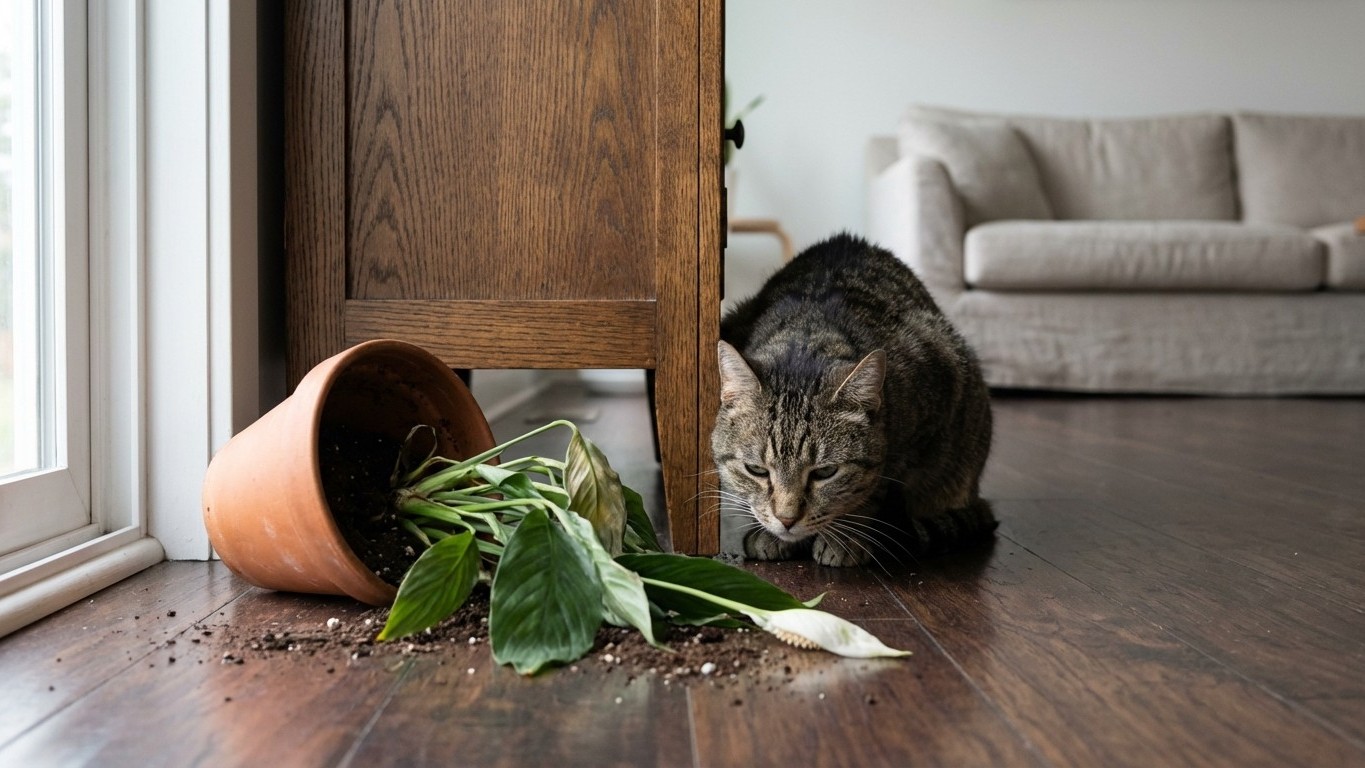
When Whiskers Stopped eating and began hiding behind the sofa for three consecutive days, I knew something was terribly wrong. My usually boisterous tabby had transformed into a shadow of herself, barely acknowledging my presence and refusing even her favourite salmon treats. The vet visit yielded nothing conclusive – blood work normal, temperature fine, no obvious signs of distress during examination. But cats are masters of concealment when it comes to illness, and I refused to accept that this was simply “one of those things.”
The breakthrough came on day four, quite by accident. While rearranging furniture to give Whiskers better hiding spots (desperate times called for desperate measures), I Discovered something that made my stomach drop. Behind my entertainment unit, barely visible unless you were lying flat on the floor, were the wilted remains of what had once been a beautiful peace lily – a houseplant I’d completely forgotten about after moving it there months earlier.
Key takeaways
- A cat owner discovers her pet’s mysterious three-day illness was caused by something she completely forgot about
- The hidden danger lurking in thousands of British homes that vets struggle to diagnose
- Which innocent-looking plants could be slowly poisoning your cat right now
The Silent Killer in Plain Sight
Peace lilies (Spathiphyllum species) are among the most common household plants that pose serious threats to our feline companions. Every part of this elegant plant contains calcium oxalate crystals, microscopic needle-like structures that cause immediate pain and swelling when chewed. What makes them particularly dangerous is their widespread presence in British homes – garden centres sell thousands annually, often without adequate warning labels about pet toxicity.
The symptoms had been textbook, though I hadn’t recognised them at the time. Whiskers had likely nibbled the plant during one of her midnight adventures, triggering immediate oral pain that made eating unbearable. The hiding behaviour? Classic feline response to feeling vulnerable and unwell. Cats instinctively seek dark, quiet spaces when they’re suffering, a throwback to their wild ancestors who needed to avoid predators whilst recovering.
Dr Sarah Mitchell, a veterinary toxicologist I consulted after this incident, explained that many cat owners miss the connection between houseplants and sudden illness. “Cats are natural explorers and often sample plants out of boredom or curiosity,” she noted. “The tricky part is that owners rarely witness the actual plant consumption, making diagnosis challenging.”
Beyond the Obvious Suspects
My peace lily discovery sent me down a rabbit hole of research that frankly terrified me. The list of common household plants toxic to cats reads like an inventory of every garden centre in Britain. Lilies of all varieties top the danger list – even pollen from Easter lilies can cause fatal kidney failure in cats. Simply brushing against the stamens and later grooming their fur can be enough to trigger toxicity.
Azaleas and rhododendrons, those quintessentially British garden staples, contain grayanotoxins that affect the cardiovascular and nervous systems. Cyclamen, popular as winter houseplants, pack concentrated toxins in their roots that can cause severe vomiting and heart rhythm abnormalities. Even the cheerful daffodils heralding spring contain lycorine, which causes digestive upset and more serious complications with larger ingestions.
The insidious nature of plant toxicity lies in its delayed presentation. Unlike chocolate poisoning in dogs, which typically shows symptoms within hours, plant toxicity in cats can manifest subtly over several days. Whiskers’ gradual decline had masked the urgency of her condition, nearly costing us precious treatment time.
Creating a Cat-Safe Haven
Transforming my home into a feline-friendly environment required more than simply removing obvious threats. I discovered that many plants I’d considered harmless were actually problematic. Spider plants, whilst not toxic, can cause mild stomach upset and have a mildly hallucinogenic effect on some cats (though thankfully less dramatic than catnip). Rubber plants contain a milky sap that irritates mucous membranes and can cause digestive issues.
The solution wasn’t to eliminate all greenery – both Whiskers and I benefit from having plants around. Instead, I curated a collection of genuinely cat-safe options. Boston ferns thrive in British homes and provide lush greenery without any toxicity concerns. Parlour palms add tropical flair whilst remaining completely safe for curious cats. Spider plants, despite their mild effects, are generally considered safe and can actually provide entertainment for bored indoor cats.
Placement became equally important as plant selection. High shelves and hanging planters keep tempting foliage out of reach, whilst still allowing plants to beautify living spaces. I invested in stylish plant stands that position greenery at eye level for humans but well above cat-height for safety.
The Recovery and Lessons Learned
Whiskers’ recovery began almost immediately once I removed all potentially toxic plants from the house and provided supportive care under veterinary guidance. Within 48 hours, she was eating small amounts of wet food, and by the end of the week, she was back to her demanding, treat-obsessed self.
This experience taught me that vigilant pet ownership extends far beyond obvious hazards like antifreeze and rat poison. The very plants we choose to brighten our homes can become silent threats to our beloved companions. Regular “cat-proofing” sweeps of the home should include checking for new plants, fallen leaves, and even cut flowers in vases.
Most importantly, I learned to trust my instincts when something seems wrong with my pet. Whiskers couldn’t tell me what had made her ill, but persistent observation and investigation revealed the culprit hiding in plain sight. How many other pet emergencies might be prevented if we simply looked more carefully at the environments we share with our four-legged family members?