
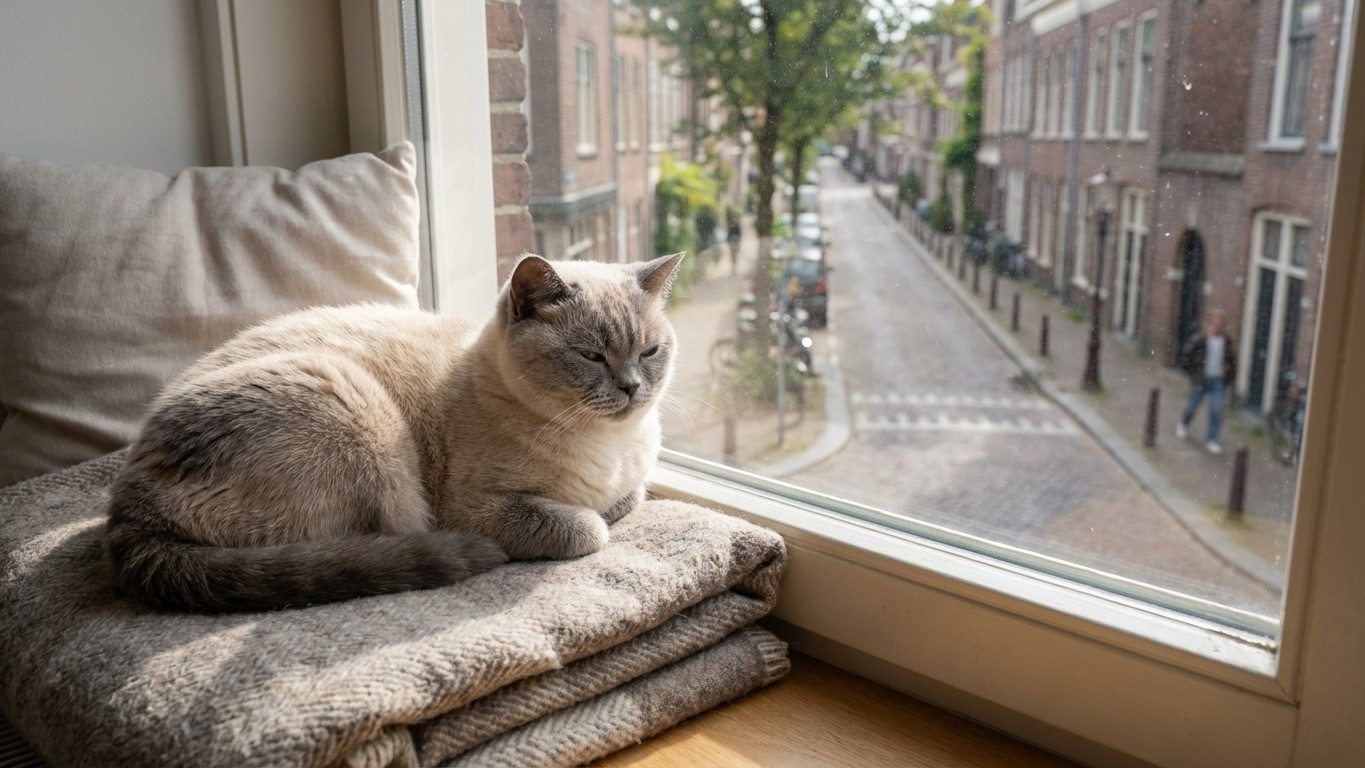
Living in a flat with no outdoor access doesn’t make you a bad cat owner. Some of the most contented, affectionate cats in Britain live their entire lives between four walls, happily perched on a windowsill or curled up on a radiator shelf, never once mourning the absence of a garden. The catch? Breed matters more than most people realise. Pick the wrong cat for a flat, and you’ll have a frustrated, destructive animal pacing the hallway at 3am. Pick the right one, and you’ll have a genuinely happy housemate.
Key takeaways
- Some cat breeds were literally developed for indoor companionship and genuinely prefer apartment life
- A mismatch between breed temperament and flat living creates frustrated, destructive cats—so genetics matter more than most people realise
- The right indoor cat won’t mourn the absence of a garden; it will simply curl up on a radiator and wait for you to come home
Why indoor life suits some cats far better than others
Cat temperament is shaped by genetics as much as upbringing. Certain breeds were developed over generations for close human companionship, low prey drive, or naturally calm energy levels. These cats don’t experience a flat as a deprivation. A Bengal, by contrast, needs the kind of stimulation that most London apartments simply cannot provide. That’s not a character flaw in the cat; it’s just a mismatch between the animal’s wiring and the environment.
Activity level, vocalisation, and the need for outdoor territory all vary dramatically between breeds. A Burmese cat left alone in a studio flat will voice its displeasure loudly and at length. A British Shorthair in the same flat will probably just find a comfortable armchair and wait for you to come home. If you’re choosing a cat for indoor-only life, these differences aren’t trivial.
The breeds that genuinely thrive without outdoor access
The Ragdoll earns its name. These cats go limp when picked up, are famously docile, and seem to have been purpose-built for sofa life. They’re sociable without being demanding, large enough to feel satisfying to cuddle, and have a gentle temperament that makes them patient companions even in smaller spaces. They do enjoy play, but a feather wand session each evening is usually enough to keep them content. They’re not climbers by nature, which is genuinely useful when your ceiling-height bookcase is the only vertical space available.
Persian cats have been indoor companions for centuries, and their laid-back, almost philosophical approach to life makes them well-suited to flat living. They’re not big movers. They appreciate a clean, calm environment and regular grooming sessions (their coat demands it), which conveniently doubles as bonding time. One thing worth knowing: their flat faces (a characteristic called brachycephaly) can cause breathing and dental issues, so regular vet checks are non-negotiable with this breed.
The British Shorthair is practically a national institution. Stocky, self-possessed, and quietly affectionate without being clingy, these cats adapt beautifully to indoor life. They’re not lap cats in the traditional sense, they prefer to sit beside you rather than on you, but they’re reliably good-natured and low-maintenance in terms of entertainment. Kittens are livelier, obviously, but adult British Shorthairs have an almost aristocratic calm that suits flat life well.
If you want a cat that actually interacts with you rather than simply tolerating your presence, the Scottish Fold is worth considering. Their distinctive folded ears are the result of a genetic mutation, and it’s worth knowing that responsible breeders pair Folds with straight-eared cats to reduce the risk of associated joint problems. Health screening matters here. But in terms of temperament, they’re gentle, curious, and unusually comfortable in confined spaces. They follow their owners from room to room without the intensity of a Siamese, and they tend to stay calm in the smaller territories a flat provides.
The Devon Rex and Cornish Rex are both British breeds (fittingly) and both make excellent indoor companions. Their curly coats are low-shedding, which is a genuine bonus for flat dwellers worried about upholstery. More usefully, both breeds are playful and people-oriented without the relentless energy of a Bengal or Abyssinian. The Devon Rex in particular has been described as “dog-like” in its loyalty, following its owner around and learning tricks with modest training effort. In a flat, this attachment to human company becomes an asset rather than a burden.
What every indoor cat needs, regardless of breed
Choosing the right breed is step one. Step two is setting up the flat to actually meet a cat’s needs, because even the most placid indoor cat requires more than food and a clean litter tray.
Vertical space is the single most underestimated element of cat enrichment. Cats feel safer elevated, and a flat without any climbing options leaves them without an outlet for one of their most fundamental instincts. Cat trees, wall-mounted shelves, or even cleared bookcase tops can Transform a small flat into a satisfying environment. Window access matters too. A bird feeder positioned outside a window you can leave slightly ajar (with mesh for safety) provides what cat behaviourists call “cat TV,” and it costs almost nothing to set up.
Play is not optional. Indoor cats don’t get the physical and mental stimulation that outdoor hunting provides, so you have to substitute it. Two focused play sessions daily, using toys that mimic prey movement, makes a measurable difference to a cat’s stress levels and weight. Puzzle feeders are another useful tool, turning meal times into a mild cognitive challenge rather than a ten-second inhale from a bowl.
One final thought that often goes overlooked: many indoor-only cats actually do well in pairs, especially if you work long hours. Two cats who get along will entertain each other in ways that no amount of enrichment toys quite replicate. Some of the most settled indoor cats I’ve encountered in my work have been bonded pairs in one-bedroom flats, sleeping in a heap while their owners commute to the office.
A flat is not a compromise for the right cat. For a Ragdoll snoozing on a heated blanket or a British Shorthair surveying the street from a windowsill, it’s simply home.