
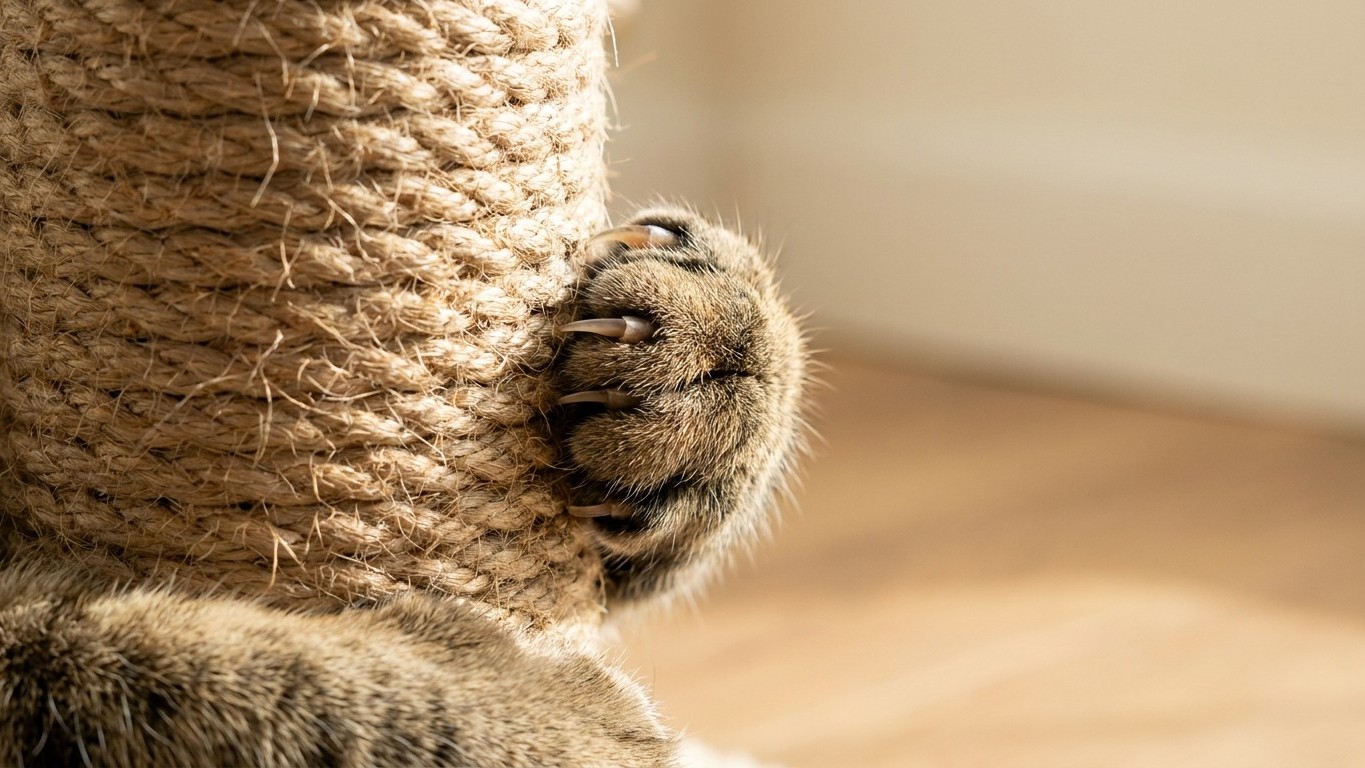
Scent, not shabby build quality, is usually the reason a shiny new scratching post gets completely ignored while the sofa arm ends up in ribbons. I’d assumed my cat was simply being fussy until a behaviourist pointed out that I’d tucked the post away in the spare room, out of sight, when what my cat actually needed was somewhere central and obvious. The post itself was fine. The postcode was the problem.
Key takeaways
- Cats have scent glands in their paw pads that communicate territorial claims—and the location matters more than you think
- A scratching post hidden away in a spare room is invisible to your cat’s territorial communication needs
- The most common owner error is placing posts in out-of-the-way spots instead of high-traffic areas where the message will be ‘seen’
The chemistry hiding in those paw pads
Cats have scent glands in the pads of their paws, and interdigital scent glands release a complex mixture of volatile compounds during scratching. Every time your cat drags its claws down a surface, it’s doing far more than filing its nails. The scratch deposits an invisible chemical signature that communicates the cat’s presence, health status, and territorial claim, while the visual mark amplifies that message by making it legible at a distance. It’s a bit like a cat leaving both a business card and a neon sign at the same time.
This is exactly why removing the temptation doesn’t remove the urge. Removing the surface does not remove the need. A vet-focused source puts it plainly too: “Your scratching cat deposits pheromones from glands on their paw pads to communicate a wealth of information, such as their health status, mating prospects, and territorial boundaries.” None of this is naughtiness. It’s a cat doing exactly what cats have always done, just aimed at your furniture instead of a tree trunk.
Why the corner of the spare room was doomed from the start
Here’s the bit that genuinely reframed how I think about scratching posts. Cats scratch where the message will be seen and smelled, near doorways, beside resting areas, in the rooms where the family spends most time, and the sofa in the living room is the single most high-value communication site in most homes. A post shoved into a quiet corner simply doesn’t do the job a cat needs it to do. A scratching post in the spare bedroom is invisible from the perspective of territorial communication, which is why it is ignored.
Other sources back this up almost word for word. Cats would not find a corner or inconspicuous area suitable for leaving such messages; they prefer a flashing billboard in the form of a tall, sturdy scratching post in a prominent area of the home. And if your cat has already chosen the sofa, don’t fight that instinct with distance. Place the new post directly beside the piece of furniture being scratched, not nearby, because the communication function requires the alternative to be in the same location. One American vet-behaviourist resource frames this as one of the most common owner errors: if you put your scratching posts in out-of-the-way spots, your cat might not use them, since cats use scratching posts to show others their territory, so they want them front-and-center in high-traffic areas of the home.
Once your cat has properly adopted the substitute, you’re not stuck with a sisal tower in the middle of your lounge forever. Once the post is in consistent use for two to four weeks, begin moving it gradually, a few centimetres per day, toward a more convenient location. Patience matters here; yank it away too fast and the cat simply goes back to the couch.
Getting the post itself right, once the spot is sorted
Location fixes half the battle, but the post has to earn its keep too. Texture is a genuine preference, not decoration. A cat behaviorist explained that sisal or corrugated cardboard surfaces are favoured by most cats, though every cat has its own taste. Stability matters just as much: a post that is unstable or does not allow a cat to fully extend its body might put off the cat from using it. If it wobbles the first time your cat leans into it, that’s often the last time it tries.
Height and orientation deserve a proper look too. Most posts should let your cat stretch fully upright, but cats like to scratch on vertical surfaces, horizontal surfaces, and angled surfaces, so watch how your cat attacks the sofa (side-on, from above, dragging downward) for clues about what shape of scratcher it actually wants. Scent transfer helps speed up the switch too: rubbing an old, already-scented cloth or a strip of the previously used carpet onto the new post gives it an instant head start, since cats gravitate toward surfaces that already carry familiar smells.
Punishing the sofa-scratching, incidentally, tends to backfire. Telling a cat off, or spraying it with water mid-scratch, risks making the whole room feel unsafe rather than teaching where scratching is welcome, and stressed cats scratch more, not less. If the behaviour changes suddenly or becomes frantic, that’s worth mentioning to your vet rather than assuming it’s simply a training gap, since sudden shifts in scratching can occasionally flag pain, anxiety or other underlying issues.
The detail that stuck with me most, though, was learning that those paw pad glands are eccrine glands, the same sweat-producing type found on human palms, which is part of why a freshly scratched post can feel faintly damp under a curious finger. Cats have remarkably few sweat glands anywhere else on their body, so the paws do double duty: cooling the cat down and broadcasting its scent, all in the same four small pads. Once you know that, a scratching post stops looking like a bit of cat furniture and starts looking like exactly what it is: prime real estate for a very deliberate message.
Sources : cats.com | feliway.co.uk