
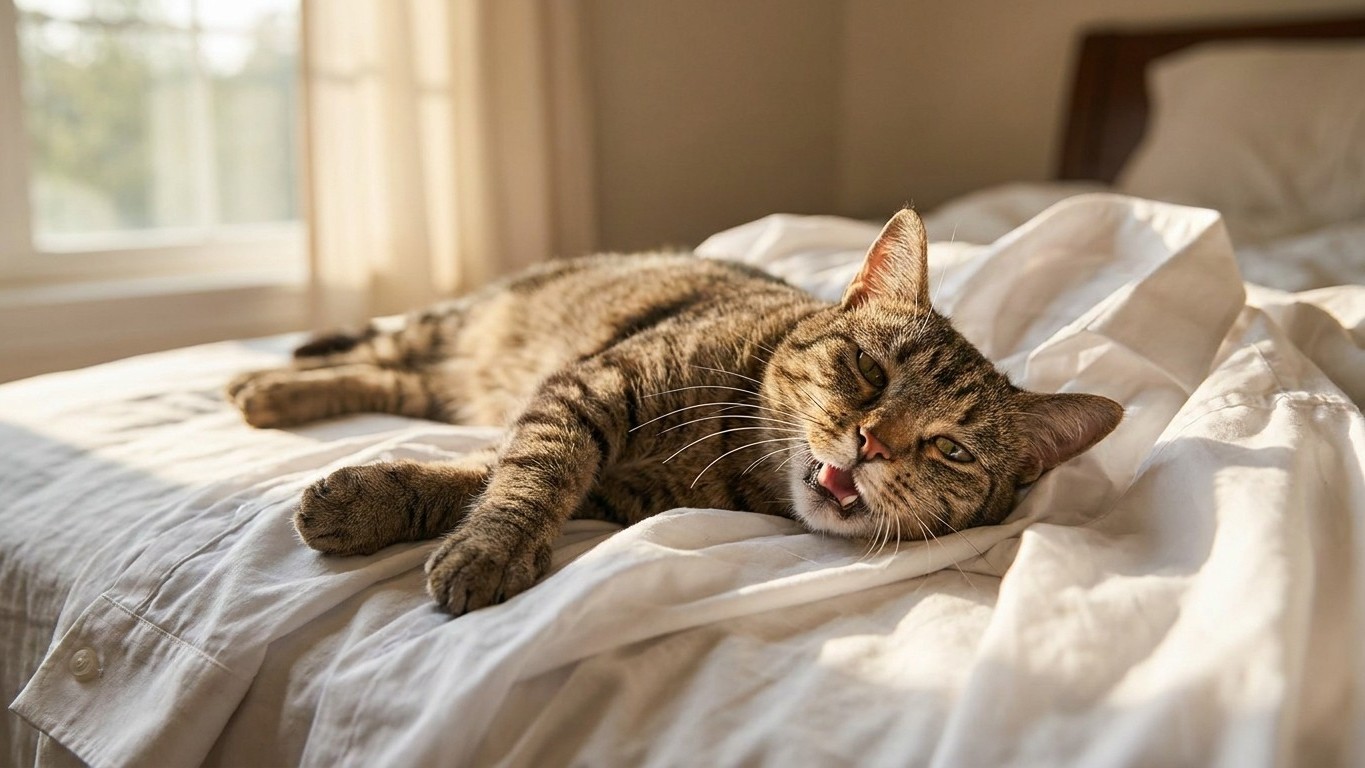
A pile of freshly ironed shirts, still warm from the iron, left on the bed. Twenty minutes later, your cat is sprawled across them, limp, panting, with glazed eyes. Your stomach drops. What just happened, and what should you do right now?
The scene is more common than Most Cat Owners realise. Cats simply cannot resist clean laundry, and most relish burrowing into warm clothes fresh from the dryer or, as in this case, off the ironing board. The warmth is the real draw. Our domestic cats are descendants of wild desert cats, and those survival instincts are still very much present, driving them to seek out warm places as a matter of deep-seated habit. The problem is that the insulating effect of their fur can put them at risk, because it prevents them from feeling an increase in heat until it is already hot enough to be dangerous. Freshly ironed shirts can hold considerable residual heat, far beyond what your cat’s instincts were designed to flag as a warning.
Key takeaways
- Why cats are magnetically drawn to warm laundry—and why their fur becomes a deadly trap
- The disturbing moment when heat exhaustion crosses into heatstroke: what you’re actually witnessing
- The precise cooling steps that buy time, and why reaching a vet is non-negotiable even if your cat seems to recover
What you’re actually seeing: heat exhaustion tipping into heatstroke
A limp, panting cat is not resting. Those are textbook distress signals. Unlike dogs, cats don’t normally pant to cool down, so this behaviour should always raise serious concern. Signs of heat exhaustion in cats include restless behaviour as they search for a cool spot, panting, drooling, and sweaty paws or excessive grooming, all of which are attempts to cool themselves down. Limpness, however, suggests things have gone further.
Heatstroke can progress from mild Discomfort to a dangerous emergency within 20 to 30 minutes. A cat’s normal body temperature sits around 100–102.5°F, and organ damage begins when their temperature exceeds 104°F. Damage to the nervous system occurs at temperatures of 105.8°F (41°C) or greater, and cell death occurs at temperatures of 106.7°F (41.5°C) or greater. That limp, heavy quality you noticed? Severe heatstroke shows as heavy panting, drooling, bright red or purple gums, and vomiting. Your cat may seem confused, walk unsteadily, or collapse.
Inflammation caused by heatstroke sets off several reactions that affect every major system of the body, causing the breakdown of essential proteins and enzymes. This puts the cat at risk of organ failure and potentially death. This is not a case of “let’s wait and see.”
What to do immediately, the steps that matter
Stay calm, move fast. Every minute counts. Immediately take your cat to an air-conditioned room or shaded area with good airflow, and place them near a fan if available, but don’t aim it directly at them. Get the ironed shirts away from them; any heat-retaining fabric needs to go.
Dampen a towel with cool (not cold) water and gently apply it to your cat’s belly, paws, and neck. Avoid covering their entire body, as this can trap heat. Replace the towel as it warms. The distinction between cool and cold is important: slowly pouring cold water from the cold tap over their body is appropriate, but keep it away from their nose and mouth. Do not use ice packs directly on the skin, and never submerge them.
Offer small sips of cool water if your cat is conscious and able to drink, but don’t force it. Then, head directly to a veterinarian for emergency care, starting brief cooling at home is important, but it is not a substitute for professional treatment. Ring ahead so the practice is ready when you arrive. Prolonged high body temperature can damage a cat’s kidneys, liver, heart, and brain. Kidney problems are common after heatstroke and may not show symptoms until days later. Even if your cat seems to perk up on the way to the surgery, they still need to be seen. Internal damage is not always visible.
Which cats are most at risk
Any cat can overheat on warm laundry, but some are more vulnerable than others. Obese, long-haired, old, young, and brachycephalic or flat-faced cats, such as Persians, are most at risk of developing heatstroke because they find it harder to cool down. The reason flat-faced breeds struggle so much comes down to simple anatomy: cats get rid of significant amounts of body heat through their nose as they breathe out, but brachycephalic cats such as Persians struggle to release heat this way because they have much less space inside their nose, putting them at much higher risk of heatstroke, even on seemingly cool days.
Risk factors like being a flat-faced breed, being dark-coated, having heart disease, or obesity can all make cats more susceptible to heatstroke. Dark coats absorb heat more readily, much like wearing black on a summer’s day. A dark-furred Persian on a pile of warm shirts in a sunny bedroom is the worst-case combination.
Keeping it from happening again
The honest answer is that you probably cannot stop your cat from being magnetically drawn to warm laundry, it is wired too deeply into their behaviour. Warm areas radiate noticeable heat and often smell like the household, which adds familiarity and security. Heat plus a familiar scent creates a preferred resting site. What you can do is manage the risk. Don’t leave warm, freshly ironed or tumble-dried clothes unattended in a room where your cat has access, particularly in summer or in any room that gets warm afternoon sun.
If your cat spends most of their time indoors, make sure they’re in a climate-controlled, well-ventilated location. Before using your clothes dryer, always check for the presence of a cat to prevent accidental entrapment, and keep it closed between uses. That last point is genuinely life-saving: cats crawl into tumble dryers with tragic regularity, attracted by lingering warmth from a recent cycle.
One practical workaround is to redirect the behaviour rather than fight it. If the coziness draws in your cat, consider providing them with a heated cat bed placed in a safe, cool-enough spot. Give them their own designated warm haven and they’re less likely to commandeer your work shirts. The pull of warmth won’t disappear, but at least the consequences become far less frightening than finding a limp, panting animal on your bed linen. Worth also knowing: a sudden increase in heat-seeking behaviour beyond your cat’s usual patterns can occasionally signal an underlying health issue such as thyroid disease or pain, so if your cat suddenly seeks heat more than usual, or seems lethargic or loses weight, a veterinary check is warranted.
Sources : quora.com | petscare.com