
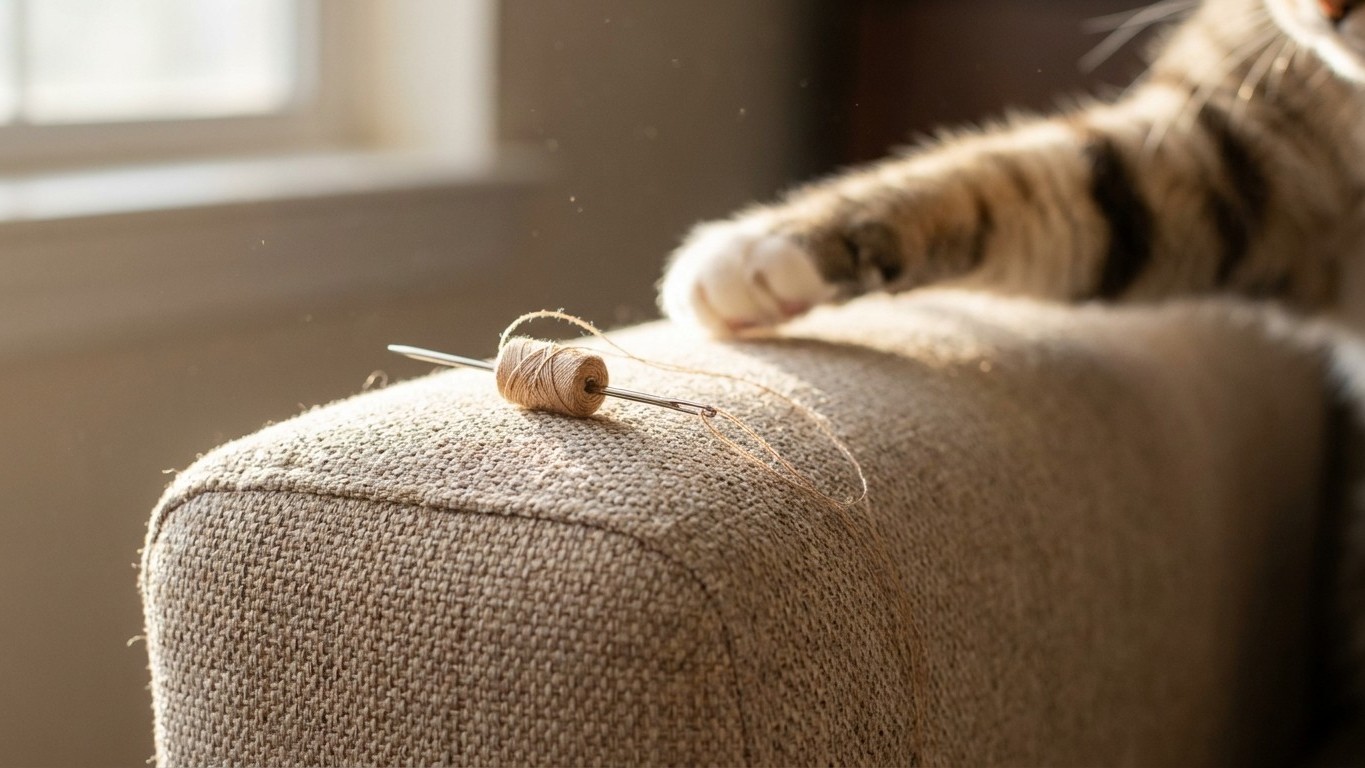
A threaded sewing needle left on a sofa arm for two minutes. That’s all it takes. You nip to the kitchen, come back, and the needle is gone, your cat sitting nearby, looking faintly smug. What happens next, and what that X-ray might show you, is something no cat owner should have to learn the hard way.
Key takeaways
- A cat’s barbed tongue makes it impossible to spit out thread once swallowed—and a needle attached to it becomes a ticking time bomb inside the gut
- On X-ray, vets see the intestines ‘pleated like an accordion,’ bunched and twisted by the anchored thread—a pattern that signals a surgical emergency
- Your cat might seem fine for hours after swallowing a needle, purring and grooming normally, while dangerous internal damage silently develops behind the scenes
Why cats and needles are such a dangerous combination
Cats have backward-facing barbs on their rough tongues that make it nearly impossible to spit out string once they start swallowing it, and playful batting at sewing materials can turn dangerous almost instantly if a needle is attached. This isn’t carelessness on your cat’s part, it’s pure, hardwired biology. The thread mimics the movement of prey, and cats love playing with long, thin materials like string, tinsel, and sewing thread because it excites and mirrors their natural predatory instincts.
Besides the sharpness of the needle itself, another danger is if it still has thread attached. Linear foreign bodies are common in cats precisely because yarn, string, or thread is so provoking to felines, what starts as a plaything can quickly get consumed. The moment the thread is in the mouth, the barbed tongue does the rest. Your cat genuinely cannot spit it back out.
Here’s the biology that turns this into a life-threatening situation. As a cat swallows thread, it may become wrapped around the base of the tongue or anchored in the stomach, pulling against that area every time the cat swallows. If the thread is attached to a needle, the needle may pierce the stomach or intestines and prevent the thread from passing through, and this type of foreign body is more dangerous still, as it can cut the intestinal tissue as it pleats them like an accordion.
What the X-ray actually shows, and why vets go pale
If one end of a linear foreign body becomes lodged at some point in the gastrointestinal tract, at the base of the tongue, in the stomach, or in the intestine — the free end trails down the remainder of the digestive tract. As the intestines attempt to move this trailing material downward for elimination, it is unable to move. The result is the intestines “crawling” up the foreign body, becoming bunched. Picture the drawstring of a hoodie being tugged from one end while the other is anchored. The fabric puckers and gathers. That’s your cat’s intestine.
On X-ray, vets look for a classic “accordion” or plication appearance of the intestines, bunched-up loops caused by anchored tension, alongside abnormal intestinal gas patterns: multiple small, sharply angled gas pockets instead of smooth loops. A needle, being metal, shows up clearly on radiograph. The thread itself may be invisible, but the damage it causes to the gut architecture is not.
Sometimes needles do pass through the gastrointestinal tract without any problems. In other cases, the sharp point of the needle may pierce through the oesophagus, stomach or intestines, and the needle can then migrate throughout the body. One documented case involved a cat whose sewing needle, having pierced through tissue, was found not in the gut but embedded in the neck, having shifted position overnight between two sets of X-rays. The surgery to locate it required following the thread through separated muscle layers.
This continued movement can cause a tear or perforation of the intestines, allowing intestinal contents to leak into the abdominal cavity, causing peritonitis, which can be life-threatening. In veterinary terms, this is the scenario no one wants. A needle could perforate the stomach, small intestine or colon. Had that happened, GI contents would leak into the abdomen, causing septic peritonitis, an infected abdomen, a very serious condition that comes with a very guarded prognosis for full recovery.
The symptoms that are easy to miss
Your cat might show subtle signs like decreased appetite, reluctance to move, or unusual litter box habits. Some cats may drool slightly or paw at their mouths. These quieter symptoms don’t mean the situation is less serious, they often mask significant internal problems. This is the part that catches owners out. A cat who has swallowed a threaded needle can appear almost normal for hours. They may groom themselves, drink a little water, and even purr.
Cats with linear foreign bodies tend to be fairly young, with an average age of 2.7 years. Vomiting and poor appetite are the most common clinical signs. Cats often continue to drink small amounts of water. On physical examination, they are often depressed, dehydrated, and may show signs of abdominal pain. The more alarming signs, repeated vomiting, crying when touched, refusing to lie down, tend to appear once damage is already underway.
One thing many owners don’t know: thread visible from the mouth or rectum indicates a linear foreign body emergency. And the instinct to pull it out is exactly wrong. If you see thread hanging from your cat’s mouth or rear end, resist the urge to pull it. The thread may be wrapped around internal organs or attached to a needle inside your cat, and pulling could cause tears in the digestive tract. Instead, carefully trim any dangling thread to a short length to prevent your cat from stepping on it.
What happens at the vet, and what you should do right now
Each of the potential complications of swallowing a needle is considered an emergency. Seeking immediate veterinary care is vital if you know or suspect your cat has swallowed a needle. Do not wait for symptoms to worsen. Do not “monitor overnight”. Phone your vet or an emergency clinic the moment you suspect something has been swallowed.
If a linear foreign body is suspected, surgery called exploratory laparotomy may be required. Your cat will be anaesthetised, and the abdomen opened to allow surgical exploration. If a linear foreign body is found, the intestines will be cut open, possibly at multiple sites, to allow removal of the foreign material. If regions of the intestine are perforated or significantly damaged, those regions may need to be removed. Recovery typically means one to three days of hospitalisation following removal, with intravenous fluids and pain medication throughout.
The linear foreign body surgery is generally considered a higher mortality situation than those involving more simple foreign bodies. Speed, as always in these cases, is the single biggest factor in whether a cat walks out of that clinic.
Prevention is straightforward, even if it requires a habit shift. Store all sewing supplies in secure containers with latched lids, and put away projects completely when not actively working on them, even during short breaks. Two minutes is genuinely all it takes. In one study, 90.6% of feline linear foreign bodies were thread, and 9.4% were thread with a sewing needle — which tells you just how ordinary the source of these emergencies really is. Wool, embroidery thread, a half-finished seam on a cushion. The things we leave lying around without a second thought are precisely the things our cats are drawn to most.
Sources : gsvs.org | urbananimalveterinary.com