
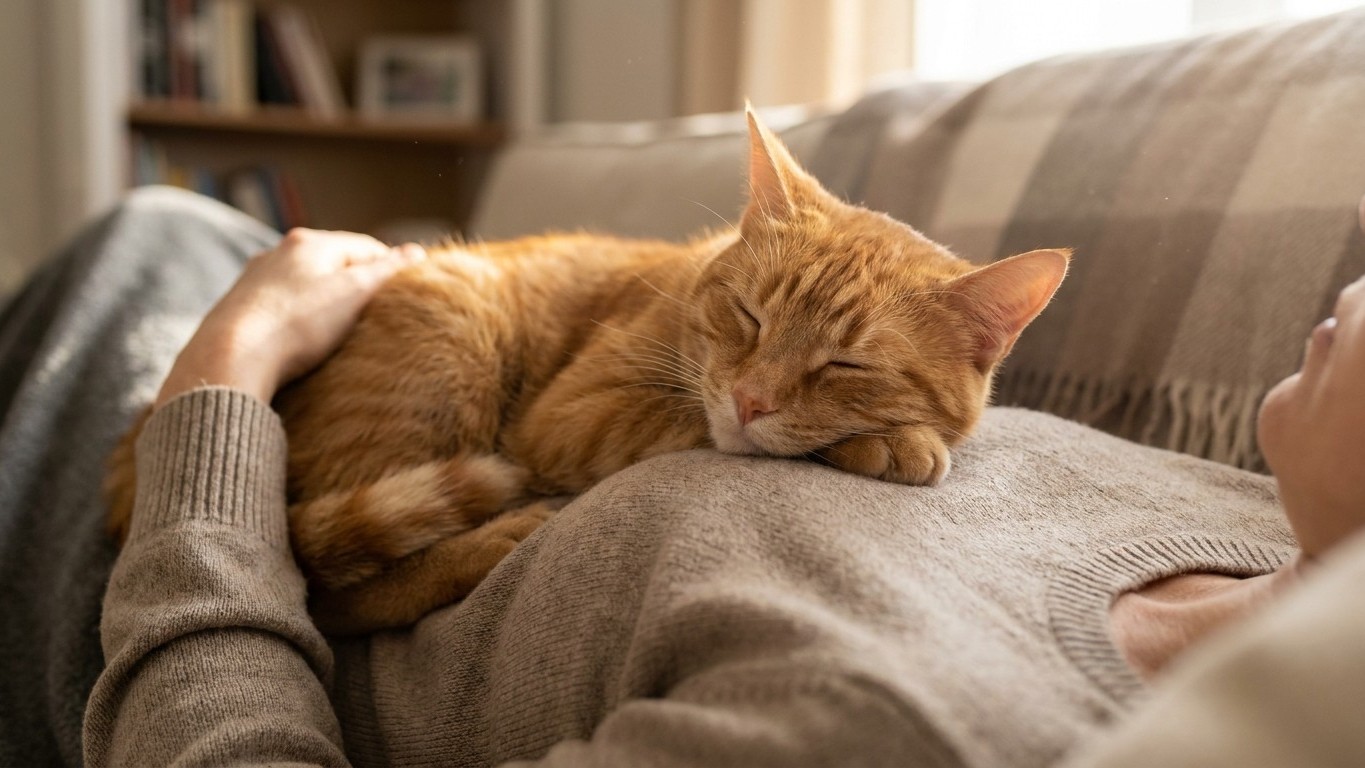
Most cat owners interpret their cat’s sleeping location as a simple matter of comfort, warmth here, a soft surface there. But the exact spot your cat selects on your body is far more deliberate than that, and the signals it sends are ones that many owners consistently misread. A cat draped across your chest is not doing the same thing as one wedged between your knees. Each location maps onto a distinct emotional state, a different level of trust, and occasionally, something worth paying attention to.
Key takeaways
- Every sleeping spot your cat chooses on your body maps to a distinct emotional state most owners completely misread
- A cat sleeping at your feet isn’t being aloof—they’re actually monitoring the room while staying close to you
- Sudden changes in where or how your cat sleeps could signal stress, pain, or significant life changes requiring attention
The spot they choose is a trust barometer, not a comfort lottery
When your cat sleeps in your bed, it is not random. Every position, every spot, tells a small story about trust, comfort, and the bond you share. The mistake most owners make is treating all co-sleeping as equivalent, flattering, yes, but ultimately the same gesture. It is not.
If your cat chooses to sleep directly on your chest, it is one of the strongest indicators of trust and affection. Unlike dogs, who often express love through active displays like licking or wagging their tails, cats prefer passive closeness, especially during sleep. A study in Anthrozoös examined feline-human relationships and found that cats who sleep on their owner’s chest or lap show the highest levels of social attachment. The reasons are both physical and emotional: your cat may want to sleep on your chest to be closer to your mouth, as your voice may provide comfort. In much the same way that the sound of a heartbeat can soothe an infant, your cat may be soothed by the sound of your heart and the rhythmic motion of your breathing. Sleeping on your chest also gives your cat a great source of body heat.
The head and pillow zone is where things get genuinely interesting. Your head is a spot that could feel comforting to a cat. Human heads release heat and move less than other parts of our bodies when we sleep, so a cat might be drawn to it for those reasons. Your cat might also like the way your hair smells. That last detail surprises people, the idea that your shampoo or the warmth radiating from your scalp is actively attractive to your cat. But feline scent detection is extraordinarily refined, and your hair carries a concentrated cocktail of your personal scent, which your cat finds deeply reassuring.
Feet, legs, and the independence myth
A cat sleeping at your feet tends to be read as aloofness. “Oh, she doesn’t really want to be close to me.” This is almost certainly the wrong interpretation. A study in the BSAVA Manual of Canine and Feline Behavioural Medicine explains that cats prefer sleeping positions that allow them to monitor their environment while remaining relaxed. The foot of the bed provides a vantage point where they can stay close to their human while still keeping an eye on the room. This means your cat isn’t just sleeping at your feet for comfort, they may also see themselves as your personal night watch.
When a cat sleeps between your legs, it may be somewhat uncomfortable for you, but it can definitely have some perks for your cat. Your cat can be very close to you, and your legs provide a warm, safe, nest-like area for your cat to sleep. Even so, your cat still has the security of an easy escape route. That escape route detail matters enormously. Cats are simultaneously predators and prey animals, and even the most domesticated moggy retains the instinct to never be fully cornered, even in sleep. A cat between your legs has warmth, proximity, and a clear exit. It is the feline equivalent of a five-star setup.
The same logic applies to cats who settle beside you but not on you. Lying next to you, but not on you, doesn’t mean your cat is not bonded to you. In fact, sleeping next to you means your cat trusts you enough to be in a vulnerable position while sleeping. Some cats are not comfortable sleeping on their human because they prefer the security of a small buffer zone. This sleeping position is their way of saying that they are bonded to you, but need a little extra space, at least in the moment.
What’s really driving the choice: scent, heat, and something more
Cats have a higher body temperature than humans, averaging about 102°F, and they adore warmth. Your body acts like a perfect, cosy heat source, especially during cooler months. So yes, part of this is simple physics. But reducing the whole behaviour to thermoregulation misses the larger picture entirely.
When they sleep on you, cats may also be marking you, subtly claiming you as part of their territory through scent exchange. Their body oils contain pheromones that signal ownership, bonding, and familiarity. This form of territorial behaviour isn’t possessive in a negative sense; it’s Actually a Sign of affection and inclusion. Think of it less as your cat owning you and more as them filing you under “safe and mine” in their internal database. Quite touching, really.
Although cats are often labelled as solitary hunters, they exhibit surprisingly social behaviours when it comes to rest. Felines may prefer some independence during the day, yet they often seek out trusted companions at night, whether those companions are fellow cats or their human caretakers. This “social sleeping” tendency reveals a more communal side of feline behaviour than many realise. It connects directly to their earliest experiences: a cat’s curled-up position mimics the way they sleep with littermates, reinforcing feelings of safety and security.
When a change in sleeping spot deserves your attention
Here is the part most owners overlook entirely. A cat who suddenly shifts where they sleep on you, or stops sleeping on you altogether, may be communicating something important. A stressed or painful feline may struggle to rest, snooze more, or slumber in an unusual pose, presumably since movement is painful, which suggests a negative emotional state of the cat.
Certain sleep patterns can indicate health issues. A cat that suddenly starts sleeping in a hunched, tense position, hides in dark or enclosed spaces more than usual, or stops stretching out entirely may be in pain. Combined with changes in appetite, grooming, or litter box habits, altered sleeping behaviour is a good reason to schedule a vet visit. If your cat has gone from sleeping on your chest every night to hiding under the bed, do not dismiss it as a mood. Always consult your vet if you notice persistent or sudden behavioural changes.
If Your Cat Suddenly becomes more affectionate, it could be their way of seeking comfort during times of change or uncertainty. A new baby, a house move, building works on the street, even a change in your own daily schedule, cats register all of it. When they press closer to you at night, they are often self-regulating in response to stress. You are their anchor. That is worth knowing.
One thing that genuinely surprises cat behaviourists: cats are a crepuscular species, which means they nap intermittently throughout a 24-hour period, but are mostly awake at night, particularly around dusk and dawn. So when your cat chooses to settle on you at 2am rather than roam, it is a genuine sacrifice of their most active hours. That is not nothing.
Sources : vettoday.com | thecattopia.com