
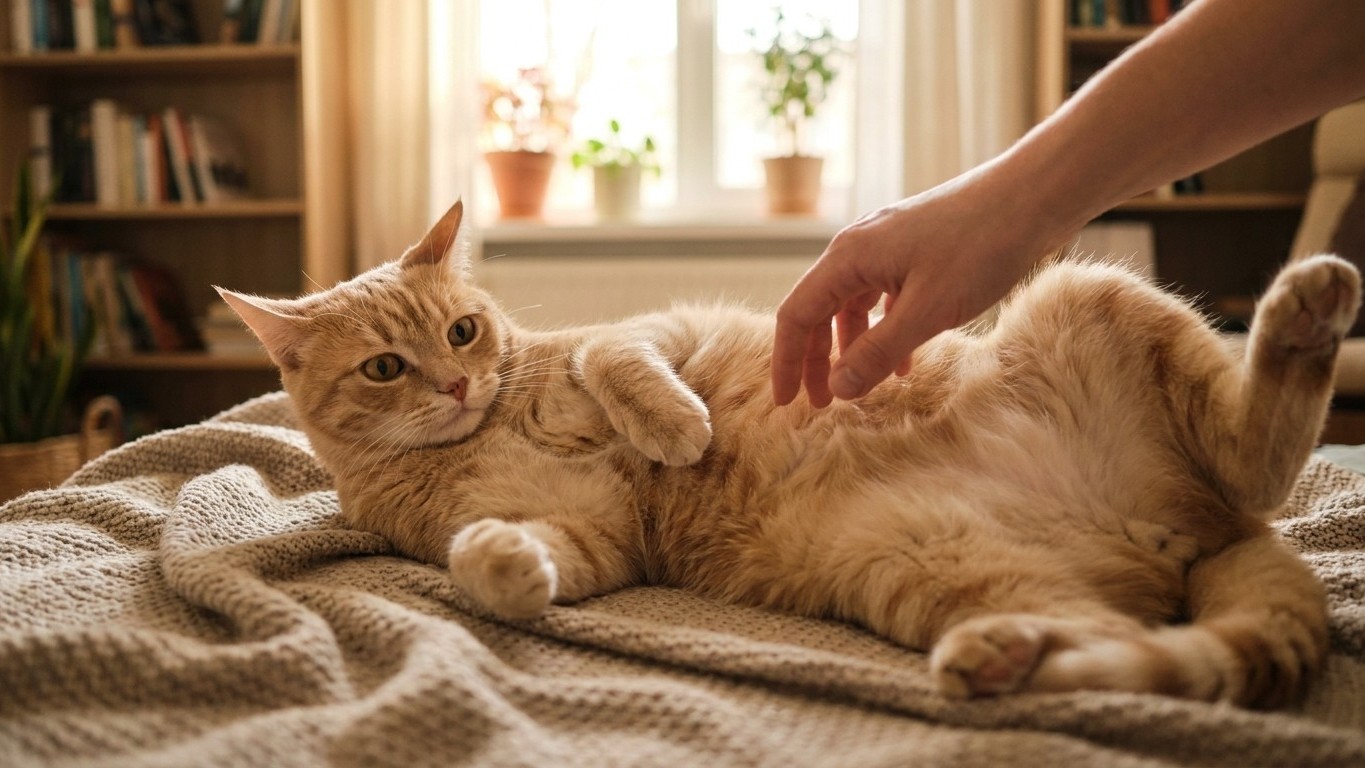
The scratch was the clearest sentence she’d ever written. Every time my cat rolled over and flashed that plush, tempting belly, I reached down and rubbed it, convinced I was speaking her love language. She’d tolerate it for a few seconds, then the paws would come. One morning she drew actual blood, and I finally stopped to think: what if I’d been misreading her completely, every single time?
Turns out, I had. And I’m far from alone. The “Tummy Rub Trap” is one of the most common experiences among cat owners: your cat rolls over and shows her soft, fluffy belly as if offering an invitation, and when you go in for the rub, you get swatted or scratched. The trap works beautifully because it looks exactly like an invitation. The belly is right there, soft and exposed. But feline body language and human body language are not the same language at all.
Key takeaways
- Your cat’s belly roll means she trusts you completely—but it’s the opposite of an invitation to touch
- The hypersensitive skin on a cat’s belly can only handle seconds of contact before overstimulation kicks in
- By the time she scratches, you’ve missed dozens of warning signs she’s been desperately sending you
The Belly Roll Is a Compliment, Not a Request
A cat rolling onto her back is completely vulnerable in that moment. She would only do this with people she knows, trusts, and feels completely safe with. Think about that for a second. When a cat shows you her belly, she’s relaxed, comfortable, and doesn’t feel threatened, safe enough to expose her most vulnerable area without worrying about being attacked. She’s essentially saying, “I trust you with my life.”
Some behaviourists call it a “social roll,” and it’s one of the highest forms of feline affection. The act of then patting your cat’s belly can be compared to a person extending their hand to greet you and you responding by kissing them, far too intimate for most. You’ve mistaken a declaration of trust for an instruction manual.
Sometimes a cat rolls over and shows her belly to a human, but it’s rarely because she wants a rub. It’s a sign of trust and proof of how Comfortable she is around you. She may also simply be having a stretch, cooling down (cats’ bellies have less fur, making them useful for temperature regulation), or just marking the moment she’s happiest in your presence. Sometimes a cat rolls on her back because she’s feeling playful, if you think that’s the case, wave an interactive toy nearby. She may take you up on some playtime. Far safer than a hand going straight for the tummy.
Why the Belly Genuinely Hurts to Touch
The defensive bite isn’t spite. There’s real biology behind it. The cat belly is a very vulnerable area. Some of the most vital organs, liver, stomach and intestines, are protected by a mere flimsy flap of skin and fat called the primordial pouch, and the fur covering it is made up of hypersensitive hair follicles. Those follicles don’t just feel things more strongly, they can reach a point of overstimulation very quickly, which is why your cat might purr for ten seconds and then suddenly turn feral.
This isn’t fully understood, but behaviourists think that physical contact like stroking can quickly become unpleasant if repeated over and over. Repetitive contact can cause arousal, excitement, pain and even static electricity in a cat’s fur. The ASPCA offers a useful analogy: imagine if someone rubbed your back but, instead of moving their hand all over it, just rubbed the same spot over and over. That could quickly become unpleasant, and your cat feels exactly the same way.
A cat is an incredible predator, but she’s small enough that she’s also prey. As prey, the last thing she wants is for a larger creature to have access to her most vulnerable area, where vital organs are located. This instinct doesn’t switch off just because she lives in a centrally heated flat and eats from a bowl. Millions of years of evolution don’t yield to good intentions.
She Was Telling You the Whole Time
The scratch that drew blood wasn’t the first message. It was the last resort. Most cats will gradually escalate their signals and show many other signs of Discomfort first before escalating to a swat or bite, it’s up to us to learn to recognise those signs and stop petting sooner. When a cat resorts to petting-induced aggression, it means we haven’t heard what they’ve tried to tell us about when and how they like to be petted.
The warning signs are there, plain to read once you know what to look for. Tail lashing or thumping, shifting body position, skin twitching and direct stares are all indications that your cat has had enough petting. If the petting continues, she will likely scratch or bite. When your cat is in your lap, watch whether she pulls her ears back, tenses her body, or begins to flick her tail as you pet her. If you see any of these signs, stop the interaction immediately. A flicking tail is not a happy wag, it’s a sentence that ends in a warning.
Cats aren’t biting because they’re mean, they’re biting because they’ve exhausted their options for communicating their Discomfort, especially if their warning signs have been consistently ignored, and have learned that biting was the only successful option to stop the unwanted contact. That’s a significant thing to sit with. The scratch was communication. The scratch worked.
Where to Pet, and How to Get It Right
Scientists in England conducted a study that concluded the head is the area cats most like to be touched. It’s thought cats prefer being stroked on their face because that’s where many of their scent glands are located. Cats use scent to communicate, including to mark territory, petting your cat’s face gets their scent on your hands, allowing them to claim you as their own. That’s the real intimacy. Not the belly rub, but being marked as family.
Pet your cat for brief periods, frequently stopping to assess her body language and determine whether she wants more or wants you to stop. Focus on the head, the sides of the face, and the back of the neck. Avoid full-body petting, at least initially, as this can be overstimulating. Many cats are more sensitive near the base of the tail, on their legs and on their bellies, so these areas are best avoided unless you’ve already established that she enjoys being touched there.
If you suspect a sudden change in your cat’s tolerance for being touched, always consult your vet first. Unexpected aggressive behaviour should prompt a thorough veterinary examination, as pain can trigger an aggressive response to touch, particularly if bites mainly occur when you pet your cat in a specific area of her body.
One last thing worth knowing: some breeds, such as Persians, Ragdolls and Russian Blues, may be more tolerant of belly rubs, but even within those breeds, each cat is her own negotiation. A cat that allows belly rubs is a very trusting soul, and if one accepts them only from you, that says a great deal about your relationship. The goal isn’t to override your cat’s boundaries until she relents. The goal is to speak her language well enough that she never has to draw blood to be heard.
Sources : sparklecat.com | meowingtons.com