
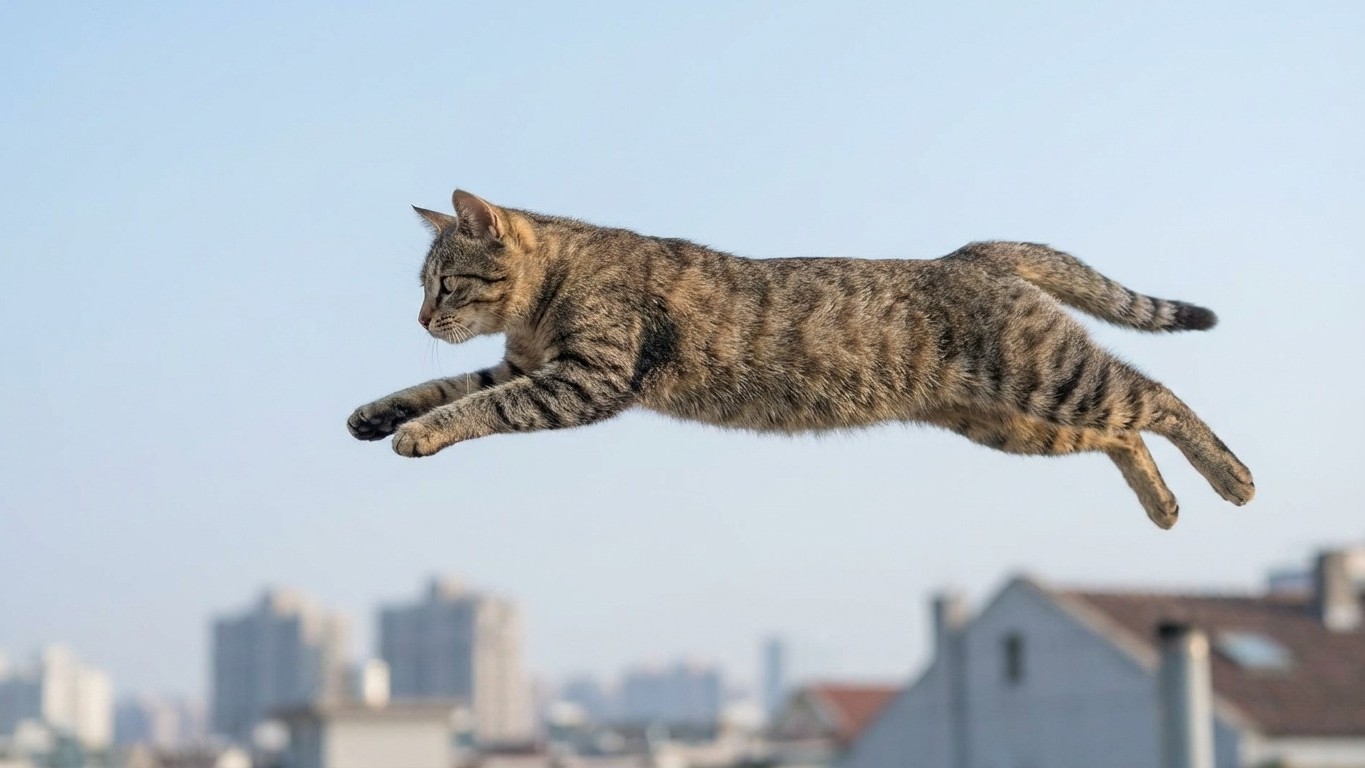
Picture this: your cat is perched on a second-floor windowsill, and a pigeon drifts temptingly past. She leans. She tips. She falls. Your instinct might be to breathe a sigh of relief, after all, it’s only the second floor. In fact, vets have known for decades that this is precisely the scenario most likely to end badly. A cat tumbling from the seventh floor stands a better chance of walking away than one falling from the second. That apparent paradox is one of the most counterintuitive findings in feline medicine, and the physics behind it are genuinely worth understanding.
Key takeaways
- Cats falling from 7+ stories have better survival rates than those falling from 2-3 stories—what’s the reason?
- Terminal velocity and a mysterious shift in body position hold the key to this feline paradox
- The second-floor fall is deceptively dangerous, offering the worst physics for a cat’s body
What Is High-Rise Syndrome : And Why Does It Exist?
High-rise syndrome (HRS) refers to the collection of traumatic injuries occurring in cats that fall from at least the second floor of a building, typically from balconies or windows. First described in 1976, the term has since been widely used in veterinary literature. The name sounds dramatic, but the condition is depressingly common in cities. HRS is most common in urban areas with high-rise buildings, where cats are at a higher risk of falling compared with those in suburban or rural settings, with falls from height accounting for 13.9% of such incidents.
High-rise syndrome is more frequent during the warmer period of the year, which makes perfect sense when you picture open sash windows on a July afternoon. Falls occur more often in summer (77%) and mainly at night (62.1%). Cats are nocturnal hunters, easily fixated on a moth, a bat, a distant sound. A momentary loss of concentration on a narrow ledge is all it takes.
The good news, at first glance, is striking. Studies of cats that have fallen from two to 32 stories and are still alive when brought to a veterinary clinic show that the overall survival rate is 90 percent of those treated. A more recent and larger study, analysing medical records and radiographs from 1,125 cases of feline HRS treated at the Freie Universität Berlin’s small animal clinic between 2004 and 2013 — put the survival rate at 87%, with some of those losses attributable not to the fall itself but to financial constraints forcing owners to opt for euthanasia. Remarkable odds, by any measure. But they come with an important caveat we’ll return to shortly.
The Seven-Floor Turning Point
Here is where things get genuinely strange. Common sense tells us the higher the fall, the worse the outcome. Gravity, after all, is not known for its mercy. When veterinarians documented the injuries, they made an astonishing observation: while the severity of the damage increased up to a height of about seven stories, it seemed to decrease thereafter. The severity of injuries rises linearly up to the seventh storey. After that height, the severity of injuries does not rise and the incidence of fractures decreases. Of 22 cats that fell more than seven stories, only one died.
The explanation lies in a combination of physics and feline biology. During a fall from a high place, a cat can reflexively twist its body and right itself using its acute sense of balance and its flexibility. This is known as the cat’s “righting reflex”. The minimum height required for this to occur in most cats is around 90 cm. So far, so familiar. But what happens at lower heights catches cats, and their owners, completely off guard.
It has been proposed that cats reach terminal velocity after righting themselves at about five stories, and after this point they are no longer accelerating, which causes them to relax, leading to less severe injuries than in cats who have fallen from less than six stories. Once a cat is no longer accelerating, something almost counterintuitive happens to its body. After having reached terminal velocity, cats would orient their limbs horizontally such that their body hits the ground first, essentially adopting a “flying squirrel” posture that spreads impact across a wider surface area. A cat’s terminal velocity is around 60 mph, compared with a human’s velocity of 120 mph, which gives the cat both time and a softer eventual impact.
The second-floor fall, by contrast, offers the worst of all worlds. The cat has barely registered it is in freefall before it hits the ground. When a cat falls from a low height such as one or two stories, it may not have enough time to properly adjust its body position to land on its feet, leading to more injuries. It hits with full muscular tension, legs positioned wrong, chin often slamming the ground. Broken bones, most often the jawbone, are the typical signs of a cat having sustained injuries in a fall, a pattern seen repeatedly in lower-floor victims.
The Injuries Vets Actually See
The clinical picture of a cat brought in after a fall is rarely tidy. Common injuries include circulatory shock (48.6%), chest trauma (58.3%), broken teeth or jaw injuries (51.1%), abdominal trauma (14.6%), limb fractures (47.2%) and pelvic fractures (11.1%). That chest trauma figure is striking, pneumothorax (a collapsed lung) is a frequent complication, as the ribcage absorbs impact even when the cat lands relatively well. One cat that fell 32 stories suffered only mild pneumothorax and a chipped tooth — an outcome that sounds almost absurd until you understand the physics involved.
Cats suffer less severe injuries than dogs due to their “righting reflex” and smaller body mass. Dogs, for reference, simply do not have the same aerial toolkit. They cannot reorient mid-fall with anything like the same efficiency, and their heavier frames mean a much harder landing. Any cat owner who has ever watched their pet pirouette off a kitchen counter and land with infuriating nonchalance has witnessed a scaled-down version of this reflex.
Age also matters. The mean age of cats treated for HRS was just 1.8 years, young, curious, not yet streetwise about ledges and open windows. A cat’s age, fall height and landing surface all influence how severe the injuries are. Landing on grass is meaningfully different from landing on concrete, and most cats in the Berlin study landed on hard surfaces (74.2%).
The Survivorship Problem : And What to Do About It
Before this all sounds too reassuring, there is a significant complication in the data that every honest vet will acknowledge. Another possible explanation for the apparent safety of high falls is survivorship bias: cats who die in falls are less likely to be brought to a veterinarian than injured cats, and thus many of the cats killed in falls from higher buildings are not reported in studies. A cat that falls from the 20th floor and dies instantly is not taken to a clinic. It never enters the statistics. The survival figures, however impressive, reflect only the cats whose owners sought treatment.
The practical lesson here is not that high-rise falls are fine. They are not. While most cats survive high-rise falls, many suffer serious injuries, some requiring euthanasia because of trauma severity or financial limitations. The lesson is that a cat falling from any floor needs immediate veterinary attention, and that a second-floor fall should never be dismissed as minor. Internal injuries, pneumothorax, and fractured jaws can all present in cats that seem, at first glance, to be walking away fine. That post-fall “I’m absolutely fine” stroll across the patio? Classic shock behaviour.
Prevention, frankly, is the only genuinely Comfortable answer. Window and balcony barriers can help prevent these accidents, and educating cat owners about these risks alongside prompt veterinary care can reduce the severity of injuries and improve survival rates. Mesh screens, balcony nets, and “cat-proofing” enclosures are widely available and effective, and they cost considerably less than an emergency vet bill at midnight. If your cat has already taken a tumble, however far, get her seen by a vet immediately. Do not wait for symptoms. The real question is whether we ever truly learn to respect how fragile the gap between a windowsill and the pavement actually is.
Sources : brainly.com | brainly.com