
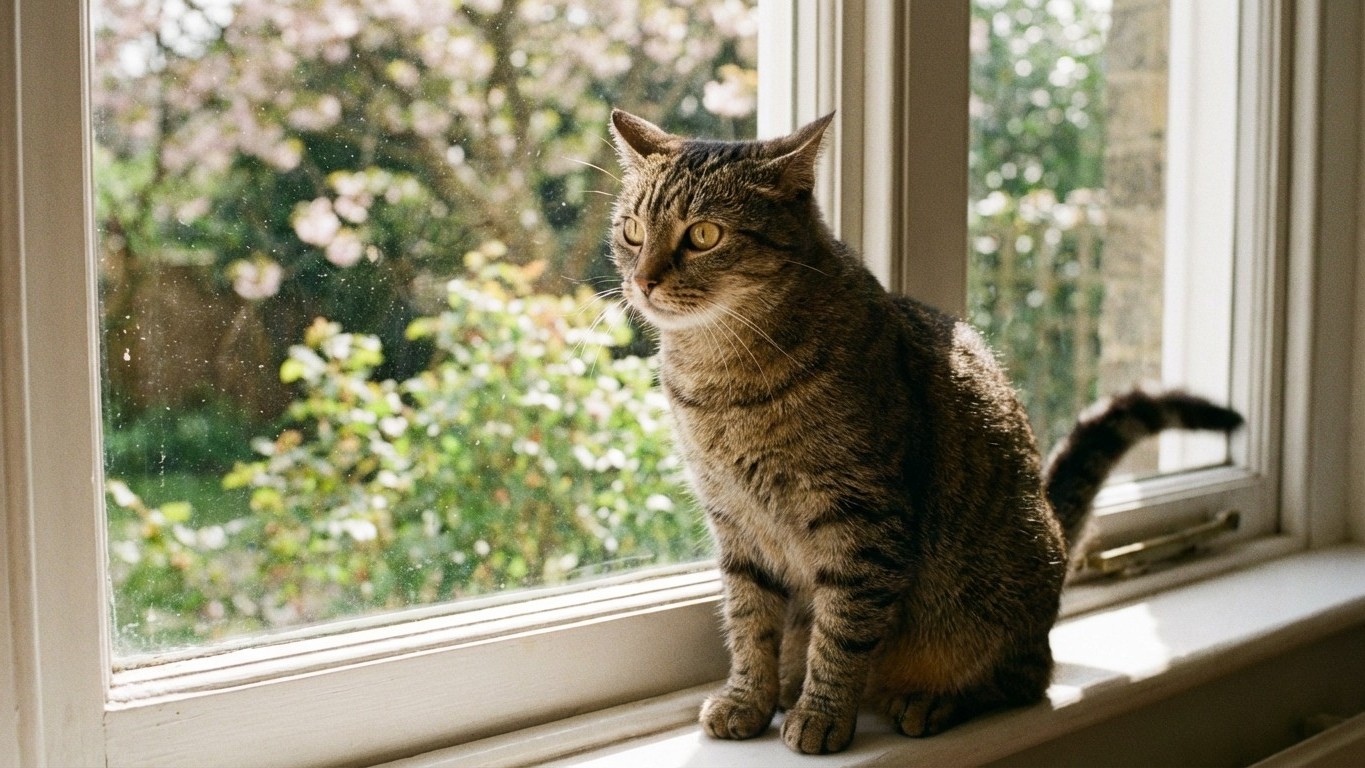
March arrives, the days stretch longer, and your previously placid sofa companion suddenly bites your hand for no apparent reason. Sound familiar? The spring hormone surge in cats is a real and often misunderstood phenomenon, and it catches a surprising number of cat owners completely off guard, especially those with indoor pets who never set a paw outside.
The key thing to grasp is that your cat’s body doesn’t care that you live in a flat in Manchester or a terraced house in Bristol. Evolution doesn’t recognise double glazing. Light does. Specifically, the increasing daylight hours of late winter and early spring trigger a cascade of hormonal changes in cats that are virtually identical whether an animal roams freely across fields or spends its days watching pigeons through a window. The Biological clock is set by photoperiod, the ratio of light to dark in a 24-hour cycle, and as March tips the balance toward longer days, your cat’s reproductive hormones respond accordingly.
Key takeaways
- Your indoor cat’s body responds to increasing daylight the same way as outdoor cats, triggering a cascade of reproductive hormones
- Warning signs happen fast and are often missed: twitching tail, skin rippling, ear rotation—seconds before the bite
- Neutering eliminates seasonal aggression almost entirely, but environmental enrichment and behavioral adjustments work for cats already spayed or neutered
What’s Actually Happening Inside Your Cat
Cats are what’s called “seasonally polyestrous”, meaning queens (unspayed females) cycle through multiple heat periods during the longer-light months, typically from late January through to autumn. The trigger is melatonin suppression: as daylight increases, the pineal gland produces less melatonin, which in turn allows the hypothalamus to ramp up production of reproductive hormones. In unneutered males, rising testosterone levels follow a similar seasonal pattern, peaking in spring when potential mates are most likely to be cycling.
But here’s where indoor cats present a twist. Artificial lighting can partially blunt the photoperiod signal, yet it rarely eliminates it entirely. Many indoor cats still experience a hormonal uptick in spring, even if it’s somewhat milder than their outdoor counterparts. For neutered cats, the surge is considerably reduced, but not always zero. Adrenal glands produce small amounts of sex hormones independently of the gonads, and some neutered cats do show subtle behavioural shifts in spring, particularly those neutered later in life.
The aggression itself tends to manifest in specific ways. You might notice redirected aggression, where your cat attacks you because it’s aroused by something Outside (a bird, another cat on the fence, a neighbour’s dog) and you simply walked into the blast radius. There’s also inter-cat aggression if you have multiple pets, as hormonal tension can upend established hierarchies that seemed perfectly stable in December. Some cats become hypersensitive to touch, a condition sometimes called petting-induced aggression, which can worsen during periods of hormonal flux.
Reading the Signals Before the Bite
Cats rarely attack without warning. The problem is that their warning signals are subtle and brief, and most people miss them entirely. A twitching tail tip, skin that ripples along the back, ears rotating slightly backward, dilated pupils despite good lighting, these are the amber lights flashing before the red. In spring, a cat that tolerates twenty minutes of stroking in January might hit its tolerance threshold in three minutes come March, and the transition from purring to biting can happen in seconds.
Unneutered queens in heat add a whole other layer of behavioural change: vocalisation that can sound genuinely distressing, restlessness, rolling on the floor, and a sudden desperate desire to get outside. This isn’t aggression in the traditional sense, but it’s disruptive, stressful for the cat, and often alarming for owners who’ve never seen it before. A cat in full oestrus can be so persistent and vocal that owners sometimes mistake the behaviour for pain or illness. If your unspayed female is Suddenly wailing at midnight in March, she almost certainly isn’t in agony, though the appropriate next step is still a conversation with your vet.
What You Can Actually Do About It
The single most effective intervention, if you haven’t done it already, is neutering. In the UK, the majority of vets recommend neutering cats from around four months of age, and doing so eliminates the seasonal reproductive hormone surges almost entirely. Cats neutered young rarely show the spring aggression patterns that intact animals do. If your cat is already neutered and still showing some behavioural changes in spring, that’s worth discussing with your vet, as it’s relatively uncommon and occasionally points to other underlying issues.
For neutered cats experiencing mild spring restlessness, environmental enrichment becomes your best practical tool. Think about what your cat would Naturally want to do: hunt, patrol, climb, investigate. Window perches, rotating puzzle feeders, more frequent short play sessions with wand toys, these aren’t just nice extras, they’re legitimate outlets for the heightened arousal that comes with the season. A cat that has genuinely tired itself out is a cat less likely to redirect its energy at your ankles.
Pheromone diffusers (the type that mimic feline facial pheromones) have a reasonable evidence base for reducing general anxiety and tension in cats, and some owners find them helpful during the spring transition period. They’re not a cure-all, but they’re a low-risk addition to an enrichment strategy. Worth trying if your household has multiple cats that start squabbling around this time of year.
Managing your own behaviour matters too. During peak arousal periods, keep petting sessions short and learn to read your cat’s signals. End contact before your cat’s tolerance runs out rather than after. It sounds almost comically simple, but respecting that three-minute threshold in March does more for your relationship than any amount of scolding following a bite.
There’s something rather humbling about the fact that your indoor cat, curled up beside the radiator with a full food bowl, is still fundamentally governed by ancient light-reading machinery designed for a much wilder life. March isn’t making your cat malicious. It’s making your cat biological. Whether that changes how you respond to the next warning flick of the tail is, of course, entirely up to you.